

Building @ https://teapawt.net/t.co/n8JO4GXsB9 | Building Talent and Trust Infrastructure | Ex- @Google, @Microsoft & @Autodesk | ISB Co’20
Bengaluru
Joined September 2023
- Tweets509
- Following268
- Followers3.8K
- Likes1.8K









Krishna Chaturvedi retweeted

Trust me, hackertube is worth checking out.
Built by @karpathy , it curates interesting videos recommended by the hacker news community.
Less algorithmic noise, more rabbit holes..🍀
Link: hackertube.org
you’re welcome 👀
Krishna Chaturvedi retweeted

We cooked something interesting 👀
labs.chaicode.com
(dm for invite with your email)
Krishna Chaturvedi retweeted

nerds, thank me later...
systemdesign.io
Krishna Chaturvedi retweeted
I redesigned my portfolio again coz i have free will and enough tokens. why not?
and ofc opus is god in itself 🍀🥞
Link: tryingtobenikhil.space
Don't forget to play with fishes in stream while changing the seasons !
Krishna Chaturvedi retweeted

Brilliant paper by NVIDIA.
they found a way to make KV cache transferable between models.
the target model skips prefill entirely, and the conversion runs 2.7 to 25x faster than processing the context again.
let's understand why this is so important today.
LLM APIs are stateless, so every turn sends the entire conversation back to the model. the model reads it again before generating a new token, and all of it is billed as input.
prompt caching lets providers hold the KV cache for a stable prefix and bill cache hits at roughly 10% of the base input rate because that compute was already done.
this 90% reduction is one of the biggest levers in LLM serving.
but the cache only works on the model that produced it. since keys and values depend on that model's weights, another model cannot directly reuse them.
this becomes a problem with LLM routing.
if traffic moves to another model for cost or capability reasons, the accumulated KV cache becomes invalid.
the entire context must be processed again and billed at full rate.
NVIDIA's recent paper treats this as a representation problem.
prefill's main output is the KV cache, so transferring it means converting one model's cache into the representation another model expects.
they first checked whether this conversion had enough structure to exploit.
for Qwen3 14B → 32B, a linear regression from a single source layer reconstructed 56% of the variance in the target model's keys.
because models can have different layer counts, there is no natural one-to-one layer mapping.
so, for every target layer, they rank the source layers by predictive power and use the top eight together.
that pushes reconstruction to 79%.
the mapper has three parts:
> each target layer and head gets its own linear map, solved in closed form instead of with gradient descent.
> cross-layer selection chooses the source layers that best predict each target layer. their ablation shows this contributes the most.
> RoPE adds a position-dependent rotation to keys. they remove it, fit the mapping in position-free space, then apply the target model's rotation again at inference.
across six model pairs from Qwen3, Llama 3.1, and Ministral 3, four retain 73 to 98% of the receiving model's standalone accuracy.
conversion is also 3 to 25x faster than processing the context again.
prior cross-model KV reuse methods either train a neural adapter for every pair or require architecturally identical models.
this approach is closed-form and training-free, but there are still important limitations.
every tested pair belongs to the same model family, such as Qwen → Qwen or Llama → Llama.
cross-family transfer is still future work.
the tested pairs also share KV head count and per-head dimension. mismatched configurations remain untested.
and the work currently covers dense full-attention models only, not sliding-window or attention-recurrent hybrids.
link to the paper: arxiv.org/abs/2608.03893
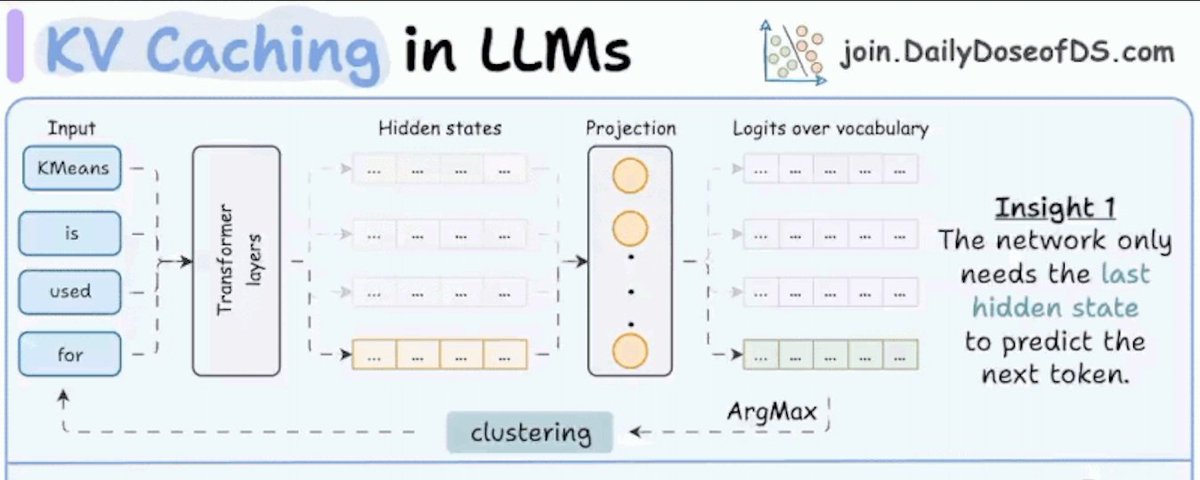
i wrote a first-principles breakdown of how KV caching works
the article is quoted below.

Krishna Chaturvedi retweeted
For all the ML/AI folks going:
bruhhh where tf are the entry-level jobs
found some ammo for you 👀
Indian startups hiring freshers for DS / ML / AI in 2026:
docs.google.com/spreadsheets…
Indian robotics startup database:
docs.google.com/spreadsheets…
But pls don’t just apply → refresh LinkedIn → cry → repeat 🥞🍀👀
Find the startup.
Find the founder.
Build something they actually need.
Slide into the DMs.
Make it stupidly hard for them to ignore you.

Krishna Chaturvedi retweeted
My friend’s Apple SDE 1 interview experience.🥞🍀
He got rejected, but he documented the entire process in a Notion page, from OA → Virtual Round → LLD → HM Round.
Thought it might be useful for anyone preparing for Apple..
Link : notion.so/Apple-Software-Eng…

Krishna Chaturvedi retweeted
If you're trying to get genuinely good at LLM inference / AI systems, I think one of the best projects you can do is take a small open-weight model and build the entire inference system around it.
1. Take a pretrained model and understand its inference path. Know what actually happens on the GPU for every token.
2. Build a naive inference server yourself. Don't touch vLLM yet. Make it work, then watch it fall apart.
3. Add batching. Understand why continuous batching matters and measure TTFT, TPOT and throughput.
4. Implement KV caching. Then actually understand why decode becomes memory-bandwidth bound.
5. Build a scheduler. Queues, priorities, backpressure, cancellation, timeouts.
6. Fix your KV memory management. Paged KV cache, block allocation, fragmentation, prefix caching.
7. Start optimizing the GPU path. CUDA graphs, kernel fusion, quantization, attention kernels, CPU/GPU synchronization.
8. Add speculative decoding and figure out when it actually makes inference faster.
9. Add observability. TTFT, ITL, throughput, GPU utilization, KV usage, queue time.
10. Throw real concurrent traffic at it. Find the point where throughput stops scaling and figure out why.
11. Only then go read vLLM, SGLang, TensorRT-LLM and other serving engines. Compare their design decisions with yours.
12. Keep going deeper. Multi-GPU, distributed inference, prefill/decode disaggregation, KV offloading, routing...
You don't need to build a production-ready serving engine.
The point is to get to the point where you can look at an inference system and understand why every ugly little optimization exists.
That's basically what I've been doing with my vLLM Inference Engine project, and ngl, every time I thought I understood inference, the next bottleneck humbled me lol.
Build the dumb version first. Let the bottlenecks teach you the architecture.
github.com/TryingtobeingNikh…

Krishna Chaturvedi retweeted
Zomato (MLE) interview questions !🥞
Also i got their detailed answers notion link as well for both
Zomato and SARVAM AI
Lemme know if you want it too for the reference !


Krishna Chaturvedi retweeted
Sarvam Ai interview questions !
There were more two more , it's just X sharing limits. 🥞


Krishna Chaturvedi retweeted
There’s this link roaming on X a lot. Lemme tell you the straight-up facts:
• It’s NOT pure AI slop many companies listed are real.
• BUT it’s outdated, not a “hiring right now” list.
• CrowdTangle is listed → Meta shut it down in 2024.
• InVision is listed → services shut down in 2024.
• CoreOS is listed → Red Hat acquired it years ago.
So yeah: real companies + old data.
Use it for leads, not gospel. Always check the official careers page before applying.
Link : drive.google.com/file/d/1MfO…
This works
Krishna Chaturvedi retweeted
I might be able to refer some of you 👀
Been working with recrivio.com for almost a month now and honestly, one of the coolest, chillest founders I’ve worked with. @Thrivewithkrish
And things is we’re looking for someone who can turn:
“Let’s try this.” → “Holy shit, this is working.”
If GTM is your playground, you’re great at communication, and you have the potential to build, own, and maintain a community of the right people ngl we need you..
Someone who knows how to find the right people, open doors, build channels, start conversations, and actually get things moving.
Basically, we want someone who sees a problem and goes:
“Cool. I’ll figure it out.”
📍On-site Bangalore
💰 ₹20–25k/month
🚀 PPO on conversion ₹17 LPA CTC
This isn’t a “sit around and wait for tasks” kind of role.
You’ll get to experiment, build from scratch, talk to people, figure out what works, kill what doesn’t, and actually own outcomes.
If that sounds like your kind of chaos, slide into my DMs with your resume.
Let’s build..🤌