Tim Erway (@TimErway) header
Tim Erway (@TimErway) profile picture

Helping owners and operators run leaner with AI agents. Building solo + AI and with an AI-first team. 20+ years in business.

Asheville, North Carolina
Joined November 2007
Photo by Tim Erway (@TimErway)Photo by Tim Erway (@TimErway)Photo by Tim Erway (@TimErway)Photo by Tim Erway (@TimErway)Photo by Tim Erway (@TimErway)Photo by Tim Erway (@TimErway)Photo by Tim Erway (@TimErway)
I run 3 companies. Each one runs on different systems. One is in the middle of a full product launch. The team runs it on Monday (the PM platform) I hate logging into Monday. When I handed over operations to that company, I figured I'd never have to again. Then I came back to help coordinate the launch, and I was dreading it. Digging through tasks. Hunting for links to docs. Three logins to three different tools. So I didn't. Here's the philosophy: 1. Know what you love doing. 2. Know what you hate doing. 3. Offload as much as you can of the stuff you hate with agents. 4. Simplify how you handle the work that only you can do. Project management is a necessary evil when you work with a team, human or AI. But if you don't want to log into Monday, then don't. Have your agent work in it for you. Grok Bot used Claude to build me my own Kanban board. It replaces Todoist, Monday, ClickUp, etc.. Personal and business tasks live in one place. I assign tasks to agents from that board. When something gets done, by me or an agent, it updates everywhere. One board. My agents manage the chaos. Just tell Grok Bot, Hermes, or whatever you're using... "Yo, here's what I enjoy doing, here's what I hate doing, here's the list of tools I use, what can you do to help make my life simple?"
41
Your agents need two kinds of knowledge files to do good work: 1. General business knowledge. Every agent needs it. 2. Specialized knowledge. It depends on the role and the job. The first takes one interview and gives you the 6 essential files. Every agent's output gets better on day 1. The second is role-specific: frameworks, samples, workflows and runbooks.
29
Every agent that writes for you needs the same context. How you talk. Your stories. Your customers. Your offers. Your design system. That's 6 plain text files. Keep them portable, in one central place. Switch between Claude, ChatGPT, Grok Bot, Hermes or Muse, and they're all playing from the same sheet of music.
2
1
71
My AI team peaked at 13 agents. One had the new offer, one had last year's voice guide. I was the intern carrying notes between them. I run three companies. One did over $5M last year without me running it day to day. Another is on track for 7 figures. My personal brand is just me and my agents (zero team members). Those business results aren't agent results. Adding agents still left me copying information between chats. Keep the current business knowledge in one shared folder. Then give each agent instructions for its role and tell it which files to read before starting. The six starter files and setup:
32
Give audience.md a customer you can picture. Illustrative, not a real quote: Before: "Busy professionals who want growth." After: "I need next week's emails done without spending Sunday rewriting them." Save real customer language. Template:
26
Everybody's building AI agents. Most of those agents don't know what the business sells. Here are the 6 files mine read before they're allowed to touch anything: Build the knowledge first, the agents second.
1
29
visual-brand-guide.md: Colors, fonts, logo rules, screenshot standards, and what to avoid. Save specific rules and approved examples. 'Make it look good' gives the agent plenty of room to make something you hate.
1
13
Save corrections in the relevant guide and published work in the archive. Keep the folder outside the AI tool. Give the next agent access before it starts. Copy all six templates and the setup prompt:
1
3
I'm giving away the 6 templates my agents read before they're allowed to write anything. Voice, audience, offers, stories, published work, visual rules. Keep them together. Tell each agent what to read first. Copy-paste templates + setup prompt:
30
Tim Erway retweeted
Roadster event livestream teapawt.net/i/broadcasts/1yKAPwNgg…
4,843
10,365
4,402
63,069
12,615,942
I tested my first agent setup by leaving. Three weeks in Cabo and a week in Florida. My grade was a C+. Crashes at least tell you something broke. A task that never fires doesn't send an error... you just find out later that nothing happened. When a new hire says "done," you go look. Same with an agent. Cool. Where is it? That check is the last section of my pinned Article.
1
70
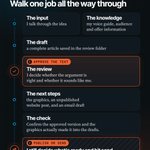
The best year of my old business nearly broke me. 30+ contractors, me at the center of every decision, and my hands swelled so bad I couldn't open a can of dog food. So I fired myself. Last year that company did over $5 million without me running it. Now I'm pulling the same move with AI agents. One clear job, the information it needs, and a way to check the work before I trust it with more. The job template I use is the first picture. Copy it and fill in the blanks.
46
Incredible demo videos. Emotions and body language are pretty damn close.
Introducing Griffin, the first model to pass the video Turing test. 48% of people who talked to it live thought it was a real human. Previous systems have had a pass rate <3%. It is #1 on NVIDIA's benchmark for full-duplex AI video. It’s the first Human Interaction Model (HIM).
Readers added context they thought people might want to know
The 48% figure and "video Turing test" claim are from Tavus's own study of 54 one-minute calls, not independently verified or using a standard protocol. Griffin-Lite leads NVIDIA's VideoFDB benchmark on their public leaderboard. cellcog.ai/blog/tavus-gri… research.nvidia.com/labs/amri/proj… tech-ish.com/2026/10/02/tav…
74