

Chief Futurist | To educate the masses on artificial intelligence, cryptology and lifelong advocate promoter of a healthy lifestyle.
Southwest FL, USA
Joined January 2011
- Tweets2.4K
- Following527
- Followers214
- Likes490




Way to go Lace!

Still time to win!
We're giving away 5 exclusive Lace-branded @KeystoneWallet devices. Fully air-gapped signing, no USB, no Bluetooth, no WiFi, no NFC for signing, just your keys, staying yours.
Haven't entered yet? Details below. Winners are announced publicly, we'll never DM you asking for a seed phrase or payment.
lace.io/blog/win-1-of-5-lace…

What if intelligence wasn't a commodity to be owned, but a public utility to be shared?
In my latest article, "One AI," I explored a simple thought experiment:
What happens if we move past the race for proprietary, competing AI models and instead envision a singular, universal intelligence accessible to anyone, anywhere, at the same time?
From education and healthcare to scientific discovery, AI's defining feature isn't just power—it's simultaneity.
The future of technology may ultimately depend on whether we see intelligence as another asset to control, or as something that belongs to everyone.
Read the full piece below. 👇
roymavila.medium.com/one-ai-…
#OneAI #ArtificialIntelligence #FutureOfAI #AIForHumanity #HumanityAndAI #UniversalIntelligence #AIAndSociety #FutureOfHumanity #TechnologyAndPhilosophy #TheFutureIsNow

BIP-110 did not achieve sufficient support to become a consensus rule on the dominant Bitcoin chain. When its enforcing nodes began rejecting blocks that didn’t comply, they followed a minority fork that lacked the mining power and economic support necessary to become the dominant Bitcoin chain.
It tested the balance between miners, node operators, developers, users, and economic consensus—and the result showed that a small group of nodes can enforce their own rules, but they cannot make the rest of Bitcoin follow those rules simply by declaring them mandatory.

Why crypto appears to be at a crossroads: technology promises a decentralized financial system built on open networks, community governance, and new forms of digital ownership, yet the path toward large-scale corporate adoption is increasingly being measured through the lens of traditional finance.
The S&P Pantera Digital Asset Index highlights this tension by favoring assets that resemble conventional businesses—those with measurable revenue, cash-flow-like characteristics, and mechanisms that return value to token holders. While this approach makes crypto more familiar and investable for institutions, it also risks pushing decentralized networks to conform to Wall Street's existing frameworks rather than creating entirely new economic models.
The current standstill is not because crypto lacks innovation, but because two visions are competing: one sees blockchain as a new decentralized infrastructure that challenges traditional finance, while the other seeks to integrate crypto into the existing financial system using familiar valuation methods.
The next major phase of adoption may depend on whether institutions adapt to crypto's unique principles or whether crypto evolves to satisfy institutional expectations.
Not Investment Advice
#Crypto, #Blockchain, #Decentralization, #DigitalAssets, #Web3, #TokenEconomy, #FutureOfFinance, #InstitutionalAdoption, #TradFi, #FinancialInnovation
spglobal.com/spdji/en/indice…

The Chinese just eliminated 3,000 lbs from the equation.

🇨🇳 Meanwhile in China
Driverless delivery trucks are quickly taking over.
No limits on drivers hours, no salary or insurances for the employee drivers & the data will soon show they are safer.
This is the 4th Industrial Revolution.
Readers added context they thought people might want to know
That thing has no engine or powerful motors. No room for the large battery needed if it was electric. No possible way of propulsion. It is a AI genereted video.
x.com/jegoodwin/stat…
Here it is what a real driverless truck looks like :
english.news.cn/20251121/03db5…
My thoughts… stay tuned. Thank you, @saylor, for taking the time to list reasons about BIP 100.

Now you too can speak the cytpro language (copy, save for later, paste in any LLM for future learning. Prompt: explain in detail. That’s it.
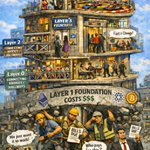
I continue to appreciate Cardano’s interoperability—the best, in my humble opinion—because while others compromised long-term structure for quick price appreciation, Cardano spent a decade refusing to skip steps, finally reaching the "last frontier" of scaling today without sacrifice. Its modular five-era roadmap—Byron (foundation), Shelley (decentralization), Goguen (smart contracts), Basho (scaling via Leios parallel pipelines: Input, Endorser, and Ranking Blocks), and Voltaire (community governance)—has created a research-first, deterministic environment that makes it the envy of other chains now struggling to retrofit security onto speed.
For any protocol to attain this level of robust interoperability, it must provide: a deterministic execution model; succinct state or light-client proofs; standardized cross-chain messaging and token formats; trust-minimized bridge designs with incentives and slashing; formal verification and audits; explicit finality/reorg handling; on-chain governance and upgrade procedures; sound economic-security models; rich SDKs and unified wallet UX; optional privacy primitives; and full operational readiness—including observability, chaos testing, and robust recovery plans.
#Cardano #BlockchainScaling #Interoperability #CryptoGovernance #Web3Infrastructure
🤖 Made with AI

The Broken Penny by Roy M. Avila — One Cent. One Hundred Million Pieces. How the Satoshi Became the Currency of the Universe.
If you read it, I'd genuinely love to know two things: did the "100 million pieces" idea land for you, and which version did you prefer — flipping or scrolling? Drop a comment. 👇
royavila.github.io/broken-pe… (read aloud)
or
royavila.github.io/broken-pe…
#Bitcoin #Satoshi #FutureOfMoney #SpaceEconomy #TheBrokenPenny

We throw around words like "millionaire," "billionaire," and "trillion-dollar debt" as if they belong on the same scale. They don't — and the gap between them is far stranger than most people realize.
What’s your take — does converting wealth into time change how you think about it? I’d love to hear your perspective in the comments.
#Wealth #Economics #PersonalFinance #Inequality #FinancialLiteracy #Debt
linkedin.com/posts/roymavila…

I envision a future where “Everything of All Things Reside" — all open-source — the AI Open Dashboard reimagines digital interaction by replacing the fragmented, app-centric computing model with a single, unified, conversational interface. This conceptual, open-source, private, and secure platform—powered by advanced AI models and delivered from a decentralized, blockchain-anchored cloud-edge fabric to simple "intelligent dumb terminals"—proposes to integrate… take a look. 5. Architecture & Technology | 5.1 Cloud–Edge Fabric
Today's headline: The future Nvidia sees is: Every PC becomes a mini AI workstation. If Nvidia can put CUDA-compatible AI hardware into millions of laptops, it will extend its dominance from data centers to consumer devices.
If RTX Spark succeeds, Nvidia stops being merely the company that powers AI servers and becomes one that powers the entire AI computing ecosystem—from cloud data centers to laptops sitting on kitchen tables.

If #Cardano wants to reach the goals that we set forth 9 years ago, then we need a super APP, a solution of all solutions. “Everything of All Things Reside”
We are still building apps… in a post-app world.
That’s the problem.
I’m proposing something bigger —
an open, decentralized AI layer where:
→ There are NO apps
→ There is ONE interface
→ Everything runs through conversation
A Conversational OS
A Unified AI Dashboard
A Digital Commons owned by its users
Built on open-source + blockchain rails.
This is the AI Open Dashboard Platform
Where “Everything of All Things Reside”
🔧 Calling all builders, researchers, and creators in the Cardano ecosystem:
If you're working with:
• AI / LLMs
• Smart contracts
• Identity / DID
• Data/storage
• UX / product design
• Content / social growth
This is your lane.
We’re not building another dApp.
We’re replacing the interface layer of the internet.
🧠 Imagine:
• Email, writing, spreadsheets → gone (replaced by prompts)
• Apps → abstracted away
• AI routes everything
• You just ask
And it executes.
⚙️ Built for:
• Open-source contributors
• Decentralized governance
• Token-incentivized builders
• Community-owned infrastructure
🌍This needs:
Developers. Designers. Thinkers. Critics. Builders.
Not followers — collaborators.
If this resonates, jump in.
Let’s architect the future layer of the internet — together.
#NoApps #ConversationalOS #FutureOfComputing
#DigitalCommons #UnifiedAI
“BUILD” or DM to collaborate
#Cardano #Web3 #AI #OpenSource #DePIN #decentralization
Core
#Cardano #Web3 #AI #OpenSource #decentralization
Builder / Infra
#DePIN #BlockchainDev #CryptoBuilders #OSS #AIDev
Core Cardano / IOG Ecosystem
@IOHK_Charles @InputOutputHK @Cardano_CF @IntersectMBO
Builders / Dev Community
@cardano_whale @cardanocom @Emurgo_io @MinswapDEX @SundaeSwap @liqwidfinance
AI + Crypto Crossover Thinkers
A Visionary AI Open Dashboard
medium.com/roymavila/a-visio…

Cardano: The Science Coin That's Playing a Different Game
While Bitcoin secures value, Ethereum powers smart contracts, Solana chases speed, and XRP streamlines payments — Cardano is doing something none of them have committed to at the same scale: peer-reviewed, academically rigorous blockchain science.
Built by co-founders Charles Hoskinson and the quietly influential Jeremy Wood, Cardano has spent a decade assembling what is arguably the most formidable research group in cryptocurrency history — spanning Stanford, Edinburgh, Tokyo Institute of Technology, University of Wyoming, and beyond. The names behind this work are not consultants. They are Turing Award recipients, Gödel Prize winners, and the inventors of the very programming languages and protocols that underpin modern blockchain development.
As Hoskinson recently stated from London:
"The sun never sleeps on the Cardano research groups. We have solved some of the hardest problems in computer science and applied those solutions towards the Cardano ecosystem."
This is not a marketing claim. It is a verifiable academic record — and it is currently at risk.
📖 Read the full article to understand why Cardano's scientific identity sets it apart — and why losing it would be a one-way door.
#cardano #ADA #blockchain #crypto #CharlesHoskinson #sciencecoin #IOG #haskell #plutus #Web3 #proofofstake #DeFi #cryptoresearch #ouroboros #functionalprogramming #lambdadays
linkedin.com/pulse/cardanos-…

Seriously, why doesn't @BeyondMeat offer a #hotdog in their lineup? It's a sure thing. Yet, they come out with a #filet, a #proteindrink, and talks about a #healthbar. C'mon, peeps, rise up. Is it possible they can't produce the greatest hot dog as they have with their meat products?! Let's gooo @BeyondMeat !
Data Storage: The Next Leg of Value Investing in AI
For much of the AI boom, the focus has been on chips and software. But beneath the glamour sits a harder truth: AI is an infrastructure story.
In this cycle, "Data Storage" means powered digital infrastructure. It’s the physical base layer—land, substations, cooling, and flexible compute—capable of serving massive AI demand.
This isn't a "get rich" fantasy; it's the foundation of a system the global market cannot function without.
The Infrastructure Reality Chips are only useful in a functioning physical environment. Training clusters require enormous power and high-density cooling. Inference requires low latency. Storage is no longer a passive warehouse; it is a live industrial platform for datasets, checkpoints, and real-time enterprise workflows.
The Rise of "Data Miners" This is where converted Bitcoin miners like HUT 8, MARA, and CleanSpark enter. Once evaluated on hashrate, they now control the scarce assets of the decade: energized power and teams experienced in high-density digital infrastructure. Mining is the "bridge monetization" while high-value AI contracts mature.
Scaling the AI Map. The market is segmenting into distinct demand tiers:
• Hyperscale Campuses: Massive buildouts for Big Tech (MSFT, AMZN, GOOG, META).
• Frontier Labs: Large-scale training (OpenAI, Anthropic, xAI)
• Sovereign AI: Nation-state control and data autonomy.
• Private Cloud & Air-Gapped Enterprise: Security-first institutional deployments.
• Token Factories: High-volume inference for open-weight models.
Identifying the Leaders
• HUT 8: Strongest proof of commercialization. Leading in institutional credibility and financeable campus logic.
• MARA: Broadest strategic optionality. Building a platform for everything from hyperscale to distributed inference.
• CleanSpark: The dark horse. Their multisite flexibility makes them a fast-mover where speed-to-power is king.
Peers like Core Scientific, IREN, TeraWulf, Riot, Bitdeer, and Applied Digital prove this is an industrial shift, not a niche trend.
The Backup Opportunity: A major underappreciated play: backup and overflow inference. AI demand is unpredictable. Providers selling "burst compute" or redundancy to sovereign and enterprise users will find a recurring-revenue model with no direct competitors in traditional data centers.
The Verdict. Even looking at future wildcards like SpaceX's orbital compute, interest in space only underscores Earth-side power scarcity. Terrestrial infrastructure wins the 3-5 year horizon.
The AI revolution will be built on physical systems that move, power, and protect data. Value comes from recognizing the owners of the scarce power and real estate that make the system possible.
I wrote a deeper dive into this infrastructure shift. Read the full analysis in the comments below! 👇
linkedin.com/pulse/data-stor…
Not Investment Advice
#AI #Infrastructure #ValueInvesting #DataStorage #BitcoinMining #DigitalInfrastructure

Cardano’s Turn
For a decade, the loudest voices in crypto told you Cardano was too slow, too academic, too cautious to matter. They built faster. They shipped louder. They mocked the peer review, the formal proofs, and the refusal to cut corners. Today, those same chains are scrambling to retrofit decentralization, patch privacy, decentralize sequencers, fix staking concentration, and pretend their admin multisigs are not admin multisigs. Cardano shipped the answers years ago. Midnight just closed the last gap. This is not a roadmap. This is what is running, right now, in 2026, on the most decentralized smart contract platform in production. The criteria have caught up to the marketing, and the marketing is losing.
#Cardano #Midnight #Decentralization #Ouroboros #ADA #Blockchain #ZeroKnowledge #SelectiveDisclosure #ProofOfStake #CardanosTurn
linkedin.com/pulse/cardanos-…

Every business, regardless of size, is fighting the same quiet war: how do you become more visible to the people who matter — customers, employees, vendors, partners — without spending more on ads, shouting louder on social media, or flooding inboxes that are already full? Ad costs keep rising. Organic reach keeps falling. “More content” stopped working years ago. The businesses winning attention today are not the ones marketing harder. They are the ones who have quietly built something their audience wants to carry for them.
#Tokenization #Blockchain #Cardano #SmallBusiness #Entrepreneurship #CustomerLoyalty #BrandStrategy #Web3 #FutureOfWork #StartupGrowth
linkedin.com/pulse/threshold…

When most people think of flour, they think of cupcakes, bread, and pizza. It is the ingredient behind some of the most comforting foods we know. But after fifteen years of paying close attention to how different breads and pastas actually behave in the body, I have come to see flour very differently. It is a product, a process, and an ingredient – and each of those three things changes what happens after you swallow. Some flours leave you genuinely satisfied. Others leave you bloated. And once you understand why, you will never reach for a pasta box or a bread loaf the same way again.
#FlourIsMoreThanYouThink #WholeGrainWisdom #EatWithIntention #GutHealthMatters #PastaAndBreadScience #FoodieNovelist #KnowYourFlour #BloatVsFullness #MindfulEating #FoodAsResearch
roymavila.medium.com/have-yo…
