

Building & Growing https://xitter.cf/t.co/XpizBDjG68 - Humaninbox - Podawaa. Exits: MailTracker (acq. by Mailmeteor), PimpMySaaS (acq. by Getfluence), PixelMe (acq. by Carbon6)
Lisbon
Joined March 2010
- Tweets7.9K
- Following1.3K
- Followers2.3K
- Likes7.4K









I launched Cited.today last week. Here's the brutally honest recap of every channel I tried.
Google Ads: since October 21, spent €105.90 (€83 in Europe, €23 in the US) for 43 clicks and 2 conversions. Around €53 per conversion. Not great, not terrible for a first week.
Meta Ads: between October 16 and 26, spent $416 across two waves (first US only, then US and Europe). 1,545 clicks, 1,208 landing page visits, and 0 conversions. Yes, zero. Traffic that doesn't convert is just an expensive vanity metric.
X post: "just bought one of my favorite domains ever." 0 DMs, but 1 signup.
Product Hunt launch: 0 signups, 0 visits. To be fair I did nothing beyond posting, and I genuinely doubt the platform moves the needle anymore.
LinkedIn post: 30 likes, 2 comments, 365 views. On paper, one of the worst performing posts I've done. But it brought me 10 DMs from people wanting to test the product.
So after a full week of paid and organic across 5 channels, the clear winner is the one with the worst public numbers: a LinkedIn post nobody engaged with, that quietly filled my inbox.
Next week we get serious. LinkedIn DMs and cold email. No mass blasting, ultra targeted.
The ad money taught me where NOT to spend. The DMs taught me where the demand actually is.

Let's go @Iam_maxb ❤️

Comment il a levé 26,5 M€ en moins de 2 ans pour sa startup dans la santé
Comment Lucis a dépassé les 10 000 clients en misant sur la communauté plutôt que sur la publicité.
Avant de lancer Lucis, Max Berthelot avait déjà créé deux entreprises dans la data.
Cette fois, il voulait s'attaquer à un problème bien plus grand : la santé préventive en Europe.
Son ambition ?
Permettre à des millions de personnes d'agir sur leur santé avant que les problèmes apparaissent.
Mais plutôt que de dépenser des fortunes en publicité, il commence par construire une communauté WhatsApp.
Et cette approche va devenir l'un de ses plus gros moteurs de croissance.
En moins de deux ans, les résultats sont impressionnants :
• Plus de 10 000 clients.
• 6,5 millions d'euros levés en seed.
• 20 millions d'euros levés en Série A.
• Une sélection chez Y Combinator.
• Un déploiement dans 4 pays européens.
• Une équipe de 30 personnes.
Et le plus intéressant ? Une grosse partie de cette croissance s'est faite sans dépendre des ads.
Dans ce nouvel épisode d'opensource, Max nous dévoile les coulisses de Lucis et les stratégies qui ont permis de construire aussi vite :
• Pourquoi ils ont créé une communauté avant même de lancer leur produit, et comment elle a servi à trouver leurs premiers clients.
• Comment partir d'une niche premium pour construire progressivement un produit destiné au grand public.
• Leur playbook d'acquisition : HYROX, influence, contenu et bouche-à-oreille. Et pourquoi ils privilégient les recommandations naturelles aux campagnes payantes.
• Comment multiplier les points de contact avec une même audience pour devenir une marque incontournable.
• Les coulisses de Y Combinator, ce que l'accélérateur leur a réellement apporté et comment ils ont convaincu des investisseurs américains de financer leur ambition européenne.
• Pourquoi ils ont choisi d'utiliser très peu de publicité payante, même après avoir levé des millions.
• Comment transformer une centaine de biomarqueurs et des données médicales complexes en recommandations concrètes grâce à l'IA et à une équipe médicale.
• Les difficultés de scaler un business qui mélange logiciel, laboratoires physiques et réglementations différentes dans chaque pays.
Franchement ? C'est un épisode pour comprendre comment construire une marque consumer ambitieuse, trouver ses premiers clients sans dépendre des ads et transformer une communauté en véritable moteur de croissance.
Pour écouter :
1. Like ce post ❤️ (en soutien aux vrais builders)
2. L'épisode est dispo ici : taap.it/EpisodeMaximeberthel…
Bonne écoute du futur podcast tech #1 en France :)

Tom Benattar retweeted

Comment il a levé 26,5 M€ en moins de 2 ans pour sa startup dans la santé
Comment Lucis a dépassé les 10 000 clients en misant sur la communauté plutôt que sur la publicité.
Avant de lancer Lucis, Max Berthelot avait déjà créé deux entreprises dans la data.
Cette fois, il voulait s'attaquer à un problème bien plus grand : la santé préventive en Europe.
Son ambition ?
Permettre à des millions de personnes d'agir sur leur santé avant que les problèmes apparaissent.
Mais plutôt que de dépenser des fortunes en publicité, il commence par construire une communauté WhatsApp.
Et cette approche va devenir l'un de ses plus gros moteurs de croissance.
En moins de deux ans, les résultats sont impressionnants :
• Plus de 10 000 clients.
• 6,5 millions d'euros levés en seed.
• 20 millions d'euros levés en Série A.
• Une sélection chez Y Combinator.
• Un déploiement dans 4 pays européens.
• Une équipe de 30 personnes.
Et le plus intéressant ? Une grosse partie de cette croissance s'est faite sans dépendre des ads.
Dans ce nouvel épisode d'opensource, Max nous dévoile les coulisses de Lucis et les stratégies qui ont permis de construire aussi vite :
• Pourquoi ils ont créé une communauté avant même de lancer leur produit, et comment elle a servi à trouver leurs premiers clients.
• Comment partir d'une niche premium pour construire progressivement un produit destiné au grand public.
• Leur playbook d'acquisition : HYROX, influence, contenu et bouche-à-oreille. Et pourquoi ils privilégient les recommandations naturelles aux campagnes payantes.
• Comment multiplier les points de contact avec une même audience pour devenir une marque incontournable.
• Les coulisses de Y Combinator, ce que l'accélérateur leur a réellement apporté et comment ils ont convaincu des investisseurs américains de financer leur ambition européenne.
• Pourquoi ils ont choisi d'utiliser très peu de publicité payante, même après avoir levé des millions.
• Comment transformer une centaine de biomarqueurs et des données médicales complexes en recommandations concrètes grâce à l'IA et à une équipe médicale.
• Les difficultés de scaler un business qui mélange logiciel, laboratoires physiques et réglementations différentes dans chaque pays.
Franchement ? C'est un épisode pour comprendre comment construire une marque consumer ambitieuse, trouver ses premiers clients sans dépendre des ads et transformer une communauté en véritable moteur de croissance.
Pour écouter :
1. Like ce post ❤️ (en soutien aux vrais builders)
2. L'épisode est dispo ici : taap.it/EpisodeMaximeberthel…
Bonne écoute du futur podcast tech #1 en France :)
Launched my first Meta ads for Cited.today on Friday.
US only, $50/day, 3 creatives.
$138 spent
219 clicks
131 landing page visits
8.8% CTR (seems good?)
0 signups
What would you do?
1. Keep running
2. Change the landing page
3. Something else
Paused for now.
@RobbyFrank what do you think?
Tom Benattar retweeted

I just upgraded to X Plus to share more here.
I'm Nicolas, 32, solo founder from France.
I speak 5 languages, currently learning German. I turn that obsession into apps:
→ @TurkishFluent to learn Turkish
→ @francaismarcel to get better at French
→ @LanguageToolsD, a directory of the best language-learning tools
When I'm not coding, I'm vibe cycling until my session limit resets 🚲
My goal is to grow a new SaaS at 1k MRR by the end of the year. I'll share the whole journey here (launch next week, stay tuned 🚀).
So inspired by @marclou, @TomBenattar, @T_Zahil, @david_attisaas and many more here. I will try to make them proud!
Follow me and I'll follow back 👋

Tom Benattar retweeted

So many people asked me to make it open-source, so here you go:
MailCheap — Self-hosted newsletters on Amazon SES:
💸 $0.10 per 1,000 emails
✍️ Editor with live preview
📰 Multiple newsletters
📝 Signup forms + API
🌐 Public archive
📊 Stats & growth charts
🧹 List cleanup
📬 Bounce + spam protection
→ github.com/marclou/mailcheap
92% cheaper than Beehiiv (for me).
Have fun!


Bye bye Beehiiv 👋
I vibe-coded my own newsletter platform:
📧 Campaign management w/ editor
🖥️ Web archives (newsletter.marclou.com)
🔗 API support
🫧 List cleanup, deliverability reports
It took a few prompts with Opus 5.5.
I left Beehiiv because they raised prices for the 3rd time in 2 years.
- My first yearly bill was $1,000.
- My future bill would have been $4,000.
Now I'm using AWS SES + MongoDB, and I will pay less than $300/year.
Newsletter platforms charge per subscriber, when in fact the real cost is the number of emails sent. Subscribers will naturally become inactive, so you end up paying more for something that hurts your deliverability (sending to dormant subscribers = spam trap).
So I've set a cleanup cron job for my newsletter alternative. It marks inactive subs as dormant, sends one last re-engaging email, and stops emailing them. Money saved. Deliverability increased.
I also gain a priceless feature: Freedom. I can change the UI, add features, connect all my apps - anything is possible with just a prompt.
I'm replacing Resend next. I love it, but it's very expensive ($400/mo)


Thrilled to finally share this: @getmailtracker just got acquired by @mailmeteor for a 7-figure exit 🔥
I took over MailTracker 3 years ago. Back then the company had 100K users and exactly 0 in revenue.
So no, with Stephen Zambaux, we didn't start from zero. But we went from 0 to 10K MRR in just a few months.
Then we kept growing. We doubled the user base, which sits at 200K users today.
We learned a huge amount running this company. And I'm not afraid to say we probably built one of the best free-to-paid ratios in the entire Email Tracking market.
In the end, we got to nearly $1M ARR.
A few weeks ago, I reached out to Corentin Brossault, someone I've known for years, and asked if he'd be interested in buying MailTracker.
He said yes. A 7-figure exit, closed in under 2 months. With August sitting right in the middle of it.
Mailmeteor and MailTracker are the perfect combination. I couldn't be happier about what's next for MailTracker.
Thank you @frenchcooc for the trust.

Just sold my second company of the year for a 7-figure exit.
Super exciting.
Now it’s time to get back to building the next one. 😅
Tom Benattar retweeted

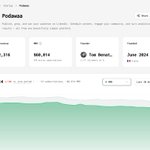
Podawaa by @tombenattar just joined TrustMRR
🔁 MRR: $60k/mo
💰 Revenue (30d): $64k
💵 Total revenue: $1.2M
📈 Growth (30d): -6%
💸 Profit margin: 90%
💳 Active subs: 546
trustmrr.com/startup/podawaa

Finally listed one of our products, Podawaa.com, on @trust_mrr and just realized that we generated $1.2M in all-time revenue with this product 🤩

One of the hardest things about my agency experience is that the service did produce results.
We started PimpMySaaS after seeing Reddit work for MailTracker. We then helped B2B SaaS companies build a presence in relevant Reddit conversations, with the aim of improving their visibility in search and AI answers.
For many clients, especially the ones who stayed longer, we saw their visibility improve in the LLM monitoring tools.
Reddit was often a major source of citations.
That doesn't mean every improvement came from our work, or that every client got the same result. But we had enough positive signals to know we weren't simply selling something nobody needed.
At the same time, we had unhappy clients and plenty of churn.
I think both things were true because the service involved more than the work appearing on Reddit.
Clients also needed consistent communication, recommendations and someone helping them understand the results. We weren't good enough at that part.
It's frustrating to look back at a business where there was demand, strong profitability and useful work being done, while also knowing we let important parts of the experience fall behind.
I don't think the honest version is that the agency was a disaster, or that it was a great business I was too tired to appreciate.
We got some things right. I got other things wrong. And I didn't want to spend the next few years becoming an agency operator.
We sold our agency for less than a year's ARR.
It was doing around $50k MRR at the time, after previously reaching about $70k.
I don't want to dress that up as an incredible valuation. It wasn't.
The business had real strengths: strong profitability, more than 80 clients signed over its life and very little marketing required to bring in business.
It also had problems we'd never properly solved.
We lost a lot of clients. Our processes and client management weren't where they needed to be. I was still heavily involved in the work, and I didn't enjoy running the company.
Before the agency, I'd spent ten years building SaaS. During it, my calendar filled up with calls, including late evenings with US clients, and that affected my family life.
I can imagine a version of the story where we hired better, improved retention and built a more valuable agency.
But doing that would have required me to spend more time working on exactly the business I wanted to stop running.
We eventually found a buyer and sold.
The feeling I remember most is relief.
I'm glad we built something another company wanted to acquire. I'm also glad I don't have to pretend that getting the highest possible valuation was the only thing I cared about by the end.
We got clients like ZoomInfo, Crisp and Livestorm into an agency that had almost no processes.
I'm proud we were able to win that work. I'm much less proud of how ready we were to handle the growth.
PimpMySaaS started with two of us. At the largest, the team was only around four or five people, and I was still doing a huge amount myself.
We signed more than 80 clients in total. The offer was usually between $2k and $3k a month, and referrals kept bringing in more conversations.
That made the business look very promising from the outside.
Inside, we needed a much more consistent way to manage clients, give recommendations, report on the work and deal with problems.
We did those things, but too much depended on individual effort rather than a service we could reliably deliver as the client base grew.
We also lost plenty of clients.
Looking back, I don't think our next useful project was necessarily another acquisition channel. We already knew how to get people interested.
I would have preferred to slow down, take fewer clients and work out how to give each one a better experience.
But I was already unhappy doing agency work. The prospect of spending more time building an agency organisation wasn't especially appealing either.
That made the situation difficult: the company needed more commitment to a type of work I increasingly wanted to leave.
Our agency was doing around 70% EBITDA, according to our numbers.
I still wanted to sell it.
That's an awkward thing to explain when the business is growing and you're making good money. It sounds like you're complaining about something other founders would love to have.
We'd signed more than 80 clients over the life of PimpMySaaS. At the peak, we were doing around $70k MRR. Most of the acquisition came through referrals, word of mouth and a few cold emails.
The difficult part was running the service.
I was doing a large amount of the work myself. We hadn't built the processes we needed, client follow-up wasn't consistent enough, and the daily calls were a big change from my life in SaaS.
Those aren't problems I can blame entirely on the agency model. I was responsible for how we built the company.
We could have hired earlier, structured the service better or taken fewer clients while improving the experience.
We tried bringing in a COO, but that didn't work out.
By the time we sold, the business was doing around $50k MRR.
I was happy to stop running it, even at a valuation below a year's ARR.
I can look at the profitability and understand why someone would want that business. I can also remember my working days and understand why I didn't want to keep it.
Before I started an agency, my calendar was empty about 95% of the time.
I'd spent ten years working on SaaS. I had the occasional call, but most of my time wasn't booked by other people.
Then PimpMySaaS grew to $30k MRR in about three months, and eventually reached $70k.
The change in my calendar happened alongside that growth.
I had client calls every day. Some were late in the evening because we worked with companies in the US. I was also doing a large part of the work myself, so having a call didn't mean the production work had gone away.
Some conversations were great. Others were with unhappy clients, and I found those particularly difficult.
The business was making money, but it was taking up much more of my family life than I wanted.
I don't think I understood how much I liked my previous working day until I no longer had it.
An almost empty calendar had felt normal. Once it was full of commitments, I realised it was one of the things I valued most about working on software.
When we sold the agency, I didn't feel that I'd finally proved something by getting an exit.
I mostly felt relieved that I wouldn't have to keep running it.
I'd already built a kind of working life I liked before the agency. I gave a lot of it up because the new business was growing quickly.
We usually delivered the 20 to 30 Reddit comments we promised our agency clients.
We still lost a lot of clients.
For a while, I found those two things difficult to reconcile. We'd done the work in the offer. There were comments to show, reports to send, and we could see visibility improving for many companies that stayed with us.
But I'd spent ten years building SaaS, and I was bringing some of that mindset into an agency.
A software customer can use the product, get the result and barely speak to you.
An agency client paying a few thousand dollars a month often expects much more involvement. They want your opinion on their business. They want you to tell them what to try next, explain what happened and raise a problem before they have to ask about it.
We did some of that, but not consistently enough.
I was doing a huge amount myself, our processes weren't good enough, and signing more clients made those weaknesses harder to ignore.
If I were reviewing that business now, I wouldn't only ask how many comments we'd published.
I'd look at the last useful recommendation each client received, whether they understood the results, and whether someone had taken responsibility for what should happen next.
I think we were much better at selling the service and producing the work than we were at making clients feel properly looked after.
The day after I arrived in Mauritius for a two-week holiday, we discovered that roughly 80% of the Reddit comments we'd posted that month had disappeared.
Client reports were due in three days.
We ran an agency helping B2B SaaS companies build visibility through Reddit. Our monthly offer included 20 to 30 comments, so this wasn't a small issue we could leave until I got home.
A large part of the month's work was suddenly gone, and we needed to explain that to the people paying us.
I was trying to work out whether we could replace the comments, whether we'd need to refund clients and how they would react.
We told them what had happened and offered to post more the following month.
Most were very understanding. That was a relief, because I genuinely didn't know how those conversations would go.
What bothered me was that this wasn't the only time Reddit had created an urgent problem for us. The platform was unpredictable, and managing that unpredictability had become part of the service.
Before starting the agency, I'd mostly been excited about the results we were getting for MailTracker.
I hadn't given nearly as much thought to what would happen when other companies were paying us for similar work and a month of it disappeared just before reporting.
I got a much better understanding of that on holiday.