

PhD Economist @Upside | Researching & speaking on consumer behavior, the economy & industry trends | Ask me about fuel, restaurant & grocery retail
Michigan, USA
Joined September 2007
- Tweets1.1K
- Following314
- Followers316
- Likes512




Pinned Tweet
My new paper came out in the Journal of Marketing Analytics! Check out the summary here or click through for the full article
medium.com/@tomweinandy/usin… #EconTwitter #Marketing #Twitter #Retail


Thomas J. Weinandy retweeted

Underappreciated how much the shale revolution unlocked the AI revolution.
It's easy to guess the jobs reduced/changed by AI, but as @AnnieLowrey points out, most people don't try to imagine what's being created.
* 1st-order: Jobs training and deploying AI
* 2nd-order: Jobs supporting AI tech
* 3rd-order: "Wealth jobs" supporting those with AI money

Great to speak with @AnnieLowrey about why the new jobs that emerge from AI may have absolutely nothing to do with AI and what the fact that our parents all think we spend our money indulgently can teach us. theatlantic.com/ideas/2026/1…

🛍️ Income growth has not always kept up with inflation over the past several years, but AI enthusiasm has pushed up investment performance. This disproportionately benefits older consumers who were more likely to have investments.
cnbc.com/2026/10/12/baby-boo…

Halfway through #NABE2026! 19% of the sessions include "AI" in their title but so far 100% mentioned AI at some point with close to that many also bringing up energy prices. This is very telling to what economists are watching ahead of 2027.
I'm on my way to Cleveland for another NABE annual meeting! Ping me if you're attending #NABE2026 too and I'll seek you out to make an in-person connection

You gotta spend money to make money, and you gotta burn diesel to transport diesel.
My latest fuel blog explains why diesel prices in particular have been climbing around the country and why Texas is more exposed than most other states.
upside.com/business/retailer…

We've gone from "data is the new oil" to "AI is the new food". Excellent article from @greg_ip on whether the economic potential and limitations of AI meet the implied valuations of frontier labs.
wsj.com/tech/ai/will-america…

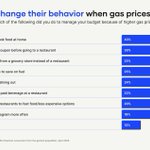
When gas prices rise, 88% of consumers change how they spend on food. Only 19% lean harder on a restaurant loyalty program. Price pressure isn't sending diners to your app.
New report: upside.com/business/retailer…


[NEW] US drivers paid an additional $66B in gas since the Strait of Hormuz crisis began.
Relative to the same time in 2025, drivers spend 24% *more* at the pump despite buying 3.5% *fewer* gallons of fuel.
Read my new analysis at upside.com/business/retailer…

ALT A line chart shows that, since the Strait of Hormuz crisis began, year-over-year change in spending per gas station has gone up 24%, while gallons bought have gone down 3.5%. Published from Fuel Trends by Upside.
Every 1% rise in gas prices → 0.51% fewer grocery visits, 0.59% less grocery revenue.
Shoppers don't stop shopping when gas spikes. They just quietly buy less, less often. Here's what 3 years of data across 1,000+ stores shows grocers 👇
grocerydive.com/news/fuel-pr…


I did say!
“Cross-shopping has been a very important trend that not enough retailers are paying attention to simply because it involves data that’s off-site, and that’s just a blind spot for many retailers,” Weinandy said.
Future convenience-store winners will build new capabilities, Outlook Report says dlvr.it/TV1N0M Read more ⬇️

Thomas J. Weinandy retweeted

.@BharatKChandar, @RuyuChen and I just released an updated version of our paper "Canaries in the Coal Mine?"
The headline is that we still don't see any widespread job displacement due to AI, but the earlier trends we identified hold up or even grow. E.g., the relative decline for young people in AI-exposed jobs widened to 19% by June 2026, from 15% in our first wave.
We also looked at changes in interest rates, remote work, the tech sector boom and bust and remote work, but none of them seem to explain the effects we see for AI-exposed jobs.
Bharat has a great thread below with more detial. It ends with links to the new paper and to a short blog post summarizing what's new.
I'd love to hear what you think.


Thomas J. Weinandy retweeted

Some great charts on global electric car sales in the latest from @_HannahRitchie (link next). She flags the massive differences in adoption rates across countries.


Thomas J. Weinandy retweeted

Global sales of combustion engine cars peaked in 2017—
To decarbonize road transport, the world must move away from petrol and diesel cars towards electric vehicles and other forms of low-carbon transport.
This transition has already started. In fact, global sales of combustion engine cars are well past their peak and are now falling.
As you can see in the chart, global sales peaked in 2017. This is calculated based on data from the International Energy Agency. Bloomberg New Energy Finance also estimated this peak occurred around that time.
Sales of electric cars, on the other hand, are growing quickly. They more than doubled in the three years from 2022 to 2025.
(This Data Insight was written by @_HannahRitchie.)

ALT Stacked bar chart of annual global car sales (non-electric and electric) from 2010 to 2025 where non-electric (combustion engine) sales peaked in 2017 and then declined while electric car sales rise and form a growing share of total sales by 2024 to 2025. Source: International Energy Agency, Global EV Outlook (2026). License: CC BY.