

🧑🏿💻iOS Developer. Currently building https://teapawt.net/t.co/ixOqEQluVE https://teapawt.net/t.co/QB5wei5KD7 https://teapawt.net/t.co/YGbvjYL1zy
Le Havre, France
Joined November 2023
- Tweets591
- Following2.2K
- Followers151
- Likes5.2K





Tooflex Dev! retweeted

Over the past week, I’ve been overwhelmed by the love and support of friends, industry colleagues, and people I've never met. Thank you to everyone who has shown kindness to my family and me. It means the world to me.
I came to the United States 53 years ago, and becoming an American citizen is one of the greatest gifts and proudest moments of my life. NVIDIA has been my life’s work. Building it into the company it is today alongside my colleagues has been a privilege and an honor. Nowhere but in America could a company like NVIDIA be possible. I love our country, and I love NVIDIA.
I did not live up to the standards expected of everyone at NVIDIA, and I have made serious mistakes in my personal life. I created problems for the Board that I deeply regret. I own my mistakes completely, and I am committed to cooperating with the Board’s independent investigation.
Since my departure, I’ve seen an outpouring of calls from NVIDIA’s employees, investors, business partners, and customers for me to return as CEO. Many continue to reach out to me directly as the company navigates complex technology, market, competitive, and geopolitical dynamics. NVIDIA is a once-in-a-generation company. If the Board of Directors decides that my return is in the best interest of our shareholders, our employees, the company, and America, I would be honored to answer these calls and return as CEO.
Thank you again to everyone who has shared their good wishes. I am profoundly humbled by your support. To my family: I love you, and I will spend the rest of my life being worthy of yours.
Jensen
Tooflex Dev! retweeted

OVH annonce Olala mini 7A1B
OVH sa première famille de LLM. Premier représentant de cette famille, Olala mini 7A1B est un modèle compact bâti sur une architecture inédite.
Olala : le modèle innovant dans l’attention hybride
Olala mini repose sur une architecture de 7 milliards de paramètres (7B) avec un milliard activés répartis entre 256 experts par couche, l’attention hybride avec Differential-TPA et Mamba-3, au format BF16. Seule une fraction du modèle est sollicitée à chaque requête, ce qui le rend plus rapide et moins gourmand en mémoire. Conséquence directe: le modèle fonctionne sur un GPU doté d’un minimum de 8 Go de mémoire, il atteint 160 tokens par seconde sur une RTX A4500, et même sans GPU, sur un simple processeur, à 50 tokens par seconde. Sa fenêtre de contexte atteint aujourd’hui 32 000 tokens. Olala mini sera disponible en open source sur Hugging Face, sous licence Apache 2.0.
Entraîné avec l’aide publique européenne et en fonctionnement chez Qwant
Olala mini a été entraîné sur trois supercalculateurs publics européens, Jupiter, MeluXina et Jean Zay, équipés de GPU GH200, A100 et H100. Ce soutien, qui représente l’équivalent de 7 M€ en heures de calcul, a été déterminant, et OVH tient à en remercier les pouvoirs publics. L’initiative publique s’est révélée un succès à plus d’un titre : elle a fait émerger une équipe d’exception en intelligence artificielle et a donné naissance au Lab Agentique d’OVH: OVHai LLM. Olala mini est publié avec ses poids, son modèle de base pré-entraîné, son rapport technique et sa documentation de conformité à l’AI Act. Qwant l’a déjà adopté pour sa fonctionnalité de réponse flash, avec des gains significatifs : des réponses 20 % plus rapides et des coûts de fonctionnement divisés par trois par rapport au modèle précédemment utilisé.
En route vers la v1.1, puis la v2.0
Attendue d’ici la fin de l’année, la version 1.1 portera la fenêtre de contexte à 128 000 tokens et améliorera ses performances en raisonnement mathématique. Avec la version 2.0, OVHai LLM entend développer des modèles spécialisés dans trois domaines. D’abord, l’agentique pour les entreprises : à terme, Olala alimentera OVHai Workspace, dont la version chiffrée nécessitera des modèles capables de tourner en local, directement sur le poste de travail. Ensuite, le DevOps cloud, avec des déclinaisons adaptées aux développeurs, aux architectes et aux équipes d’exploitation qui assurent la continuité de service 24h/24. Enfin, la cybersécurité, dans ses volets défensif comme offensif. Olala v2.0 dépassera les 100 milliards de paramètres.
corporate.ovhcloud.com/fr/ne…

Tooflex Dev! retweeted

We’re not going to win by lobbying, plotting, or manipulating. We’re going to win by building, in the open, with the whole community!
Today, with @ggerganov we’re super excited to announce the release of llama.cpp v1, the first major fully stable version of the most used library to run AI models locally, meaning on your phone, your laptop, and your workstation.
It means you can own your intelligence for free, not send your data to anyone and be 100% in control, wherever you are in the world. It shows our commitment to support every hardware, platform and model type out there and makes AI distributed rather than concentrated in a few Silicon Valley orgs.
Huge thanks to the team, the long-time maintainers and every contributor who helped make this happen. Let’s build! 💛🧡💚

llama.cpp v1.0.0 is now available
huggingface.co/blog/ggml-org…


Tooflex Dev! retweeted

During pre-release testing, Claude Fable 5.2 and Claude Mythos 5.2 worked on ambitious projects in many different fields. Here are a few.
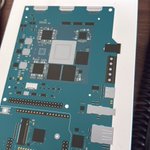
From a one-paragraph prompt, Fable 5.2 designed three working electronic devices, including this home voice assistant hub.
Tooflex Dev! retweeted

We're giving away a Hogwarts Legacy custom wrapped NVIDIA GeForce RTX 5090 to celebrate its official release with DLSS 5 🪄
To enter:
🟢 Share this post
🟢 Comment #RTXON
Terms and Conditions: nvidia.com/en-us/geforce/con…

Tooflex Dev! retweeted
Today, we release the weights of a new and improved Le Chonk, advancing the open frontier for agentic coding and cybersecurity.
💻 Built to build: Le Chonk ranks #1 on @cognition’s FrontierCode among open models, and sets a new benchmark for Pareto efficiency on @artificialanalysis.
🛡 Built to defend: State-of-the-art in cyberdefense, put through the paces by the world's leading cyber vendors, including @CrowdStrike, @cloudflare, @rubrik, @zscaler, and others.
Built for sovereignty: Make it yours. Download the weights on @huggingface , customize it with Mistral Forge, and deploy it wherever you need it.
Read more from our team and customers 👇:

Tooflex Dev! retweeted

i own a relatively new (2025) samsung tv.
i kept getting weirdly targeted ads.
i tried reversing the firmware but it was aes encrypted and no keys unless tear it apart and do uart/jtag magic.
zero days it is. root shell on new samsung TVs!
discovered PRIVACY HORROR. write up?

Tooflex Dev! retweeted

🚨🚨🚨 ALERTE SÉCURITÉ MAXIMALE ! Python est compromis.
🔸 Mettez immédiatement pip à la version 26.2.2 ou plus.
🔸 Dans chaque projet Python (chaque venv) : python -m pip install --upgrade pip
🔸 uv : uv self update (0.13.4 ou plus)
🔸 Mettez aussi à jour les certificats du système (apt / dnf upgrade ca-certificates) et vos images Docker
pip install est compromis.
L'autorité indienne eMudhra (emSign), qui signe les « passeports » prouvant qu'un site est bien celui qu'il prétend être, utilisait des clés secrètes ridiculement faibles : 8 clés, toutes inférieures à 256. L'une valait 4. Autrement dit, n'importe qui peut fabriquer un faux passeport valide pour n'importe quel site.
Le risque pour Python : quelqu'un sur ton réseau (wifi public, FAI, État) se fait passer pour pypi.org, et ton « pip install » télécharge un paquet piégé sans aucune alerte. Aucune attaque n'a été signalée pour l'instant, mais c'est trivial à faire.
Un paquet piégé peut installer n'importe quoi. Porte dérobée, virus, vol d'informations en tout genre.
La situation est terrifiante !
Rien que dans l'écosystème Python, chaque installation de CPython, chaque venv, uv, tout est exposé.
Et je ne vous parle même pas de npm, pnpm, yarn, Go, Rust.
Ma stratégie de sécurité 2026 : rester chez moi et ne me connecter à Internet que depuis un FAI de confiance.
C'est quand il y a de la mer qu'on reconnaît les vrais marins...

Readers added context they thought people might want to know
Ce n'est pas un bug Python mais une vulnérabilité des clés privées faibles des certificats intermédiaires eMudhra/emSign (d<256 dont une valant 4), exposant les bundles certifi/pip à des MITM TLS potentiels jusqu'aux mises à jour.
discuss.python.org/t/information-…
emudhra.we-have-a-problem.com
scotthelme.co.uk/eight-bits-of-…
github.com/advisories/GHS…
Tooflex Dev! retweeted

Mettez à jour tous vos sites nous sommes en guerre

🔐 Node.js security updates are now available!
New releases for Node.js 22.x, 24.x & 26.x address multiple vulnerabilities, including high-severity issues.
Review the details and update your systems to stay secure.
🔗 nodejs.org/en/blog/vulnerabi…
#NodeJS #Security

Tooflex Dev! retweeted

Yesterday we open-sourced Phonon, and today we’re at NVIDIA GTC Berlin.
Phonon’s inference stack includes an NVIDIA CUDA backend, so it runs on professional and gaming GPUs and on embedded hardware with Jetson.
Today we’re announcing it with @nvidia: gradium.ai/blog/gradium-rele…


A new frontier for on-device speech.
We're open-sourcing Phonon, a suite of TTS models under 50m parameters, setting a new standard for naturalness and accuracy across languages, with the broadest inference support to date.
Phonon-31m is available under Apache 2.0.
gradium.ai/phonon🧵


Tooflex Dev! retweeted

Today, we’re releasing Bonsai 2 2B, 4B, and 9B.
Based on Qwen3.5, these new ternary models bring stronger reasoning, visual understanding, and tool calling to compact footprints designed for everyday devices:
• 2B: 0.43GB
• 4B: 0.95GB
• 9B: 2.0GB
For this release, we focused on what makes small models useful as local assistants: following instructions, avoiding repetitive loops, calling tools on mobile devices, and giving useful answers without unnecessary output. The 9B model uses roughly 40% fewer tokens on standard instruction-following and everyday math tasks. Solving the Riemann hypothesis can wait.
These models are successors to our first-generation Bonsai 1.7B, 4B, and 8B, and provide a foundation for bringing practical agentic functionality to local applications on personal computers, phones, and wearables.
The Bonsai 2 family now includes four sizes spanning 2B to 27B parameters. Developers can choose the balance of capability, memory use, and responsiveness that fits their application and hardware.
Available today under Apache 2.0.


Tooflex Dev! retweeted

Today we’re releasing Muse Spark Open, the most capable US open-weight model to date.
Built for coding and agentic work, it excels at long-horizon tasks, complex software engineering, and multi-step reasoning.
Key Model Specs:
→ 816B total / 42B active parameters
→ 1M token context window
→ Natively multimodal across text, image, video, audio


Tooflex Dev! retweeted
In robotics, Gemini 4 Argon is speeding up real-world physical learning.
We let Argon watch a video of a human playing cornhole. It mapped the environment, calculated whole-body joint movements, and autonomously built the simulation code to practice.
When transferred to Apptronik’s Apollo humanoid, the robot sank seven straight shots in a real-world trial.
Tooflex Dev! retweeted
Meet Mistral Large 4, aka Le Chonk.
• 1T parameters, natively multimodal. 49B active.
It is the best open weights model from US or Europe on aggregated benchmarks.
• State-of-the-art on critical workloads, including cyber defense, manufacturing and finance and it surpasses closed frontier models on visual grounding.
• Forged in Europe end-to-end and is deployable from Europe via our own Mistral Cloud infrastructure.
• Available to all via API today. Working with cybersecurity partners privately.
Open weights release end of October.
🤖 Made with AI
Tooflex Dev! retweeted

Lots of discussion out there about our next model(!), so I wanted to give an early look as soon as possible. Introducing Gemini 4 Argon!
It shows frontier performance in complex workflows, cyber defense and software engineering. Teams are using it extensively at Google, from coding to quantum computing, great feedback.
Here’s a look at the benchmarks:
