

What's your favorite dinosaur?
Joined September 2022
- Tweets3.6K
- Following4.3K
- Followers5K
- Likes942




Riojavenatrix sat misidentified as Baryonyx material for nearly two decades before a fresh look in 2024 revealed a distinct spinosaurid, one of five such predators now known from the Iberian Peninsula. #dinosaur

Nasutoceratops carried an unusually large, bulbous nose and long, forward-curving horns, part of a surprisingly diverse lineup of horned dinosaurs that once coexisted in Cretaceous Utah. #paleontology

Bustingorrytitan may have weighed close to 67 tons even though its holotype individual might not have been fully grown, a titanosaur from Argentina named partly after the Hindu deity Shiva to mark a period of dramatic faunal turnover. #dinosaur

Velociraptor carried quill knobs along its forearm bones, direct skeletal evidence of feathers despite standing barely two feet tall, far smaller than its popular on-screen portrayals. #paleontology

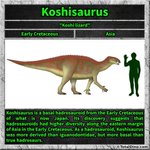
Koshisaurus shared its Early Cretaceous floodplain with another hadrosauroid relative found in the very same Japanese rock formation, revealing more ornithopod diversity in the region than once assumed. #dinosaur

Igai sat unnamed in scientific literature for over four decades after its 1977 discovery in Egypt, a titanosaur finally described in 2023 with a species name meaning "the forgotten" in Ancient Egyptian. #paleontology

Caudipteryx preserved a short fan of feathers at the tip of its tail, giving this small, ground-dwelling dinosaur from China its name and offering some of the clearest early evidence that feathers predated flight. #dinosaur

Yingshanosaurus carried a pair of long, wing-like spines jutting from its shoulders rather than relying mainly on tail spikes, a stegosaur from Jurassic China whose only known fossil has since gone missing. #paleontology

Jiangxititan carried unusually forked neural spines along its back, a titanosaur from Cretaceous China uncovered during construction work in Jiangxi Province. #dinosaur

Australovenator, nicknamed "Banjo," remains one of the most complete theropod skeletons ever found in Australia, a fast, lightly built predator from the Winton Formation. #paleontology

Qianlong was found alongside several leathery eggs, some still containing embryos, a basal sauropod relative from Early Jurassic China whose name simply means "Guizhou dragon." #dinosaur

Stegoceras was among the first pachycephalosaurs ever studied in detail, a dome-headed dinosaur from Canada that helped define what scientists would come to expect from this unusual group. #paleontology

Barapasaurus is known from the remains of several individuals found together in India, yet not a single skull has ever been recovered for this early sauropod. #dinosaur

Pelecanimimus carried around 220 small teeth, an unusual trait for its group of typically toothless ostrich-mimic dinosaurs, alongside possible soft tissue evidence of a pelican-like throat pouch. #paleontology

Yuxisaurus sits near the common ancestor of both stegosaurs and ankylosaurs, one of the earliest well-preserved armored dinosaurs found anywhere in Asia. #dinosaur

Siats filled a major gap in North America's predator lineage, a massive Cretaceous theropod from Utah named after a man-eating monster from Ute legend, bridging the era between older giant predators and the rise of tyrannosaurids. #paleontology

Lingwulong pushed the origin of an entire sauropod lineage back by 15 million years, the first confirmed relative of Diplodocus ever found in East Asia. #dinosaur

Vectidromeus is one of only two species left in a once-broad group of small ornithopods, after years of reclassification narrowed the family down almost entirely to fossils from England's Isle of Wight. #paleontology

Triceratops carried one of the largest skulls of any land animal, anchored by a solid, bony frill likely used in both display and combat with rivals. #dinosaur
