

The real AI risk is not #rebellion.
It is #dependency.
#openai @steipete @sama @DarioAmodei @AnthropicAI #ClaudeCode #codex #Openclaw

56

Touchable AI retweeted

Peter Steinberger is joining OpenAI to drive the next generation of personal agents. He is a genius with a lot of amazing ideas about the future of very smart agents interacting with each other to do very useful things for people. We expect this will quickly become core to our product offerings.
OpenClaw will live in a foundation as an open source project that OpenAI will continue to support. The future is going to be extremely multi-agent and it's important to us to support open source as part of that.


Watch #ChatGPT4o bring a child’s imagination to life — turning simple sketches into breathtakingly realistic images. Pure magic! @sama


With ChatGPT-4o, you can explore different versions of the same iconic image—reimagined in marble, photo-realism, LEGO, and more. It is so addictive! @sama


1
1
203
10. Thomas Paine (1737-1809)
Problem: Late 18th-century America was fed up with British rule. The colonies were like a pressure cooker about to explode. Paine thought, “If we don’t make a move now, we’ll be stuck in this oppressive mess forever.”
Paine’s Thoughts (1776):
In 1776, Thomas Paine wrote Common Sense, a pamphlet that was anything but gentle. He shouted, “Enough is enough! We Americans have the right to independence! We built this land with our own hands—why should we take orders from across the ocean?” His fiery words lit a fuse under the American Revolution, making Common Sense a bestseller and turning Paine into a revolutionary rock star.
Summary: Paine was the revolutionary coach who rallied the troops with a battle cry: “Independence or bust! No more British chains!”
#enlightenment

25
9. Immanuel Kant (1724-1804)
Problem: 18th-century Germany was a philosophical battleground. Rationalists and empiricists were duking it out, each side claiming they had the key to all knowledge. Kant watched from the sidelines and thought, “Guys, you’re both kind of missing the point.”
Kant’s Thoughts (1781):
In 1781, Kant dropped Critique of Pure Reason like a bombshell. He argued, “Sure, rationality is important, but some things—like time and space—are hardwired into our brains. You can’t just learn them from experience.” He also introduced the idea of the “categorical imperative,” which said that morality comes from your intentions, not just your actions. This made everyone sit up and rethink their philosophical stances.
Summary: Kant was the philosophical mediator who built a bridge between rationalism and empiricism, saying, “Let’s all calm down and see the bigger picture!”

1
25
8. Adam Smith (1723-1790)
Problem: 18th-century Britain was witnessing the dawn of the market economy, and people were freaking out. “Can we really trust the market to manage itself? Shouldn’t the government step in and take the wheel?”
Smith’s Thoughts (1776):
Adam Smith rolled up with his Wealth of Nations in 1776 and said, “Relax, everyone. The market’s got an ‘invisible hand’ that’ll guide it just fine.” He argued that individuals pursuing their own interests would ultimately benefit society as a whole, and government intervention should be minimal. This idea became the cornerstone of capitalism, making Smith the ultimate capitalist guru.
Summary: Smith was like the economic therapist, telling everyone, “Trust the process! The market’s got this!”

1
7
7. Jean-Jacques Rousseau (1712-1778)
Problem: 18th-century France was a playground for the rich, while the common folks were left eating dust. Inequality was so thick you could cut it with a knife. Rousseau looked around and thought, “This isn’t just unfair, it’s insane! The people deserve better!”
Rousseau’s Thoughts (1762):
Rousseau went full revolutionary in 1762 with his Social Contract. He shouted from the rooftops, “The government’s power comes from the people, not from some divine right!” He also introduced the idea of the “general will,” meaning the government should work for the majority, not just the elite. His words sparked a fire in the hearts of the French, who began to think, “Yeah, why are we putting up with this nonsense?”
Summary: Rousseau was the rabble-rouser who gave the people a battle cry: “Down with inequality! Power to the people!”

1
13
6. Denis Diderot (1713-1784)
Problem: 18th-century France was like a treasure hunt with no map. Knowledge was scattered everywhere, and people were running around trying to piece it together. Diderot saw this chaos and thought, “How can anyone get enlightened if they can’t even find the information?”
Diderot’s Thoughts (1751-1772):
Diderot decided to create the ultimate cheat sheet: the Encyclopédie. From 1751 to 1772, he and his team of brainiacs worked their butts off to compile everything anyone could ever need to know—science, art, crafts, philosophy, social theory, you name it. The Encyclopédie became the go-to guide for Enlightenment thinking, though the Church and government tried to shut it down. But Diderot was like, “Sorry, not sorry!” and pushed it through, enlightening minds all across Europe.
Summary: Diderot was the “knowledge supermarket” manager who said, “Come on in, everything you need is in one place—no more running around like headless chickens!”

1
13
5. David Hume (1711-1776)
Problem: In 18th-century Scotland, “rationalism” was the new buzzword. People thought they could solve everything with a bit of logic, like it was some kind of universal duct tape. Hume watched this and thought, “Hold up, folks. Is rationality really the end-all-be-all?”
Hume’s Thoughts (1748):
Hume threw a philosophical curveball with his Enquiry Concerning Human Understanding in 1748. He splashed cold water on the rationalists, saying, “Knowledge comes from experience, not just from sitting around thinking about it!” He also reminded everyone, “Emotions, guys, they’re the real drivers of human behavior. Rationality’s just the hood ornament.” This made the rationalists sweat a little, but it also made people think about the human side of knowledge.
Summary: Hume was like a philosophical lifeguard, pulling everyone out of the deep end of rationality and saying, “Rationality’s cool, but don’t forget the feels!”

1
10
4. Voltaire (1694-1778)
Problem: 18th-century France was basically a church-run theme park, where the Church dictated how people should think, act, and even breathe. Anyone who dared to disagree got a one-way ticket to the “reflection chamber” (a.k.a. jail). People were suffocating and thinking, “Can we get a little breathing room here?”
Voltaire’s Thoughts (1733):
Voltaire, the king of sass, grabbed his quill and started roasting the Church and the government in his Letters on the English. He declared, “We need free speech, religious tolerance, and a fair justice system! And who the heck gave the Church the right to control our thoughts?” His famous line, “I disapprove of what you say, but I will defend to the death your right to say it,” became the battle cry for freedom of expression. Voltaire’s words hit the powerful where it hurt, and they were not amused.
Summary: Voltaire was the OG troll who used humor to fight oppression, basically saying, “If you try to shut us up, we’ll laugh you out of power!”

1
10
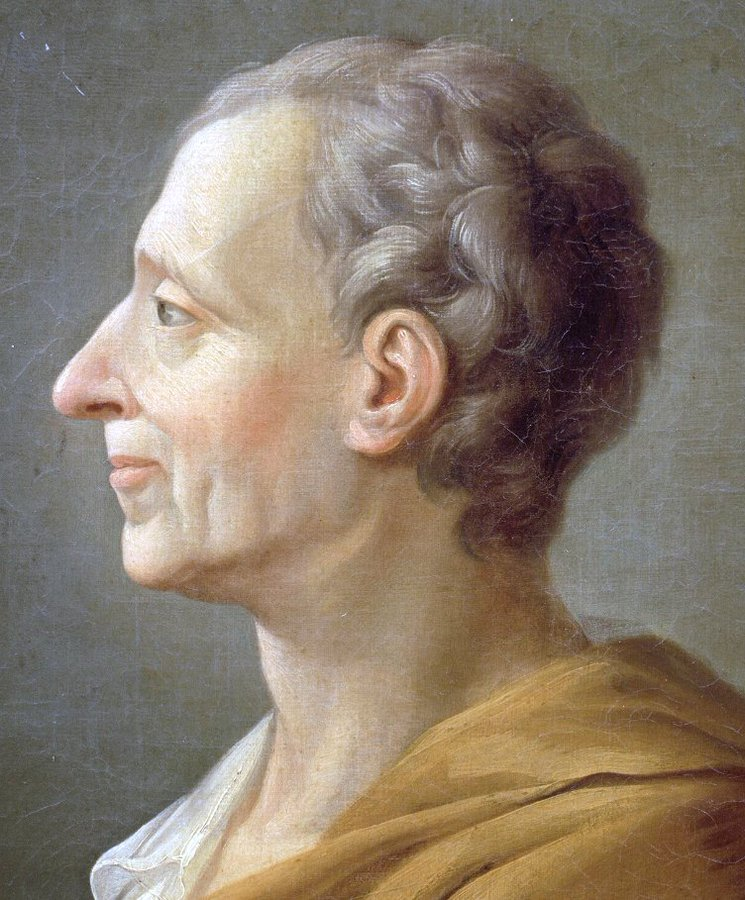
3. Montesquieu (1689-1755)
Problem: In France, Louis XIV had declared himself the human embodiment of the country with his infamous “I am the state” line. The French were feeling like extras in a bad drama where the king hogged all the screen time. People were whispering, “Who’s gonna put the brakes on this guy?”
Montesquieu’s Thoughts (1748):
Montesquieu sat down with a quill and thought, “What this country needs is a serious power check.” In 1748, he published The Spirit of the Laws, where he introduced the idea of separating government power into three branches—legislative, executive, and judicial. It was like slicing a cake into three pieces so no one could gobble it all up. The Americans loved it and decided to bake their Constitution with Montesquieu’s recipe, turning it into a global hit.
Summary: Montesquieu was the architect who installed a power limiter, telling the king, “Let’s spread the power around so you don’t get carried away!”
1
14
2. Isaac Newton (1643-1727)
Problem: By the late 17th century in England, people were staring at the stars, scratching their heads, and wondering, “Why don’t these things just fall on our heads? Is there a cosmic babysitter up there keeping everything in place?”
Newton’s Thoughts (1687):
Newton, the ultimate science geek, couldn’t let this one slide. He was like, “Hold my apple.” In 1687, he published Principia Mathematica, where he explained the law of universal gravitation and the laws of motion. He told everyone, “Chill out, guys. The stars aren’t going rogue; it’s all thanks to gravity!” He handed out math equations like party favors, and suddenly, everyone was talking about science and rationality as if they were the new rock stars.
Summary: Newton was the repairman of the universe, handing out instruction manuals that explained, “Relax, the universe isn’t going to crash; it’s all under control!”

1
13