

Systematic futures trader | Trading since 2017 I build rules, backtest them with data and AI, and share what works and what fails Newsletter ↓
Joined August 2017
- Tweets14.1K
- Following157
- Followers5.7K
- Likes17.7K




Pinned Tweet
𝗠𝘆 𝗰𝗼𝘂𝗿𝘀𝗲 𝗶𝘀 𝗼𝗽𝗲𝗻: 𝗯𝘂𝗶𝗹𝗱 𝗮𝗻𝗱 𝗯𝗮𝗰𝗸𝘁𝗲𝘀𝘁 𝗮 𝘀𝘁𝗿𝗮𝘁𝗲𝗴𝘆 𝘄𝗶𝘁𝗵 𝗔𝗜, 𝗳𝗿𝗼𝗺 𝘇𝗲𝗿𝗼
It starts on Thursday 12 November, for a group of 20 people, and from today the places are open to everyone.
It's for traders who already know what they trade and want to test it properly, and you don't need to know how to code, because Claude writes the code and I show you how to check it.
This is what you'll find in it:
1. A real case from the setup on the chart to the last test, with every number, including the bad ones.
2. The part that tells a real edge from luck, even when the answer is that the strategy doesn't work.
3. A simulation of a funded account with the prop firm's real rules, or of your own capital, to see if a setup gets you paid before it blows the account.
4. Your specific questions, answered by me personally.
5. A clear order, step by step, so you only learn what you actually need.
Every delivery is a written document that you read and do at your own pace, with Claude on your own screen, so there are no live classes or videos, and I answer your questions within 48 hours.
The founding price of this first edition is $99 (plus VAT where it applies), and you can ask for a full refund within 14 days of your purchase.
You can take your place here: tradingamok.gumroad.com/l/fr…

Today the Fed announces its interest rate decision (the FOMC), and a while ago I wouldn't have traded at all, because staying out on FOMC days was one of those rules I took for granted without ever checking it.
Once I had years of past data to test my setups on, I checked how they did on FOMC days compared with every other day.
So this morning I followed my rules as on any other day, and when the setup showed up, I took the trade without hesitating.
The win itself doesn't prove anything, because a loss would have been just as normal on a day like this.
What matters to me is that I took it because of something I had checked in my own data.
I teach how to check this kind of rule against your own past data in my course: tradingamok.gumroad.com/l/fr…

If you test setups with AI and never tell it when a setup is really dead, it will decide that for you, often after one bad test.
So I keep a short protocol in the instructions it reads every time, with five questions to answer before a setup is buried:
1. Was the result measured the right way for that kind of test?
2. Was each setting tested across its whole range, and not just one value?
3. If a number looks strange, was it checked in the code before trusting it?
4. Is there a written list of the alternatives not tried yet?
5. What result would change my mind?
Until all five are answered, it's only a provisional close, and the AI has to propose those alternatives on its own.
The same rule works the other way too, because when the list runs out and the last test fails, the setup is dead even if I liked it.
How to know when a strategy is really dead is part of my course, Build and backtest a strategy with AI, from zero. It starts on November 12: tradingamok.gumroad.com/l/fr…
Before I trust a backtest, I ask two different questions, and a strategy needs a yes to both.
The first is whether the result could have come from luck, because even a strategy with no edge at all can end a backtest in profit.
The second is whether the strategy keeps working when something changes, because a result that wasn't luck in the past can still fade once conditions are different.
They're separate questions, so a yes to one of them tells you nothing about the other.
Before you give your strategy the final OK, check both.
I explain the checks I use for each question here: tradingamok.substack.com/p/t…
A common belief is that if a trade hasn’t moved your way quickly, it’s probably going to fail.
I thought the same, so I tested it on a new setup with seven years of data.
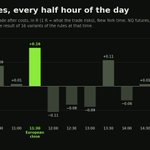
I took the trades still open at 30 minutes and compared closing them right there with letting them run.
Both ways made money and gave almost the same result per trade, so closing early wouldn’t have changed anything.
Checking what an exit rule really does to your results is one of the things we work through in my course on building and backtesting a strategy with AI, from zero.
It starts on November 12: tradingamok.gumroad.com/l/fr…
𝗘𝘂𝗿𝗼𝗽𝗲 𝗮𝗻𝗱 𝘁𝗵𝗲 𝗨𝗦 𝗱𝗼𝗻’𝘁 𝗰𝗵𝗮𝗻𝗴𝗲 𝘁𝗵𝗲𝗶𝗿 𝗰𝗹𝗼𝗰𝗸𝘀 𝗼𝗻 𝘁𝗵𝗲 𝘀𝗮𝗺𝗲 𝗱𝗮𝘆
Many traders take it for granted that London is always five hours ahead of New York.
That’s true for most of the year, but Europe turned its clocks back today and the US won’t do the same until next Sunday, so this week the difference is only four hours.
The same thing happens for two or three weeks every March, because the US moves its clocks forward before Europe does.
Say a setup is built around the London open, which is usually at 3:00 New York time, and its rule is written in New York time, from 3:00 to 4:00.
In those weeks, London opens at 4:00 New York time, so the rule looks at the hour before the open instead of the first hour after it.
The same goes for anything measured over the London session, like its high and its low, because a window written in New York time takes in an hour before London opens and misses its last hour.
In a backtest, those weeks mix in trades that the setup was never meant to take, and in live trading you’d take them without noticing.
Writing the hours of that rule in London time fixes it, because then the rule moves with London when the clocks change.
My data comes in UTC, the world’s reference time, which never changes its clocks, so I can turn it into New York time or London time with the real clock-change dates of each year.
If a setup is tied to the London session, it’s worth comparing its results in those weeks with the rest of the year, keeping in mind that they’re only a few weeks a year, so a difference there can easily be luck.
All my setups have a time limit, so if a trade hasn't reached its target or its stop by a set time, I close it at whatever price the market gives me.
Today one of them closed a long at a loss of 0.3R, less than a third of what I was risking.
After I closed it, the price first kept falling and then came back close to my entry, so for a few minutes closing looked right, and a few minutes later it looked wrong.
But I don't judge the exit by what the price did afterwards.
My backtest closed every one of those trades at the same time, so the results I trust already include these losses, and also the trades the clock saved from getting worse.
If I keep a trade open only when it suits me, I'm trading a strategy I never tested, and I have no data on how that one behaves.
So I closed it on time and logged it like any other trade.
A backtest can take a trade knowing where the day is going to end, something you can't know when you enter, and that makes its results look better than anything you could trade live.
It happens because the computer doesn't watch the day unfold like you do, candle by candle.
It loads the whole history at once, as a big table with one row per day, and each row already has that day's open, high, low and close filled in.
So if your rule says "target the high of the day", the code goes to that day's row and reads the high, and that number is the final high, the one you only know at the close.
But if you entered at 10:00, that high didn't exist yet, so the test is aiming at a target you couldn't see, and it hits it far more often than you would live.
The same goes for any level that is still forming when you enter, like the session's range or a zone whose last candle hasn't closed.
So I make sure the code only looks at the candles up to the moment of the entry, the same ones I would see on my screen.
If the target is the high of the day, it has to use the highest price reached so far, not the one the day ends with.
If you're starting to backtest with AI, this is the kind of mistake I teach you to catch in my course, from zero.
Places open to the waitlist tomorrow, and you can still join it here: tradingamoklab.substack.com/…
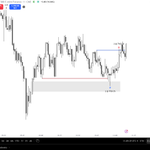
When a setup on the chart looks obvious, it's tempting to trade it right away or the next day.
This chart is one of those for me, but it wasn't a setup I had backtested on years of data, so I asked Claude to test it first.
Taken together, the versions I tested lost money, but one of them made good money, and I still dropped the whole setup.
In my newsletter I go through how I tested it and why that good version wasn't enough: tradingamok.substack.com/p/i…
In my latest study I tested the same entries with five ratios, 1:1, 1:1.5, 1:2, 1:2.5 and 1:3, and the results were very different: with 1:1 the strategy made no money, and with 1:3 it made the most.
Picking 1:3 after seeing all five feels like the obvious choice, but when a small change in the target moves the result that much, a big part of the best result is usually those particular years happening to suit that target.
So the version you pick looks great in the years you used to choose it, and there's a good chance it does much worse in years of data it has never seen.
The same thing happens with any other setting you choose after looking at the results, like the size of the stop, the hours you trade or how many candles a signal needs.
What I trust more is a strategy whose results stay similar when I change those settings a little, because then the result doesn't depend on having picked exactly the right one.

After a bad run of losses, it's easy to drop a strategy and take that run as proof that the edge is gone.
In my latest study I wanted to know how bad things can get for a strategy that does have an edge.
I took the real trades of a setup that made money over eight years of 1-minute data and had the computer deal them out again in a random order, many times over, as if each new order were a future I could have lived through.
Even with the edge intact, going nine trades in a row without a winner was completely normal, and close to 20% of those futures ended a whole year in a loss.
So a losing streak, or even a losing year, tells me very little on its own, because a strategy that works goes through them too.
What matters is whether the losses go deeper or last longer than what those reshuffled futures said was normal.
That's why I want to know how deep a normal bad stretch can go before I trade a setup, and not find out in the middle of one.
One of my strategies can only enter at one exact moment of the day, 3:00 pm New York time.
I don't mean a window like 3:00 to 4:00 pm, because the rule is to enter at 3:00 pm sharp.
That alone makes it very comfortable, because at 3:00 pm I already know whether there's a trade or not, so it's enough to sit in front of the chart a couple of minutes before.
On top of that, I built the indicator myself so it shows me where to enter, where the stop and the target go and how many contracts to trade, and it even shows me in advance how likely it is that there'll be a trade that day.
All of it comes from price and the time of day, with no mix of other indicators or special settings.
Before I had this indicator, if I left the computer I kept thinking “what if the setup is forming right now and I'm not seeing it?”
Even when I knew a trade was unlikely, I had never measured how unlikely, so I ended up staying at the computer just in case.
Now I can see that probability on the indicator and the alerts tell me when it's time to act, so I can be away from the chart without that doubt in my head.
Yesterday was one of the days with a trade, at 9 pm my time in the middle of dinner, so I placed the order and stayed at the computer until it closed a few minutes later, because I don't like leaving orders running on their own.
If there hadn't been a trade, I'd have gone straight back to the table.
The time I used to spend in front of the chart now goes into the work behind my strategies, which is where I put the hours and the thinking.
I recently started a newsletter where I share that work, from how I test a strategy to how I get it ready to trade: tradingamok.substack.com

Someone wrote this week that trusting a backtest, especially one from TradingView, is like buying a lottery ticket, because the result almost never shows up in real trading.
I think they're right about what goes wrong, but not about what to do with it.
What they're right about is that the TradingView tester can fool you very easily.
It can't see what happened inside each candle, so when price touches your stop and your target in the same one it has to guess which came first.
A script can also use prices from later in the day without you noticing, and the tester charges no costs unless you set them.
On top of that, if you try many versions of a strategy and keep the best one, it will often look great just by luck, and that version really is a lottery ticket.
I also expect my own strategies to do worse live than in their backtest, which is why I plan with a lower number than the one the backtest gives me.
Where I disagree is the lottery part, because a lottery ticket loses money by design and you know it before you buy it.
A backtest is a measurement that can be off, and you can find out by how much before you put real money on it.
This is what I check, in this order:
1. I write the rules before the first test, so I can't adjust them to what I see.
2. I keep a few years of data hidden and open them only once, at the end, with the rules frozen.
3. I repeat the whole search with a coin flip deciding longs and shorts, to see how often luck alone finds something that good. The more versions I've tried, the higher I set the bar.
4. I add realistic costs and worse fills, and then I double them.
5. I simulate the strategy in the accounts I trade, and only after that does it get real money.
Skipping the backtest doesn't make you more realistic. You still trade a strategy, but with less information about it.
So I'd say it another way: a backtest nobody checked is a lottery ticket.
Before you trust yours, ask whether it still makes money with real costs and on years you never looked at.
If you'd like to learn to run these checks on your own setups, with AI and from zero, my course opens to the waitlist on October 22: tradingamoklab.substack.com/…
I don't choose my risk per trade with one number.
Before every trade I work out three limits in dollars and take whichever is smallest:
1. The daily cap. The account's consistency rule caps how much a single day can make.
2. The firm's limit. Simply the most the prop firm lets me risk on one trade in that account.
3. The room left. Half of the room between my balance and the level where the account dies, minus anything I've already lost today. The idea is that no single trade can ever kill the account, and it always takes at least two losers in a row to get there, however the day goes.
Once I have the smallest of the three, I divide it by what my stop costs per contract, and that gives me how many contracts to trade.
I don't do the maths by hand, though. I built my own TradingView indicator with Claude: I pick the account, type in its margins and today's result, and it shows the contracts highlighted on the chart, so I never have to calculate anything under pressure.
𝗜 𝘁𝗲𝘀𝘁𝗲𝗱 𝗮 𝘀𝘁𝗿𝗮𝘁𝗲𝗴𝘆 𝘁𝗵𝗮𝘁 𝘄𝗶𝗻𝘀 𝟴 𝗼𝘂𝘁 𝗼𝗳 𝟭𝟬 𝘁𝗿𝗮𝗱𝗲𝘀
A TradingView script for Nasdaq futures came my way recently. Its backtest won about 8 out of every 10 trades, but a win rate on its own tells you very little, so I went through the rest of the numbers.
The first thing I found was in its settings: they left out commission and slippage, the two costs every real trade pays.
I rebuilt it in Python on ten years of my own 1-minute data. With its settings it made a small profit. With what a trade really costs me, it lost, and only two of the last ten years ended positive.
The reason is arithmetic. Each win paid about a third of what each loss cost, so once costs were in it needed to win about 85 trades out of 100, and it won about 79.
Before you trust a backtest, open its settings and check what it charges per trade.
In my newsletter I go through every step, from reading the code to trying to save it before closing it for good: tradingamok.substack.com/p/i…
𝗕𝗮𝗰𝗸𝘁𝗲𝘀𝘁𝗶𝗻𝗴 𝗯𝘆 𝗵𝗮𝗻𝗱 𝗼𝗻𝗹𝘆 𝗹𝗲𝘁𝘀 𝘆𝗼𝘂 𝗰𝗵𝗲𝗰𝗸 𝘁𝗼𝗼 𝗳𝗲𝘄 𝗱𝗮𝘆𝘀 𝘁𝗼 𝘁𝗿𝘂𝘀𝘁 𝘁𝗵𝗲 𝗿𝗲𝘀𝘂𝗹𝘁, 𝗮𝗻𝗱 𝘁𝗵𝗮𝘁'𝘀 𝘄𝗵𝗲𝗿𝗲 𝗔𝗜 𝗵𝗲𝗹𝗽𝘀
Testing a setup by hand means going back through the charts day by day, checking whether the setup triggered and marking how it ended. It's how most of us start, and I did it for years, but by hand you only get through a few dozen days before it becomes too slow.
A few dozen days only give you a handful of trades, and a handful of trades can easily be luck. Flip a coin 10 times and you get 7 or more heads about one time in six, so 7 winners out of 10 trades can't tell you whether the setup works or you just looked at a lucky stretch.
There's also a cost that doesn't show in the results. Reviewing days by hand is slow and tedious, and the same day can be marked differently depending on how you read the chart, so the result carries part of your own judgement. And after weeks of work, a setup that fails is hard to accept, and the motivation to start again with another idea is very low.
That's where working with AI gives me a real advantage, because this is what I do now:
1. I write the setup as fixed rules: when to enter, where the stop goes and when to exit.
2. I ask Claude to write the code that goes through ten years of 1-minute data, about 2,500 trading days, and checks every one of them, so in minutes I get every trade those rules would have taken.
3. I check whether the result shows up in most of those years, or whether it comes from a few good months.
It doesn't replace thinking, because I still have to check that the code does what I wrote, but it removes the limits that made manual testing so unreliable.
Most of the setups I've tested this way didn't survive. Since each test took minutes and not weeks, dropping them was easy to accept, and I'd rather learn it from past data than from my account.
If you want to learn to test your own setups this way, with AI and from zero, places in my course open on October 22 for the people on the waitlist, and you can join it here: tradingamoklab.substack.com/…
Today is Columbus Day in the US, a holiday where only the bond market closes. The New York Stock Exchange stays open, and that's the only closure that stops all my setups, so for me today is a normal Monday.
But today is also a holiday in Japan, and that stops one of my setups, because it uses the highs of the Asian session and of the London session as targets. When Tokyo or London is closed, that session isn't a normal one and I can't treat its high the same way, so the rules of that setup say it doesn't trade on those days. My other setups don't use the high of one specific session, so they don't have that rule and they trade today.
So before a holiday, check for each of your setups which markets its rules depend on and whether those markets are open that day, because the answer can be different for each setup.
Writing down rules like this one, including the days a setup doesn't trade, is one of the steps of my course on building and backtesting a strategy with AI, and the waitlist is here: tradingamoklab.substack.com/…
