

Trader. Speaker. Innovator. Thinker. Leader.
Johannesburg, South Africa
Joined April 2015
- Tweets83
- Following739
- Followers273
- Likes40




Big pharma just told you where the next mania is going. Most people aren't listening.
AbbVie paid up to $1.2B for a single psychedelic candidate. Otsuka followed. The White House signed an executive order. The FDA handed priority vouchers to Compass Pathways, Transcend, and Usona. The psychedelics ETF is up 35% this year and 60% over twelve months.
Here's the reality: this isn't a fringe science story anymore. It's a regulatory regime change. When the approval pathway shifts and the acquirers start writing billion-dollar checks, the thesis stops being "does it work" and becomes "who captures the value."
And that's where most retail money gets it wrong. They buy the theme. They ignore the structure.
The entire industry still sits on a Schedule I classification. Patent law was never built for naturally occurring compounds. Commercialization and patient access are unsolved. The tailwind is real. The moat is not — yet.
Theme investing feels like conviction. It's usually just crowd-following with extra steps.
The winners here won't be whoever has the best trial data. They'll be whoever owns distribution and clears the regulatory stage-gates first.
So before you chase the ETF: are you buying a business, or buying a headline?
1
57
SpaceX raising $20B in junk debt to refinance an AI acquisition tells you more about this cycle than any earnings call. Watch the plumbing, not the price.
2
53
Breadth is screaming what price won't say: a handful of semis are carrying the whole tape. Narrow leadership isn't strength — it's a countdown.
1
12
Thesis: The market isn't topping — it's narrowing. And narrowing is how tops get built in slow motion.
Strip the headline indices away and the internals tell a different story this week. Breadth has gone extreme negative while a select group of semiconductors keep roaring. That's not a healthy market absorbing a pullback. That's a market where participation has collapsed to a handful of names, and the averages are being propped up by the very concentration that makes them fragile.
Mechanism. When leadership narrows, every incremental dollar of index strength rests on fewer balance sheets. The crowd reads "indices near highs" as confidence. What it actually measures is dependency. The tell isn't price — it's rotation. Sharp operators are already taking the other side: stepping into oversold, defensive cash-flow names trading at technical extremes rather than chasing the crowded mega-cap longs. The logic is simple — when the move is this concentrated, your asymmetry is no longer in the leaders. It's in what's been left for dead.
The financing signal reinforces it. A $20B junk-debt raise to refinance a bridge loan from an AI acquisition (due 2027) is not a footnote — it's a structural tell. The AI buildout is increasingly leaning on high-yield credit, not free cash flow. When a theme starts funding itself through the junk market, the risk stops being about valuation and starts being about refinancing windows. Watch credit spreads, not price charts. Credit cracks first; equities find out later.
Where the asymmetry actually lives. The counterweight to a crowded, narrowing market is idiosyncratic conviction — positions that don't need the index to cooperate. Two showed up this week worth real diligence: an oncology microcap whose patent protection on its lead asset was just locked out to 2044 alongside fresh FDA alignment — the kind of de-risking catalyst institutions ignore until the regulatory path is undeniable, then chase. And a basket of mispriced quality compounders (the "Amazon of Latin America" trading below its own growth, a brand with genuine pricing power dismissed as "a sandal company") where the edge is patience, not timing.
Risk framing. None of this is a call to short the tape — narrow markets can grind higher far longer than bears survive. The risk is being long the consensus while believing you're diversified. Two tail risks are also building quietly: a regulatory probe into an autonomous-driving fatality (real overhang for the AV trade) and a $20B transfer-pricing fight where a loss costs one mega-cap roughly $14B. Neither is priced.
55
The AI trade just changed hands.
For two years the only question was who builds the best model. That question is settled enough to be boring. The new question is who can finance the compute — and that isn't a growth story. It's a balance-sheet story.
Look at $ORCL this week: $553B in contracted future revenue. A $300B compute deal with OpenAI. And negative $24.7B in free cash flow. The stock took a 10% punch. Read that again — record backlog, and the market sold it.
Here's the mechanism nobody's pricing properly. Contracted revenue is an asset that pays out over years. The capex to deliver it is a liability you fund today, in cash. The gap between those two timelines is exactly where balance sheets break.
Meanwhile every private AI name is sprinting for the public exit at the same moment — SpaceX, OpenAI, Perplexity. When insiders rush the door together, the smart question isn't "how big is the IPO." It's who they're selling to.
The model wars are over. The financing wars just started. And financing wars are won by whoever survives the quarter where the capex bill lands before the revenue does.
Most portfolios are still positioned for the last war.
So be honest: are you long the AI story, or long the AI balance sheet? Because this cycle, only one of those gets paid.
79
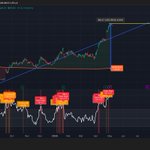
$SE looking good on the weekly, holding support from two trends that go back to 2019.
SE is sitting directly at the long-term horizontal resistance-turned-support dotted line (~$85) — the same level that capped price from 2018 through mid-2020 before the blow-off rally to $372.
After the parabolic collapse from the 2021 peak, price has built a higher-low structure since mid-2022, underpinned by a clearly ascending blue trendline.
SE is a real business with real revenue, so full swing allocation is defensible with tiered entries.
1
115
The AI trade has already bifurcated — and the unglamorous side is winning quietly. Cooling, HVAC, pipelines, grids and chip-equipment chokepoints (Vertiv +86%, Comfort Systems +99%) are absorbing rotated capital. Own AI through what it physically consumes, where the multiple risk is lower.
$VRT
28
The AI trade already made the obvious winners obvious.
GPUs. HBM. Intra-datacenter optics. All moved. In some cases 1,000%+.
What the market still hasn't priced: the infrastructure required to connect distributed AI campuses to each other.
AI clusters are hitting power ceilings inside single facilities. The solution isn't bigger data centers — it's distributed campuses linked by high-bandwidth optical networks. That creates a new bottleneck: inter-datacenter connectivity.
One research house flagged a European optical supplier this week. $100–750M market cap. 46% insider ownership. Already winning neo-cloud contracts. Still valued like a niche telecom vendor.
Lumentum re-rated when the market connected the dots on intra-datacenter optics. The structural setup here is identical — just one layer up.
Meanwhile: Berkshire is buying homebuilders. Jensen Huang is talking up MRVL. SoftBank just dropped €75B into AI infrastructure in France.
The capital knows where it's going. The question is whether you're positioned before the re-rate or after.
What part of the AI infrastructure stack is your portfolio actually exposed to?
25
$NVDA Into Intel's Territory Is a Scenario-Defining Move If Nvidia enters CPU/datacenter chip categories, the competitive dynamics for Intel become existential — not just difficult. Intel is mid-turnaround, burning cash on the foundry business, and already losing data centre GPU share. A Nvidia competitive push into traditional CPU categories compresses the one area Intel still has defensible margin. This is not priced. The market is treating NVDA and $INTC as separate stories. They won't be for much longer.

68
MSFT executed a textbook recovery off the 200W SMA + yellow horizontal support confluence (~$364–374) in March/April. That double-floor held precisely — the bounce was sharp, sustained, and now accelerating. Price has broken decisively above the prior consolidation range ($418–432), closing today at $460.52 with strong momentum candles.

45
70% probability Fed hikes again by year end. Semis at 100x revenue. New Fed Chair. Sticky inflation.
13
This week tests two things. Whether the AI hardware cycle is durable (Dell) and whether the software layer can justify a recovery (Salesforce). In both cases, the market is pricing them as certainties. They are not.
Meanwhile, the rate hike clock is ticking, and Iran deal progress is giving equities a short-term relief rally.
40
The Japan yield angle is an underappreciated macro driver. Most retail investors aren't watching JGB yields but they're one of the most significant forces in global capital flows right now.
17