

Founder, BIMP - Relationships × Product. Founder, Assura - Traditional Thrift Excluding Its Weaknesses, Digitalized.
🕯
Joined March 2024
- Tweets10.2K
- Following221
- Followers974
- Likes8.8K


Sam Bare retweeted

Your body doesn’t always need medication 💊
Sometimes it needs better food choices, enough water, quality sleep and regular movement!

Sam Bare retweeted

I know we like to dunk on the celebrating that goes on around IPOs, but every startup is a miracle.
Going public requires beating near-impossible odds, and everyone involved in making that happen should be proud.
Congrats to the @AnthropicAI team and their investors!
Sam Bare retweeted

We're all tired of seeing tweets about the Anthropic IPO but I decided to aggregate some of the wildest stats I've seen on it:
#1 Anthropic, the company behind Claude, just raised $81 BILLION in the biggest stock market debut in history. And the company is only 5 years old...
#2 When shares started trading today, the company was briefly worth over $2 TRILLION. That's more than the annual economic output of most countries...
#3 Anthropic has committed to spending nearly $900 BILLION on computing infrastructure. Yes $900 billion just to help build and run its AI...
#4 Some early employees received stock options that let them buy shares for an average of just 52 CENTS. The IPO price today is $83. That's nearly 160x higher...
And #5 One estimate suggests nearly 600 employees could each be worth over $100 MILLION from their company stock. And some of these early employees weren't even engineers or executives...
Quick note - these are estimates of stock value, not money sitting in bank accounts. But imagine taking a job at a startup 5 years ago and today potentially having generational wealth.
Absolutely wild. Huge day.

Sam Bare retweeted

eleven years ago Karim and I were in YC S15 with an app that read your inbox, found receipts, and emailed stores asking for your money back when prices dropped. we’d applied twice. Garry was one of the people who bet on us.
Paribus could see waste. we were reading hundreds of millions of emails a day and knew exactly where people overpaid. but all we could do about it was write a polite note to customer service and hope. Ramp started from the opposite question: what if you were close enough to the money movement to actually stop it?
I didn’t expect to relearn that lesson inside our own company a decade later.
early this year, AI was breaking Ramp. a handful of people got 100x more productive and whole functions fell behind them. the teams using the least AI asked for the most headcount. it got bad enough that, while we were growing revenue 100%+, we stopped hiring for a quarter.
the problem wasn’t the models. it was the same problem Paribus had. most people could see what AI could do and couldn’t let it act. we’d tell someone in sales to use Claude Code, and the first question was “what’s terminal?” then: can it see our data? our Slack? our customers? no, no, and no.
so we connected it to everything. in Q2, 7,000 pull requests at Ramp came from non-engineers, mostly our CX team. two years ago that number was zero. a customer emails about a bug, the fix ships, and the customer gets a reply the same afternoon.
I think most of the economy is stuck in that same spot. business spend on AI tokens grew more than 5x from December to August. since then it’s gone a bit sideways, even as the models keep getting better and cheaper. model progress didn’t stall. organizations did. most companies are Paribus with AI. they can see everything and act on almost nothing.
that’s the best news I can give anyone starting a company today. the advantage isn’t access to intelligence anymore. it’s being willing to let it do the work.
thank you @garrytan, for this and for betting on two guys with a refund bot a decade ago.

Ramp started with a simple promise: help companies save time and money. Seven years later, it’s a $60 billion platform running the financial operations of tens of thousands of businesses, with more than $2 billion in annual revenue.
Now, Ramp is using AI not just inside its products, but to rethink how the company itself works.
On this episode of How to Build the Future, @tryramp co-founder and CEO @eglyman joins @garrytan to talk about the company’s journey from its earliest days and how AI has made some people at Ramp radically more productive. That shift led Ramp to rethink how work gets done across the organization, and Eric believes it could eventually let even large companies move with the speed of startups again.
00:46 — Eric’s First Startup
03:02 — How Paribus Began
05:39 — Finding the First 10,000 Users
08:17 — The Idea Behind Ramp
12:57 — Agents Need the Ability to Act
14:42 — Ramp’s Next Chapter
18:28 — Why AI Adoption Is So Uneven
20:24 — The Rise of the 100x Employee
24:28 — Inside Ramp’s AI Stack
27:07 — Getting the Rest of the Company to Catch Up
29:59 — Glass: Ramp’s Company Brain
32:32 — Teaching AI How the Company Works
36:49 — Can Big Companies Move Like Startups?
39:24 — What Cheap Intelligence Makes Possible
44:23 — When Anyone Can Ship Software
48:18 — Every Software Company Needs an AI Harness
49:45 — How Ramp Finds Great Builders
52:09 — The Power of Asking for Help
Sam Bare retweeted

eve 1.0 feels like my life work even though it was just a markdown file back in March. I’m bias but I think it’s the best framework for building agents that lead to real business outcomes. And I don’t think it’s particularly close.
This is less to do with some brilliant light bulb moment and everything to do with being at a company that has access to the best builders in the world. We built this framework along side them. Every feature and API in eve went through many variations purely based on real world experience. Both internally working with different teams at Vercel and externally working with companies like Clay, Mux, Browserbase and many others.
Obviously any design can be copied and recreated in today’s token economy. In many ways it’s very flattering to see it happen. But I don’t think the stream of feedback and constant obsession over meeting that feedback can be copied in the same way. I’m very excited to keep delivering and see what people build.
vercel.com/blog/eve-is-now-g…

Sam Bare retweeted

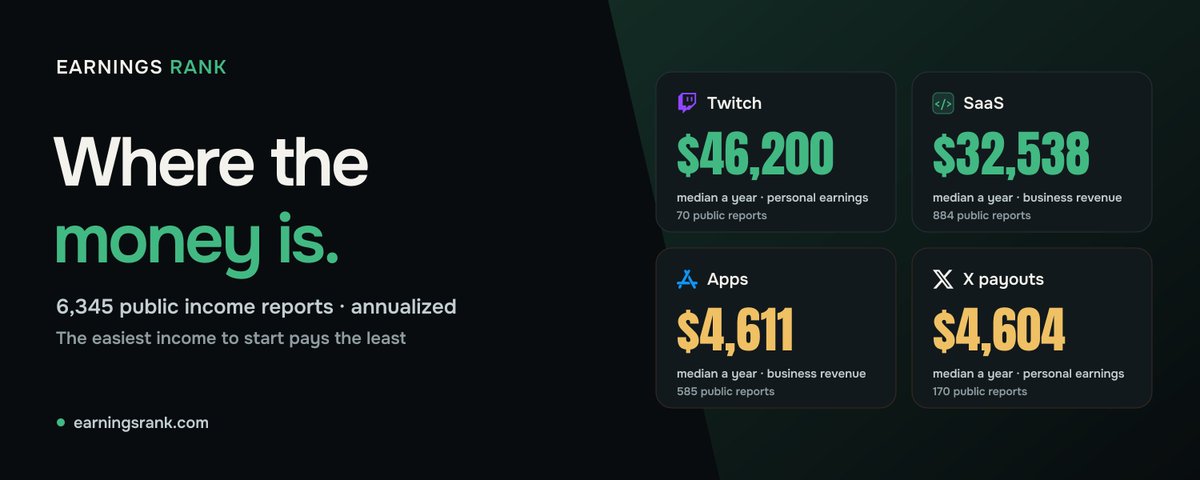
I collected 6,345 public income reports and found...
that the easiest income to start pays the least. Apps and X payouts both have a median around $4,600 a year
here's the ladder from $14K to $4.62B, and how to read anyone's revenue screenshot

Sam Bare retweeted

Looking for some great ideas for how to “persuade” the Nvidia board to bring Jensen back…
Creative, wild ideas welcome… #bringJensenBack

Nvidia board is not considering bringing Jensen Huang back as CEO, source tells CNBC cnbc.com/2026/11/16/nvidia-c…

Sam Bare retweeted

So often we think that power has changed people, when in fact it simply reveals more of who they are.
Sam Bare retweeted

.@asenkut on the duct-taped servers that let early @Google outscale everyone:
"Larry designed these crazy servers at 10 PM one night.
We all thought, 'We have all this money. Why don't we go buy servers?'
But Larry said, 'Why would I buy servers? It's a huge waste of money. They're inefficient. They're very expensive. They're not designed to do what I want.
I'm gonna buy these cheap Intel CPUs and a crap ton of disk. We're gonna literally duct tape it.'
He said, 'Sanjay is gonna run software.' Sanjay, who just started a new company with Jeff Dean, basically wrote the precursor of AWS. Just like S3. He built it inside Google 10, 15 years before Amazon did it.
We used such cheap chips and disks that it failed all the time. It pissed people off.
There was literally someone whose job was to write babysitter software that knew when things were failing.
Then when it failed, someone would literally run to the data center to plug in and replace 10 new disks.
That's early Google. Nobody rational would ever do that.
But Google scaled way faster and way more economically than people imagined because they did things like this."
Sam Bare retweeted

Big week on 20VC with @HarryStebbings and @rodriscoll.
Sequoia closed London and killed Scouts and Arc, Jensen resigned the day after we recorded, Anthropic's IPO book is reportedly 6x oversubscribed, and agents kept eating seat-based B2B.
My takes:
#1. The biggest Sequoia news wasn't London. It was winding down the evergreen fund.
Holding generational assets for decades was the best idea in venture. It launched right before stocks fell 30%, and LPs don't want to be forced to hold.
#2. Sequoia can cover Europe from the Bay above pre-seed
The best European founders are already here every month. Mati from ElevenLabs is at every dinner I go to. Pre-seed still needs someone local doing the hands-on work.
#3. On Tuesday I said Jensen needed a pass. Rory said you can hope for a pass but can't assume one. Rory was right.
He resigned Wednesday, and the CFO is now interim CEO. China comes out the biggest loser here. Selling GPUs there, or parking them just over the border, just got a lot harder.
#4. The AI trade doesn't crack on supply
Not on data centers, not on AMD taking share. It cracks only if demand cracks, and you'll see that in OpenAI and Anthropic ARR first. The $2.5T NASDAQ drop was hedge fund pods getting stopped out.
#5. I called Anthropic's IPO fatigued. A 6x book says otherwise
The $70 to $78 range isn't the price. It could still go up before pricing on Nov 18. Either way, you'd rather be Anthropic than OpenAI right now: public, with the float and roughly $200B in cash.
#6. OpenAI reaccelerated to 70% annualized revenue growth in Q3, and enterprise is now the majority of revenue
It's a two-horse race, and the next question is how price-sensitive token demand is. If you cut price 20% and usage goes up 21%, revenue grows. If usage goes up 15%, it shrinks.
#7. IC this week was Zipline at $21.5B, fal at $16B and Revolut at $115B. I'd do all three.
If I have to pick, it's fal. Sometimes in venture you have to be a tourist and ride the wave. Harry and Rory both took Revolut, which is set up to become Europe's biggest bank.
#8. Stolen AI API keys are the crime of the yea
Bot swarms are hitting everyone, and my own Claude limit had defaulted to $100K. It's better than stealing Rolexes off wrists in London. And customers can't leave their inference provider, because there's nowhere else with the capacity.
#9. Dialpad buying Ada for about $430M in stock isn't an exit
What depresses me more is that so many pre-AI companies still ship at 2021 speed. If your 2027 plan is "build an AI-native team next year," that was the 2025 plan.
#10. Cloudflare grew 39% on agents while Atlassian fell on seat growth
Agents don't care about your UX. If it's not an agentic beneficiary, I don't want to hear about it. Figma below $10B is the cautionary tale: turn down $20B, execute brilliantly for three years, and you can still end up worth half.
Rory's best line: "You could work for the next three years, do an amazing job, grow your damn company 40% a year, get the damn thing public. And at the end of that, you're going to be worth half what you are today. No one ever said capitalism was fair or easy."
youtu.be/ffh7fdwfrWU?si=g5Xj…

Sam Bare retweeted

Skyfall launched Steve, an AI "CEO" running 3 software businesses they acquired. Now they're putting $2M toward buying 5 more startups for it to run.
I love this as an experiment. P&L as the scoreboard is about as honest an eval as it gets.
My question as an investor: can an agent do the messy part? Getting the first customers, reading the room on a call, knowing when a customer is lying to be nice haha.
Maybe I'm wrong. Show me the numbers in 12 months and I'll happily eat my words :)

Sam Bare retweeted
Something founders should understand about raising venture that nobody really says out loud.
In any given VC conversation, there's maybe a 1% chance that investor develops real conviction. Conviction means they're convinced they need to be part of what you're building no matter what. They'll write the first check, they don't need a ton of diligence, and they don't need proof that anyone else is coming in.
Conviction almost always comes with something contrarian. You have an idea that might be 2, 3, even 4 years early, and you find the one investor who already shares that weird belief about the future. That's how most of the first checks that really matter happen.
Everything else is consensus. Sometimes it's consensus about a category, like every firm deciding humanoids are the future and going out to find a humanoid company, whether or not they got there from first principles. And a LOT of it is plain FOMO. A famous firm is in, so it must be good. The round is oversubscribed, so I need to be in too. If I had to guess, something like 90% of venture investments happen largely because of FOMO.
So founders should stop thinking of VCs as brilliant oracles. Most of us behave a lot more like stockbrokers. Run a tight process, create real momentum, and use FOMO to your advantage, because it works.
But if you find the person with real conviction, do whatever you can to build the company with them. That's the investor who goes to bat for you when things get hard, and things WILL get hard.
Maybe I'm being too harsh on my own industry haha. I don't think I am though.

Sam Bare retweeted

The standwithjensen.com/#letter is currently overwhelmed with requests to sign it.
Need to upgrade those servers!


