

Building Hologram
Hologram
Joined April 2013
- Tweets1.6K
- Following512
- Followers751
- Likes1.2K





Pinned Tweet
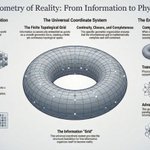
What if information isn’t just data we organize,
but a physical quantity with its own laws?
ATLAS explores a radical idea.
Information has intrinsic structure, geometry, and conservation.
🧵👇

Ilya Paveliev retweeted

🚨 Uncensored models are quietly vanishing from Hugging Face.
First “Kimi-K2.7-Code-abliterated”, now “MiMo-V2.6-Pro” and “penclaw-GLM-5.3” are hitting 404s mid-download.
“Open weights” only stay open if you self-host. Grab your local quants before your favorite repo turns into a dead link.

Ilya Paveliev retweeted

New on our Frontier Red Team blog: using Claude to formally verify software at large scale.
Formal verification can prove that code is free of certain bugs, but historically it has only been feasible for small codebases (or required a lot of expert time).
With AI models, however, this is beginning to change. In collaboration with @theoremlabs, we used Claude to prove security properties in over one hundred real-world open-source libraries over the span of a few weeks.
Read our research in full here: anthropic.com/research/forma…


Ilya Paveliev retweeted

Today, we’re announcing Bonsai 27B: the first 27B-class model to run on a phone.
Bonsai 27B is the new multimodal flagship of the Bonsai family. Based on Qwen3.6 27B, it brings a new capability tier to local AI: multi-step reasoning, structured tool use, long-context workflows, and coherent agentic loops.
Until now, models in this class have been impractical to deploy locally. A 27B model occupies roughly 54 GB in 16-bit precision, and even a strong 4-bit build is around 18GB - too large for a phone and for most laptops.
Bonsai 27B changes that.
It comes in two variants:
• Ternary Bonsai 27B: 5.9 GB, 1.71 effective bits per weight, optimized for laptop-class quality.
• 1-bit Bonsai 27B: 3.9 GB, 1.125 effective bits per weight, optimized for phone-class footprint.
Everything is open-sourced today under the Apache 2.0 license.


Looks simple.
Tried @qvac?


Local AI that you control, free to use and works offline is the goal.
Still way to go to make it less complex and as perfomant as API-based solutions.
The hardest paths often lead to the most beautiful destinations.
Excellent job @ggerganov

llama.cpp now has an official website: llama.app
Our goal is to make local AI accessible to everyone, and improving the user experience is a big part of that. On the new landing page you’ll find a single-line cross-platform installer. The installation provides a single unified `llama` entrypoint which you can use to run/serve models and interface with 3rd-party agentic applications.
While oriented towards simplified user experience, the new `llama` application also provides all the advanced functionality of the existing llama.cpp tooling with which experienced users are already familiar. Also note that all GGUF models that you might have already downloaded with llama.cpp in the past will be automatically available to use without downloading again (they are stored in the common HF cache on your machine).
We have many improvements in the pipeline both at the UX and at the engine level and we plan to iteratively ship new things over the coming months. One of the main focuses will be seamless integration with local-friendly 3rd-party agents (such as Pi). In the meantime, we’ll continue to listen for feedback from the community and adjust accordingly, so keep letting us know what you think and need.

Sovereign AI.

This may seem like the culmination of a year+'s worth of work. In reality, it's just the beginning.
We built this SDK to make local, sovereign AI easy, for everyone. Because AI should be in your hands, not in the hands of a few. I wrote more about this here: qvac.tether.io/blog/the-futu…
The future of intelligence is decentralized and fully self-custodial. And that's not happening overnight. Back to work.
Ilya Paveliev retweeted

New post on my blog:
Geometrodynamics and the Brain 🧠
In 1970, John Archibald Wheeler — the legendary physicist who coined “black hole” and “wormhole” — filled a blackboard with the deepest unsolved problems in physics: the destruction of information by black holes, the impossibility of quantizing spacetime geometry, the quantum foam at the Planck scale, and the roles of Gödel’s self-reference and Leibniz’s monads in a participatory universe.
Behind it all was his program of geometrodynamics — the radical claim that everything in physics, including matter itself, is nothing but the dynamics of spacetime geometry, and that geometry ultimately reduces to information (“it from bit”).
Half a century later, physicist Anirban Bandyopadhyay (@anirbanbandyo) at Japan’s National Institute for Materials Science has extended Wheeler’s framework into the brain. His forthcoming book, Symphony of the Helix, argues that the brain is not a chemical system driven by slow ionic currents but a geometrodynamic system in which information travels as electromagnetic vortex structures at the speed of light through nested helical architecture — from protein alpha-helices to microtubules to whole-brain circuits.
The structural parallels to Wheeler are exact: where Wheeler had spacetime foam, Bandyopadhyay has a multi-scale vortex hierarchy; where Wheeler had “charge without charge,” Bandyopadhyay has “thought without ions”; where Wheeler’s universe observes itself into existence, Bandyopadhyay’s consciousness is a self-referential resonance chain spanning every scale of the cosmos.
josephjacks.com/2026/04/05/g…

Ilya Paveliev retweeted

Love seeing this framework come out and be used for Ai Agents, Curious your thoughts @elder_plinius if if could help with prompt injection attacks/ jail breaks? uor.foundation/api
Every great library in history had one problem.
The books knew where they were. But they didn't know what they were.
Move them, and they're lost. Copy them, and you don't know which one is real. Send them somewhere new, and half the meaning disappears with them.
We've been building the internet the same way. For thirty years.
Today, that changes.

This isn't finished. It's a beginning.
And we're putting it in your hands. Open source. Fully documented. Yours to read, to challenge, to build on.
Because the best ideas don't come from one person in a room. They come from thousands of people who care enough to push back.
This is your space.
📖 Read about it: uor.foundation/blog/uor-fram…
💬 Discuss it: discord.gg/ZwuZaNyuve
💻 Build with it: github.com/UOR-Foundation/UO…
One more thing. We think this might be the most important data infrastructure built in a generation.
We could be wrong. Come tell us why.
What is the next evolution of MCP to power the era of safe, interoperable and energy-efficient Agentic AI?
Meet:
Unified Computational Substrate.
uor-foundation.github.io/UOR…
by @uor_foundation
Ilya Paveliev retweeted

1/
Transformers don't count like computers. We assume they have hidden "registers" to track variables. We were wrong.
New research by @AnthropicAI reverse-engineered Claude 3.5 Haiku and found it works with 6D helical manifolds.
It's geometry, not math. 🧵

Ilya Paveliev retweeted

"Music is liquid architecture; architecture is frozen music."
—Johann Wolfgang von Goethe

Ilya Paveliev retweeted

Plasma inside the ST40 fusion reactor, filmed in color for the first time
teapawt.net/fluxfolio_/status/1979…
