

A Family Tree DNA community project
Joined January 2017
- Tweets40
- Following23
- Followers11.5K
- Likes477


Sadece eski örneklerin düzeltilmesi gerek. Karluk, Karahanlı ve Kimek örnekleri %45-50 Doğu Avrasyalı. Avrupa Hunlarının karışmamış olanları %75-80 Doğu Avrasyalı. Diğerlerini de bu grafikte görebilirsiniz.
teapawt.net/TurkDNAProject/status/…


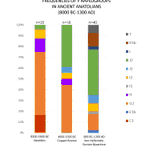
Y-DNA haplogroups in different time periods of ancient Anatolia
Neolithic (n=25) → CopperBronze (n=18) → IronHellenisticRomanByzantine (n=40)

Comparison
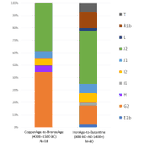
Chalcolithic-Bronze Age (4000–1500 BC) vs. Iron Age-Hellenistic-Roman/Byzantine (800 BC–AD 1400+)

Y-DNA Haplogroups in Chalcolithic and Bronze Age Anatolians
Çamlıbel Tarlası, Çorum (n=4)
İkiztepe, Samsun (n=4)
Ilıpınar, Bursa (n=2)
Yassıtepe, İzmir (n=1)
Harmanören, Isparta (n=1)
Kalehöyük, Kırşehir (n=3)
Ovaören, Nevşehir (n=1)
Devret Höyük, Amasya (n=2)


Try clicking the link to the study. See if it is propaganda or not.
As for the boycott: teapawt.net/TurkDNAProject/status/…
We are not boycotting DNA tests, we are boycotting a specific company (@Ancestry) for their updated descriptions, in which the historical events known as the Greco-Turkish War (1919-1922) is described as genocide.
Y-DNA haplogroups in Kurds
Sulaimani Polytechnic University, 2023
Source: doi.org/10.26682/sjuod.2023.…

East Eurasian admixture in various ancient (Turkic, Mongolic, Para-Mongolic and Uralic) populations
teapawt.net/TurkDNAProject/status/…
• The colored provinces are represented by their native ethnic Turkish population in terms of genealogy.
• Some provinces are represented by less than 3 individuals, they are likely to show some changes over time.
East Eurasian (occasionally referred to as East Asian) admixture in ethnic Turks of Turkey
• Not to be confused with Central Asian admixture. The medieval Turkic samples from Central Asia have a mixed ancestry of West Eurasian and East Eurasian.
Data: docs.google.com/spreadsheets…

Y-DNA haplogroups in Volga Tatars
Sample Size: 1970
Source: shorturl.at/mrvR5


The Early Medieval Slavs used in the qpAdm model are genetically close to present-day East European Slavs.

The Ottoman-era Turks (AD 1300–1650) used in the qpAdm model genetically resemble present-day west Anatolian Turks and can be modelled as a mixture between West Asian and Central Asian populations.


Early Medieval Slavic ancestry in present-day Balkan and Aegean populations
qpAdm admixture modelling of present-day Balkan and Aegean populations
Source: sciencedirect.com/science/ar…
(Data S2, Table 8)

The samples are from multiple studies. The PCA was generated using their G25 coordinates.
eurogenes.blogspot.com/2019/…

