




Pinned Tweet
Animals can’t learn by being tele-operated. But, they do learn by observing and interacting with the world around them. So, why don’t robots learn this way?
Excited to release, “Planning from Observation and Interaction”, for real-world observational learning on robots! 🧵(1/12)
Tyler Han retweeted

At #CoRL2026, many of you asked for best practices on using D&A as a robotic reward model 🧬
Here is a cheat sheet of tips & tricks to get cleaner rewards, faster inference, and a lighter hit to your wallet:
1. Inject as much prior knowledge as possible.
D&A is designed to be general, but because it’s prompt-based, you can guide any stage of the pipeline:
- Hardcode or cache object/entity names to ensure the VLM recognizes the objects in the scene and that they stay consistent across predictions.
- Make language instructions oddly specific (e.g., "pick up the hook piece, insert it, then pick up the other one and hang it"). Better instructions = better predicted success criteria.
- If you already have a rubric in mind, explicitly set the success criteria for more stable, less noisy rewards.
- Use potential-based reward shaping if the reward magnitude feels noisy or inconsistent.
- Average multiple runs per prediction if budget isn't a bottleneck.
2. Match frame density to your downstream task
- Need fine-grained rewards (e.g., offline RL)? Annotate more frames per trajectory.
- Just doing coarse subtask filtering? Annotate fewer frames.
- Rule of thumb: Larger models handle 16–64 frames well. Smaller models hit their sweet spot at 8–16.
3. Debug through the language interface
- Because D&A uses natural language between stages, inspect intermediate outputs to see where things break.
→ Missed an object? Reword the entity description.
→ Missed a subtle failure mode or subtask? Make the task instruction more specific.
- Plot success vs. failure trajectories to verify you have clean reward separation.
4. Optimize inference speed & cost
- Lower image resolution: Full resolution is rarely needed for strong performance.
⁃ Downsize the base model: Test smaller VLMs to find the best speed-to-accuracy trade-off for your task.
weirdlabuw.github.io/dna

Want to turn any VLM into a better reward model for robotics? (yes, even Astra)
Introducing D&A: decoupling description and assessment improves any VLM family for zero-shot robot rewards.
D&A scales with improvements across GPT, Gemini, Claude, Qwen, ...
It enables zero-shot RL and filtered IL, improves code-as-policies via rich language feedback, and achieves SOTA on three benchmarks.
Website: weirdlabuw.github.io/dna
Tyler Han retweeted

🌟 Peer review is the foundation of #CoRL2026. Huge thanks to all our reviewers and ACs, and congratulations to our 5 Outstanding Area Chairs and 99 Outstanding Reviewers! 👏
🔗 corl.org/program/outstanding…

Tyler Han retweeted

Come by the sim2real2field-CoRL.github.i… workshop tomorrow!! See some cool work from the @ember_ucb researchers (and so many amazing high quality submissions)!

Introducing Double-T DINER: a tool-improvement method for robot agents!
Our team at @ember_ucb built a loco-manipulation agent for the Spot dog and improved subtask completion by 23%!
Come visit us at the Sim2Real2Field CoRL workshop tomorrow at 3pm in Hilton (Salon E).
🧵
Come to Poster #32, Floor 3 from 10:30-12 to hear about how Inverse RL enables learning in deployment!

How will robots learn in deployment, where hand-designed rewards, simulators, and tele-operators are nowhere to be found?
At #CoRL2026 presenting MPAIL2, the first demonstration of on-robot Inverse Reinforcement Learning from scratch towards robots that learn from observation and interaction!
🧵 More below
1
70
Tyler Han retweeted
Come see our talk tomorrow! In addition to excellent work from NVIDIA, Ken and Lucky, @octi_zhang, @mateoguaman, and I will also talk a bit about SGS/AlphaNIST!

At #CoRL2026?
Join NVIDIA researchers and robotics leaders, including @UCBerkeley's @Ken_Goldberg and @SkildAI's @Luckyballa, for breakout sessions and community discussions on scaling training and evaluation with Isaac Lab.
📅 Wednesday, Nov. 11
🕐 10 am CT
📍 JW Marriott Austin, Brazos Room (2nd Floor)
🔗 Spots limited. RSVP here: luma.com/kwu1p419
Tyler Han retweeted

Excited to be at #CoRL2026 this week! 🤠 I'll be presenting two papers with my coauthors - come check out our spotlight paper FlowDAgger (flowdagger.github.io/) today 11/10, 5-6:30pm (poster #29 at the main poster session). We'll be talking about sample efficient adaptation of flow matching policies such as VLAs using interventions!
That's not all - also come by the Agentic Robotics workshop on Thursday 11/12 to hear about ARCHITECT (robo-architect.github.io/) where we'll be discussing how to adapt agentic policies with natural language feedback.
Feel free to reach out to chat - DM or find me at the poster!
Tyler Han retweeted

報酬もシミュレータもテレオペもない場所で学ぶロボット
観察だけで逆強化学習を回すMPAIL2
実機の上でゼロからというのが肝
報酬設計の手間が消えると展開の速さが変わる
現場のデータで育つロボットが増える
CoRL2026の発表
How will robots learn in deployment, where hand-designed rewards, simulators, and tele-operators are nowhere to be found?
At #CoRL2026 presenting MPAIL2, the first demonstration of on-robot Inverse Reinforcement Learning from scratch towards robots that learn from observation and interaction!
🧵 More below
Tyler Han retweeted

Check out our project on enabling real world robot learning using the principles of IRL along with some model based magic!
How will robots learn in deployment, where hand-designed rewards, simulators, and tele-operators are nowhere to be found?
At #CoRL2026 presenting MPAIL2, the first demonstration of on-robot Inverse Reinforcement Learning from scratch towards robots that learn from observation and interaction!
🧵 More below
How will robots learn in deployment, where hand-designed rewards, simulators, and tele-operators are nowhere to be found?
At #CoRL2026 presenting MPAIL2, the first demonstration of on-robot Inverse Reinforcement Learning from scratch towards robots that learn from observation and interaction!
🧵 More below
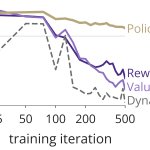
A takeaway: policy improvement itself may not need to be stabilized. Instead, actors can stably improve through interaction by planning over faster, more robust verifiers.
1
43
Website: uwrobotlearning.github.io/mp…
Paper: arxiv.org/abs/2602.24121
Code: github.com/UWRobotLearning/m…
Come find us at #CoRL2026 : Wednesday 11/11 from 10:30 - 12:00 at Poster #32. With @bxtbold, Siyang Shen, @RohanBaijal, Richard Ebock, @harine_ravi, @kevin_huang8, Sanghun Jung, and Byron Boots.
2
128
Tyler Han retweeted

Excited to share the first paper of my undergrad, Q-OIL, which we’ll be presenting at #CoRL2026 in Austin!
Interventions provide a natural source of feedback for robots to learn from in the real world. But, humans intervene suboptimally, which needs to be accounted for in both simulation benchmarking and algorithms.
We analyze human intervention data and measure intervention suboptimality in both timing and execution. Thus, rather than using interventions as supervision, we use them as soft exploration guidance.
(1/8)
Tyler Han retweeted
Want to turn any VLM into a better reward model for robotics? (yes, even Astra)
Introducing D&A: decoupling description and assessment improves any VLM family for zero-shot robot rewards.
D&A scales with improvements across GPT, Gemini, Claude, Qwen, ...
It enables zero-shot RL and filtered IL, improves code-as-policies via rich language feedback, and achieves SOTA on three benchmarks.
Website: weirdlabuw.github.io/dna
Tyler Han retweeted

Multi-arm robots can do more together, but teaching them to coordinate carefully is hard.
Introducing ScheduleGen, an automated data gen system for multi-arm manipulation.
We evaluate it in 28 sim and 8 real-world tasks including real2sim2real.
njawale42.github.io/Schedule…