

University of Cincinnati's Rocketry Senior Capstone | Formerly Queen City Rocketry
Cincinnati, Ohio
Joined January 2023
- Tweets81
- Following7
- Followers3
- Likes13



Get excited!! We're set on IREC 2027, be on the lookout for updates and follow along on our progress! 🚀

1
🚀 Excited to introduce Queen City Rocketry at @uofcincy! We're designing an innovative rocket system with a payload to compete at the Spaceport America Cup 2025. Huge thanks to Grant Schaffner, Curt Fox, and UC for the support!
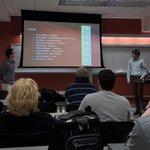
📸 Pics from our project definition presentation.


1
14
Fortunately the main parachute did not break during deployment but upon finding the rocket after touchdown its cords were tangled and the parachute appeared to not be fully deployed.
8
The force from the drogue opening is also theorized to be the reasoning for the main parachute deploying early. The two shear pins holding the upper body tube to the avionics bay prematurely broke enabling the main to deploy close to apogee.
1
10
When the drogue parachute was chosen, the maximum horizontal velocity was assumed to be less than 20 mph at apogee. The force from the wind opening up the drogue was greater than the strength of the stitching which resulted in the drogue being ripped apart.
1
4
What looks like pieces of cloth that are held together by strings used to be the drogue parachute! When the rocket took the hard angle into the wind, it started to gain a horizontal velocity, achieving a horizontal velocity of ~70 mph at the rockets apogee.


1
1
19


Believe it or not, the capsule survived its rapid descent thanks to a soft field and tree that we believe broke its fall.
Thanks to Carson Billy for all his hard work on the GUI and ground station that enabled us to view the data!
12
The capsule's parachute failed, for reasons that will be explained in a later post, and fell at 70.9 mph (104 ft/s) from apogee (7184 ft). The high speed descent speed and lack of parachute limited the capsules drift to be about 1 mile from the launch site.
1
15
Wonder what our payload capsule experienced during it's flight? No need to ponder, our live data replay for our ejected capsule is here to feed your curiosity.
1
16
It has been nonstop smiles since Saturday, but we can't decide whether it is from the successful launch and recovery of the rocket or graduation this Friday... we are leaning more towards rocket.


Have a little bit of rocket with your coffee this morning.
Our real time rail launch is then followed by a 1/8th speed video. Are you able to see the Mach diamond?
Video credits: Alex Hulteen & Sam Theil
We will be sharing more videos, images, lessons learned and experiences as the weeks progress. Thank you for joining us on this amazing journey!
For now, please enjoy our launch (we may have watched this videos a several dozen times already).
8
On Saturday, the team successfully launched our rocket and had successful ejection of the payload capsule. Battling 15 mph winds, the team was able to achieve an altitude of 7,184 ft. The rocket and payload capsule were both recovered with minimal damage.
Our payload system utilizes compressed nitrogen to expel our capsules from their bays. Table testing proved the system delivers a sufficient force to break the shear pins holding the capsules during assembly and ascent. Our balcony testing validated the parachute deployment.
On Tuesday the team presented our project at the CEAS Expo. It was a blast being able to share our project with the rest of the college and get to see some of the other amazing capstone that were worked on throughout the year!

1
7
We will use a black powder charge in the rocket sections to break the shear pins that hold the rocket together during ascent. Here is a slow motion video of us testing one of these charges and its effectiveness with separating the avionics bay from the upper body section.
7