

Official tweets from Student Financial Services at #UVA 434-982-6000 | [email protected]
- Tweets1.8K
- Following109
- Followers1.4K
- Likes171










ALT What To Do If My Contributor Doesn't Have an SSN You can immediately access your FAFSA form before completing identity validation, though you must eventually complete the process. Your identity validation status can be viewed on StudentAid.gov or via email. If you don't receive an email within the next few days or see a green check on StudentAid.gov, you need to follow the process for manual identification validation.


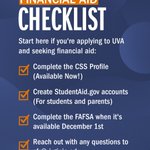
ALT Financial aid checklist. Complete the FAFSA. Complete your CSS profile (and make sure UVA is listed as one of your schools!). Check your UVA SIS portal for "To Do List" items. Respond to all communications from Student Financial Services. Reach out with any questions to [email protected].

ALT How to Submit the 2024-25 FAFSA Form Webinar flyer.

ALT Como Presentar el Formulario FAFSA 2024-25.


ALT How can I continue to receive student aid for the next school year? You will need to complete a 2024–25 FAFSA form if you will be attending school between July 1, 2024, and June 30, 2025. You and your contributor(s), if you have any, will each need your own StudentAid.gov account to complete the form.

ALT Can I share a StudentAid.gov account with my parent, child, or spouse? No, you can't share the same StudentAid.gov account with anyone else, including your parent, child, or spouse. You'll each need your own StudentAid.gov account username and password as you'll each have different tasks to do and complete.





ALT How does your repayment plan impact your payoff amount? Standard Repayment Plan: $60,462 Pay As You Earn: $53,151 Borrower details: Single tax filing borrower in Delaware with a $50,000 loan balance, 3.9% interest, and a $42,000 Adjusted Gross Income (expected increase in income of 2% per year).


ALT How to read your financial aid offer

ALT 1. Cost of Attendance - This section lists the expected cost for a year at school. Your financial aid offer may break down what is included in the estimate (tuition and fees, housing and meals; and allowances for books, supplies etc.), or it may just include a total number. Do your research to understand what is in your school's cost of attendance. 2. Grants and Scholarships - This section shows any grants and scholarships that you've been awarded. These are funds that do not usually have to be repaid. Grants and scholarships can come from your school, state, or the federal government and may be abbreviated in your financial aid offer.

ALT 3. Student Loan Options - This section shows student aid that must be repaid with interest. You may be offered a Direct Subsidized Loan or a Direct Unsubsidized Loan, which may be abbreviated to "Sub" and "Unsub." To learn about the different types of loans, visit Studentaid.gov/loans. 4. Net Cost This section shows the actual amount you will need to pay out of pocket to attend school for a year. The formula to calculate this is Cost of Attendance plus estimated unexpected costs equals total cost. Total costs minus amount of student aid you were awarded equals net cost.

ALT 5. Work Options This section will show you if you're eligible for the Federal Work-Study program. This program provides funding through part-time jobs while you're enrolled in school. Students who are awarded Federal Work-Study receive the funds in a paycheck as they earn them based on hours worked, just like a normal job. Federal Work-Study jobs may be limited and not guaranteed. 6. Additional Options This section lists other resources that can help you pay for college or career school, including PLUS loans, tax credits and any military benefits, if applicable. Some schools may also include scholarships you receive from other sources, such as local businesses or nonprofits, in this section.