

Volt-Test is a native performance testing tool for developers. Run load, stress, and scenario-based tests easily. Built for developers. Fast. Simple. Powerful.
Joined March 2025
- Tweets124
- Following5
- Followers9
- Likes5


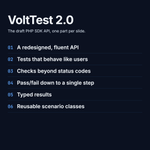



Typed results from the engine's JSON, down to one step's p99, instead of parsed console text.
And scenario classes you can share across tests. Inline and class scenarios produce the same test definition.
Draft, not released. 4/5


1
6
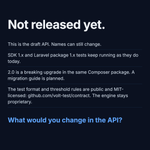
Staying on 1.x changes nothing. 2.0 is a breaking upgrade, same Composer package, migration guide planned.
The test format and threshold rules are MIT; the engine is proprietary. github.com/volt-test/contrac…
What would you change in the API?
5/5

10
We’re planning V2 of the VoltTest PHP SDK.
The goal isn’t just to add more features.
We want load tests in PHP to feel much closer to describing real user behavior:
setup & teardown
loops and conditions
per-scenario load models
richer assertions
better data handling
more control over HTTP behavior
smoother local → cloud execution
Still designing the API, so this is exactly the right time for feedback.
If you use PHP for performance testing, what would you want in V2?

22
Load tested a real Symfony app, not a hello-world endpoint.
The bottleneck wasn't Symfony. It was bcrypt: 479 ms per login at cost 13. Cost 10 moved the knee from 100 to 400 users.
FrankenPHP vs php-fpm, same app: +14% overall, 2.7x on bootstrap-heavy pages, nothing on login.
volt-test.com/blog/symfony-l…

37
Load testing shouldn’t mean repeatedly hitting one endpoint.
With the VoltTest PHP SDK, you can simulate complete user journeys:
→ Log in
→ Extract the authentication token
→ Reuse it in the next requests
→ Browse products
→ Add an item to the cart
→ Complete checkout
All written in PHP.
docs.volt-test.com

The goal is not to generate a huge request count for a screenshot.
The goal is to learn:
• When does latency start degrading?
• Which dependency fails first?
• Does the app recover?
• Can the next release handle the traffic you expect?
1
18
VoltTest Cloud is currently in closed beta.
The free beta plan includes up to 500 virtual users and 10-minute test runs, with no credit card required.
Join the waitlist:
volt-test.com
Read the docs:
docs.volt-test.com
Feedback is welcome 🙌
26
Every PHP stress testing tool you find wants you to write tests in a different language.
k6 in TypeScript.
JMeter in XML in a GUI.
Locust in Python.
Your app is in PHP. Your team thinks in PHP. Why should your stress tests live in a separate toolchain?
That question keeps bugging a lot of PHP developers. So we put together a guide we wish existed when we first tried to stress test a PHP app.
It covers the real trade-offs between the popular tools — no "best tool ever" nonsense, just what fits which team. k6 is genuinely great if your team already lives in JavaScript.
JMeter has unmatched protocol breadth. Apache Bench is perfect for a quick single-URL sanity check.
But if you're a PHP developer and you want your stress tests living right inside your project — written in PHP, installed with Composer, version-controlled alongside your application code - that's the gap VoltTest fills. A Go engine handles the concurrency. You stay in your same codebase.
On Laravel it gets even simpler, one Artisan command to hammer an endpoint, or a test class sitting in your app directory with automatic CSRF handling.
The guide also covers something easy to get wrong early on: reading results. An average latency of 74ms looks safe. But if your P99 is 2,000ms, one in every hundred users is waiting two full seconds, and the average never told you.
Tool comparison, plain PHP setup, Laravel setup, reading your numbers, and the common mistakes that make results misleading, all in one guide.
Read the full guide in reply 👇
1
41

VoltTest retweeted

A Laravel package by @elwafa90 for performance testing with the VoltTest PHP SDK ⚡️ - madewithlaravel.com/volt-tes…

500 virtual users, 10 minute runs, free.
After months of building (and a lot of testing the tester 😄 ), the VoltTest Cloud closed beta is now open, and that's what every account starts with.
It's enough load to surface the problems that only show up under concurrency: connection pool exhaustion, N+1 queries, the tail-latency spikes your averages hide.
VoltTest is load testing that stays in PHP. You write scenarios in plain PHP with the SDK - or run them straight from Laravel with one artisan flag:
php artisan volttest:run CheckoutTest --cloud
One line switches execution from your laptop to managed cloud infrastructure. No JMeter XML, no JavaScript DSL, no servers to provision.
Results land in your dashboard: throughput, P95/P99 latency, error breakdowns, and side-by-side run comparison.
Getting in takes a minute, no credit card: create your account, verify your email, and you're on the waitlist. we're approving access in waves.
And if 500 VUs is holding you back, email [email protected] . we're upgrading serious beta testers to higher packages while pricing is finalized.
Full announcement and how access works👇.
#PHP #Laravel #LoadTesting #PerformanceTesting