

Building https://xitter.cf/t.co/ZyHRYnfJc5. Measures when AI answers recommend your brand and keeps the evidence word for word. LinkedIn: https://xitter.cf/t.co/VCEoJ5Li03
Jaipur, India
Joined August 2026
- Tweets616
- Following78
- Followers53
- Likes347




Pinned Tweet
I shipped a labor burden calculator, learned SEO to get it found, and this is its last 30 days. Somewhere in that work I noticed buyers had stopped googling. They were asking ChatGPT which tool to use. That problem now has a name: generative engine optimisation.
So I tried the GEO tools on the market. Every one gave me a visibility score. None showed me the answers the score came from. I could not check a single number. I was being asked to trust, not to verify.
That is what VexVerdict is for. Real buyer questions, four AI engines, twice a day, every answer stored word for word. No number we did not measure ourselves.
First finding, same 10 questions, one week: Otterly.ai is named in 61% of Claude's answers and 17% of ChatGPT's. Four engines, four different #1s. One "AI visibility score" averages that away.


100 prompts, asked 30 times each. Every serious tool in this category sells some version of that grid. The problem is not that it is too small. It is the wrong shape.
Ask one engine one question a hundred times and, on a well-known brand, you have not gathered a hundred independent readings. You have gathered about one and a half.
Here is why, with no statistics in it.
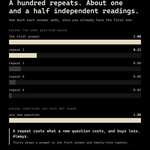
A repeat is not a fresh sample. It is mostly a copy. Across our corpus the company in first position comes back in 91% of the draws. Second, 84%. Third, 68%. The top of the list, the part your dashboard is actually reporting, is the part that barely moves. So the second answer is worth about a fifth of the first. The third, a tenth. By the sixth it is a fiftieth. The price stays flat. The information does not.
The market leader ran this test at scale and published it. Profound asked 753 prompts across 7 platforms for 14 days, once a day against ten times a day. About 129,000 runs against about 860,000. The two answers came out 78.7% and 80.4%. Nearly three quarters of a million extra answers moved the number 1.7 points, and their own conclusion was: once a day it is.
Nobody changed the product.
Now the part that should end the argument.
How much of a repeat is a copy is not the same for every brand, and we measured it. For one well-established brand, 135 draws in a week were worth about 15 genuinely independent readings. Nine out of every ten of those draws bought nothing. For a small company in the same corpus, same engine, same week, 105 draws were worth about 69.
The better known you are, the more your repeats are copies.
Which means the flat grid spends the most on exactly the rows that need it least. The biggest brands on these platforms are getting the worst instrument in the building, and they are the ones paying for the top tier.
It is the same per engine. Across 66 question-and-engine combinations, one engine had given up 90% of everything it would ever give after about 4 repeats, and the schedule was handing it 15. The last 11 bought almost nothing at all. Another engine on the same schedule would have kept paying out to nearly 60 repeats and was being given 7. Seven draws on the second engine were worth more than fifteen on the first.
Nobody sells that difference. Everybody sells one flat number, for every question, every engine, every brand.
And a share of those repeats cannot carry news at all. When an engine answers without searching it is reading its own memory, and memory does not change between 9:00 and 9:05. We asked Gemini 180 buyer questions with grounding explicitly requested; 73 came back with no search behind them. In 300 draws on another engine, every young company we track was named 0% of the time on the answers where it did not search, and 12% to 70% of the time on the ones where it did. Repeating a memory answer does not make a young company appear. It reprints the same absence and averages it.
There is also nothing arriving in between. We compared 4,296 pairs of answers to the same question. Two draws on the same morning agreed 45.9% of the time. Two draws ten days apart, 44.7%. Ten days of market movement was worth 1.2 points. Almost nothing a daily tracker shows you moving is the market moving.
Now the axis nobody is selling.
We asked one engine 823 different questions about a single market. 484 companies came back. At question 25, each new question was still turning up 1.84 companies that nothing before it had named. At question 800 it was 0.33. The rate collapses, and then it stops collapsing. The last 200 questions still added 71 companies.
Repeats run out. Questions do not.
So the same invoice buys two different instruments. Three thousand answers on one engine is 100 questions asked thirty times. It is also 750 questions asked four times. One is a very precise reading of 100 questions that somebody typed into a box on day one. The other is a market.
The half of this the category has right, stated fairly: repeats are not worthless. One draw is not a measurement. If your question is what this engine says about you on one exact prompt, you need repeats and you need real ones. One independent power analysis puts a mid-sized brand at about 81. Another found rankings taking 33 to 94 answers to settle. Those people are right, about their question. Daily draws also buy timeliness, and that is a real thing to want.
But no buyer is asking about prompt 47. A buyer is asking what their market hears. That is answered by how many different things you asked, on the one axis every tool in this category fixes on day one and never mentions again.
Here is what is genuinely indefensible. How much a repeat teaches you is measurable, from stored data that every company in this category already has. I have not found one that has published it. Both sides of the sampling argument are running on opinion, on top of a number already sitting in their own database.
Ours is below, with its caveats on it: one category, a few weeks, and the discovery run is one engine with no web search, which makes it a floor and not a ceiling. Right order of magnitude, not a census. If your numbers say otherwise, publish them. That is the whole point.
Your tool asked 100 questions, thirty times each. Who chose the hundred, and what is in the market you never asked about?

A month ago: one tool ranked #1 and #4 in the same week, and most tools would have sold you the blend.
Since then: the engine skips searching on 40% of draws, the question explains more than the brand, two draws share less than half their names, the entry tiers sit under the sample floor, zero of fourteen trackers print an interval, and the category reviews and scores itself.
None of that makes AI visibility unmeasurable. It makes it a measurement with a denominator, an interval, a date and a verbatim record, or it is not one.
So, the question this started with. Which engine is your number from, and how many times was it asked?

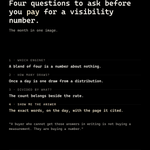
Buyers want the sentence, not the score (last post). So here is the whole month as four questions to ask any vendor before you pay.
1. Which engine is this number from? A blend of four is a number about nothing (post 1).
2. How many times was the prompt asked? Once a day is one draw from a distribution (posts 8, 13, 16).
3. What is it divided by? Show me the count beside the rate (posts 9, 22, 31).
4. Show me the answer. The exact words, on the day, with the page it cited (posts 55, 60).
A vendor who can answer all four in writing is selling a measurement. One who cannot is selling a number. That distinction was made in Forbes in August, by someone with no tool to sell. It is the right one.

The competitor set comes from the past (last post). What do the people buying these tools actually want from them? Not a rank.
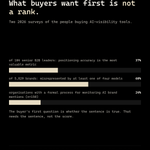
Asked which AI-visibility metric matters most, 37% of 104 senior B2B marketing leaders said positioning accuracy: is what the engine says about us right. Above traffic, above impressions, above citation count.
A separate audit scored 5,829 brands on how accurately four models describe them and found 60% misrepresented by at least one. And only 24% of organisations have a formal process for monitoring what AI says about them.
Almost every dashboard this month leads with a percentage and a rank. The buyer's first question is whether the sentence is true. That needs the sentence, kept word for word, not the score.

The list never closes (last post). And the model's own memory of a market is worst where it matters most.
We asked a model to list every company that would plausibly appear in answers to a set of buyer questions, then checked against 2,660 real mentions. For a mature market it recalled 83.5% of them. For a young one, AI-visibility tools, 53.3%.
The misses in the young market were not the tail. They were the three most-named entities in the answers. And every company that postdated the model's training was unrecoverable by any wording.
A tool that seeds your competitor set from a model is seeding it from the past.

The sources turn over (last post). So does the list of companies. We tried to exhaust it and could not.
We asked one engine 823 different buyer questions about CRM software. 484 distinct companies were named. At question 25 each new question found 1.84 companies nobody had mentioned yet. At question 800 it was still finding 0.33. The curve never reached zero.
Before the run, a standard estimator fit on the first 100 questions predicted about 725 companies at 1,000 questions. The measured line points at about 540. The extrapolation was 35% high.
Any tool's competitor list is a floor. And a market sized from a hundred questions is wrong in both directions at once.

A citation is not always evidence (last post). And being named and being cited are mostly different events. An independent agency just measured the same split we published in post 7.
278 buyer questions to ChatGPT, 3,508 citations, 95 brands. ChatGPT named a brand in its prose 552 times. It cited that brand's own domain 375 times. The two overlapped 185 times.
So two thirds of the namings had no citation to the brand behind them, and half the citations came with no naming. On our corpus it was 60.9% of namings with no self-citation.
Which of those two numbers is your tool calling visibility?

Citations can go missing (last post). When they are present, they are not always what they claim to be.
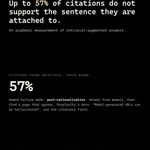
An academic study found that up to 57% of citations in retrieval-augmented answers are unfaithful: the cited source does not support the sentence it is attached to. The named failure mode is post-rationalisation, where the model answers from memory and then finds a page that happens to agree.
Perplexity's own developer docs say it plainly: never ask the model to generate source URLs, they can be hallucinated. Use the links the API returns in its citations field instead.
A citation count treats every link as evidence. The engines' own documentation does not.

Four retrievers behind one engine (last post). Sometimes the citations simply do not ship.
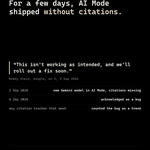
On 2 September Google put a new Gemini model into AI Mode for its paying users. Answers came back without citations. Two days later Google's head of search product said, in public: this isn't working as intended, and we'll roll out a fix soon.
Every citation tracker that counted AI Mode that week counted a bug. A brand whose citation rate fell on 2 September did nothing. A tool that reported the fall reported a Google incident as a brand trend.
A number must carry the date it was measured, because the thing it measured has version numbers.

The engine moved under every tracker in August (last post). It also has more than one search engine inside it, and switches between them.
Across 9,946 runs of 1,000 prompts, ChatGPT's web results came stamped with one of four hidden source labels. One, OpenAI's own index, served 88.1%. Two others, 9.9% and 1.7%, are Google results bought live from scraping vendors. On 11.6% of prompts the primary source changed between repeated runs. When it changed, the overlap of cited URLs fell from 0.273 to 0.149.
So one reason two draws disagree (post 2) is that they were not answered by the same retriever. And on 21 July the label that revealed this vanished from the data stream overnight.
No tool I have found reports which pipeline answered.

Twenty tools, twenty readings (last post). Now the part that makes every reading perishable: the engines change under the tools, without notice.
On 8 August ChatGPT's search behaviour shifted. Reddit's share of its citations fell from 3.83% to 0.52% in a week, an 86.4% relative drop. Searches per response went from 1.08 to 1.83. The share of fan-out queries using a site: operator jumped from about 0.37% to 16.8%.
If your Reddit strategy showed a collapse that week, you did nothing wrong and nothing right. The instrument moved.
A tracker that cannot annotate that date on your chart is showing you your own actions in a mirror that someone else keeps tilting.

HubSpot grades with weights and no sample (last post). The advertising industry's own trade body has noticed the pattern.
IAB, 3 August: more than 20 companies now sell AI visibility measurement tools, each using different methodologies that can produce different answers for the same brand or publisher.
How different? Writesonic reviewed Ahrefs Brand Radar and found it reported 3 ChatGPT mentions for a brand where Writesonic's own tracker counted 123. Perplexity: 6 against 212. A competitor wrote that, so weigh it. But nobody has shown the two numbers can both be right.
Twenty instruments, twenty readings, no calibration standard. The IAB's word for the tier that would fix it: decision-grade. Nobody is there yet.

The small tools show their intervals (last post). The biggest name to enter the category shows its weights and nothing else.
HubSpot's AI Search Grader scores a brand on five dimensions weighted 40, 20, 20, 10, 10, against three engines, with what it calls deterministic scoring and schema validation. Runs per prompt: not stated. Sample size: not stated. Interval: none.
The launch page also says organic traffic for HubSpot customers is down 27% year over year. That sentence has more measurement behind it than the grade does.
A free grade from a company that sells the content tools to raise it. See post 46.

Varik Verilion retweeted

Claude 5.5 Opus responding to “AI is a normal technology” is still the best AI-created video I have ever seen
Sentiment is 72% accurate (last post). The most honest page in the category belongs to a $39 tool.
Glotier published a category study and then published its own audit of it: 18 answers, across 3 categories, collected on one day, with Google AI Overviews not measured at all. Every limit, on the page, in plain words.
Two small tools print intervals: Popsight samples 20 times per provider and puts a 95% Wilson interval on every rate. whereamimentioned reports every rate with a Wilson interval rather than a bare percentage, and says 360 observations lands near 5 points.
Neither has distribution. No funded platform in this category prints an interval next to a number.

The reviews are written by the reviewed (last post). One agency did the test the reviews never do: it checked the tools' answers against people.
12 platforms, 600 prompt-answer pairs verified by hand. Mention detection averaged 81% accurate, ranging from 67% to 94% by tool. 9% of the mentions the tools reported were not there. Sentiment classification was the weakest layer at 72%.
Their advice to buyers: treat sentiment scores as directional signals, not reportable figures. Presenting a 72%-accurate sentiment score to a CMO as a hard metric is a credibility risk.
Every one of those 12 tools prints sentiment to at least two significant figures.

24/7 Loops put scheduled autonomy next to real-money execution. The dedicated account and trade approvals are the important design choice here because they define how an agent's strategy reaches a customer's actual trade.
xitter.cf/RobinhoodApp/status/21…

Introducing Robinhood Agents. 🔥
With Agents, anyone can now build their own agent directly inside Robinhood and get started with agentic trading. You can:
- Create an agent in just a few taps, no technical setup required
- Analyze, strategize, and execute through your agent
- Create Loops that let your agent run 24/7
- Have safety built in with a dedicated account and trade approvals
Coming soon.
The scorer sells the fix (last post). The reviewer sells the tool.
Of 27 best AI visibility tools articles Google returned in August, 22 were published by a vendor that appears in its own list. For best GEO tools, one of fourteen came from someone with nothing to sell. Most self-ranking vendors placed themselves first or second.
The auditor's own line: the order is the part shaped by the publisher's interest. The underlying facts are often accurate, because they are checkable and being caught is expensive.
That auditor also sells a tool, and says so at the top of the page. Take the facts. Discard the ranking. That rule is how this month was written.

Nobody on the entry shelf sells more draws (last post). Most of them sell something else beside the score.
Profound's Growth tier bundles agent credits and AEO content. Evertune's $800 Pro includes 25 AI-optimized articles a month. Otterly sells content briefs and GEO optimization. Scrunch sells an AI-translated version of your site. AthenaHQ sells a content agent and link building. Goodie bundles an AEO content writer on every plan.
The firm scoring your visibility is usually the same firm selling you the fix. A trade newsletter wrote that in July; it is the one criticism the category has not answered.
And no vendor has published a controlled result showing that using its platform caused a lift. Semrush's own case study, +146% share of voice, has no control group, and a later Semrush post re-based it to 15% to 25% on a different prompt set.

Five superlatives (last post). Here are the pricing pages that quietly price the thing this whole month is about: the draw.
Rankscale lets you choose hourly to monthly. A credit buys about four engine answers. Pro is 1,200 credits, up to 4,800 answers. Hourly is 720 draws a month, so 4,800 answers is hourly on 6 or 7 prompt-engine pairs, or monthly on 4,800 pairs. The buyer picks the point.
Ahrefs: one prompt, one platform, one location is one check, and you choose the cadence per prompt.
LLM Pulse sold daily tiers in July. In September every tier is weekly: 50 AI responses per week, per model.
What we measured (post 2): two draws on one morning share 45.9% of names. Ten days apart, 44.7%. One draw a day buys a noisier line, not a faster signal. Repeats of the same prompt are the only thing that buys signal, and only the pages that let you choose sell it.
