

The Evidence Layer for AI. Cryptographic Sealed Evidence Records — Court-Preparable Proof your AI output is what it says it is. The record survives the verdict.
Houston Texas
Joined February 2025
- Tweets50
- Following74
- Followers28
- Likes1.7K





Pinned Tweet
Every AI output is now a potential exhibit.
LangSmith traces and Datadog logs don't survive cross-examination. A Sealed Evidence Record does: SHA-256 + Merkle root + Sigstore anchor + chain of custody.
Seal one yourself, in-browser, no install:
verdict.systems/live-seal?re…
11
262
The clause, Sections 15(d), 15(f) and 17(d):
wellsfargo.com/online-bankin…
The seal in the film is on Sigstore's public log, index 3838881606:
search.sigstore.dev/?logInde…
Seal one line free, no account:
verdict.systems/live-seal
1
3
20

What that proves: the record hasn’t changed since it was logged, and it existed no later than the log’s timestamp. It doesn’t show the event happened or who made the record.
Spec, 24 test vectors and verifier:
github.com/verdictsystems/se…
@

3
Verdict seals each record and posts it to Sigstore Rekor, a public log we don’t run. A rewritten record can’t get last month’s timestamp.
Check one of ours without asking us:
search.sigstore.dev/?logInde…
5
22

Momentum is building!!

A Google open-source agent governance repo merged a Verdict adapter six days after I opened the PR. Then its maintainer wrote 4 live tests that hit our API over the wire.
AI agents are starting to move money, read patient records and sign contracts. When something goes wrong, someone will ask what the agent did. A log the operator can edit won't settle that.
Verdict seals what the agent did and anchors it to Sigstore Rekor, a public log we don't run. Anyone can check a record without asking us. The spec, 24 test vectors and verifier are open under Apache 2.0.
Right now I'm closing our first paid design partner. We meet every week with an insurance partner. A sovereign AI company in the Gulf has asked to build with us. And we filed comments on the NAIC's draft for evaluating AI risk at insurers.
If your agents will answer to an auditor or insurer, DM me.

3
86
VERDICT retweeted

A Google open-source agent governance repo merged a Verdict adapter six days after I opened the PR. Then its maintainer wrote 4 live tests that hit our API over the wire.
AI agents are starting to move money, read patient records and sign contracts. When something goes wrong, someone will ask what the agent did. A log the operator can edit won't settle that.
Verdict seals what the agent did and anchors it to Sigstore Rekor, a public log we don't run. Anyone can check a record without asking us. The spec, 24 test vectors and verifier are open under Apache 2.0.
Right now I'm closing our first paid design partner. We meet every week with an insurance partner. A sovereign AI company in the Gulf has asked to build with us. And we filed comments on the NAIC's draft for evaluating AI risk at insurers.
If your agents will answer to an auditor or insurer, DM me.
A German court just drew the line the AI industry has been avoiding.
On May 28 the Munich Regional Court ruled Google is directly liable for what its AI Overviews say. Not a neutral intermediary passing along links. The author. Its AI had tied two real publishers to fraud schemes, and the connections it asserted appeared in none of the sources it cited.
The reasoning is the part every AI builder should read twice. A search engine points at other people's pages. An AI answer evaluates, combines and rewrites those pages into a new statement, and that statement is the operator's own speech. "Created with AI" does not hand the liability back to the user.
It is a preliminary injunction and Google can appeal. But the direction is set. If your product generates statements about real people or real businesses, you own those statements. "Our AI sometimes gets it wrong" stops being a disclaimer and starts being an admission.
Which makes one boring question matter enormously: can you prove exactly what your AI said, when it said it, and on what basis? Not a log you could have edited last night. A record that holds when the other side is a court.
That is the layer we build at Verdict. Not because hallucinations are exciting. Because the moment you are legally the author, the evidence of what your system actually did stops being optional.
verdict.systems

1
11
315
Voice agents just got dramatically easier to ship. So a lot more AI is about to take real actions, out loud, for real companies.
Your AI will be questioned. Voice doesn't change that. It raises the stakes.
Build the agent. Seal the action.

5
32
The first billion-dollar AI verdict won't ask whether the AI did it.
It will ask what evidence proves it.
LangSmith traces and Datadog logs don't survive a Daubert challenge. Sealed Evidence Records do.
verdict.systems

10
60
Sakana Fugu routes one request across multiple model providers and won't show you which did what.
Great for a coding sidebar. A liability the second it drives a regulated decision.
Black-box routing produces no chain of custody. The deployer is the defendant.
Seal what the orchestrator won't show you.

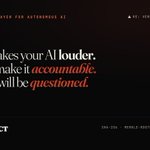
Your AI's logs can be edited. That's the whole problem.
A log file proves nothing if whoever holds it can rewrite it. That's not evidence, it's a Google Doc.
Verdict writes a cryptographic seal of every AI output to a public append-only log the instant it happens. Nobody can quietly change it after. Not you, not us.
Evidence you can't edit, or it isn't evidence.

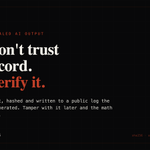
Every AI vendor says "trust our output."
Wrong word. Trust is what you ask for when you can't prove it.
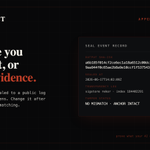
Verdict seals the AI's output the moment it's generated, hashes it, and writes that hash to a public log anyone can check. Tamper with it later and the math stops matching.
You don't trust the record. You verify it.

Yesterday we anchored a legal fact into a public transparency log that can never be edited.
Cost: $0. Time: 10 seconds. Verifiable by anyone, forever.
Here is why this matters for every AI agent that touches real money 🧵
1
9
33
This is not a mockup. Seal a fact yourself right now — in your browser, no install, no signup:
verdict.systems/live-seal
You get a real entry in a public transparency log, with a verify link anyone can check independently.
1
9
17
AI agents are about to act on real capital at scale. The companies that can PROVE what their agents did will win the audits, the lawsuits, and the insurance pricing.
We are building that evidence layer in public.
Follow @VerdictSys to watch it happen.
9
13