

Headteacher | NPQH | Future Leader | FCCT | SLE | BSc | PGCE | MEd | WomenEd RL | T&L | CPD | DSL | Wife | Mum | Woman | 3 Dog wrangler| slow runner
Sheffield, England
Joined February 2016
- Tweets7.6K
- Following2.4K
- Followers1.6K
- Likes9.4K









Victoria Hall FCCT MEd NPQH retweeted

In 2023, a coroner found the distress caused by an Ofsted inspection contributed to the death of Ruth Perry, a head teacher who took her own life.
Ofsted promised to reform its processes.
But instead of removing high-stakes, graded judgements from its reports - as has been successfully achieved in Wales and Northern Ireland - it has proposed to give *even more* graded judgements.
Schools want accountability, but not at the cost of staff mental health. There is another way.
Help us help schools by telling Ofsted what you think: bit.ly/42m3zG0
Victoria Hall FCCT MEd NPQH retweeted

Children love being successful and hate being scared. Don’t we all. Don’t bark at them; teach them how to do it. @tombennett71 @researchED_US

Victoria Hall FCCT MEd NPQH retweeted

Lowering behavioural standards leads to worse outcomes for students, higher absence, and increased staff turnover. As night follows day.

In Los Angeles reductions in suspension rates were followed by decreased GPAs & test scores and increased student absences and teacher turnover particularly for inexperienced teachers. That said there were small achievement gains for at-risk students:
bit.ly/4bdK0ni ($)

Victoria Hall FCCT MEd NPQH retweeted
Gentle reminder: if a school has a suspension or exclusion rate higher than the national/area average, it's ridiculous to get self-righteous about it because:
1. Some schools deal with larger, more challenging cohorts than others, and consequences are more frequently required
2. Lot of schools still don't suspend when they probably *should*.
3. Unless you can point to a suspension/ exclusion where the law and the school policy wasn't followed, then you should probably park your moral outrage and let people leaders do their job and manage school culture. Because these are perfectly legitimate tools to create safe environments.
Victoria Hall FCCT MEd NPQH retweeted

And in case you missed it this summary of the BRILLIANT Teach Like A Champion 3.0 by @Doug_Lemov, here it is!
tinyurl.com/2s4d9xbh


Victoria Hall FCCT MEd NPQH retweeted

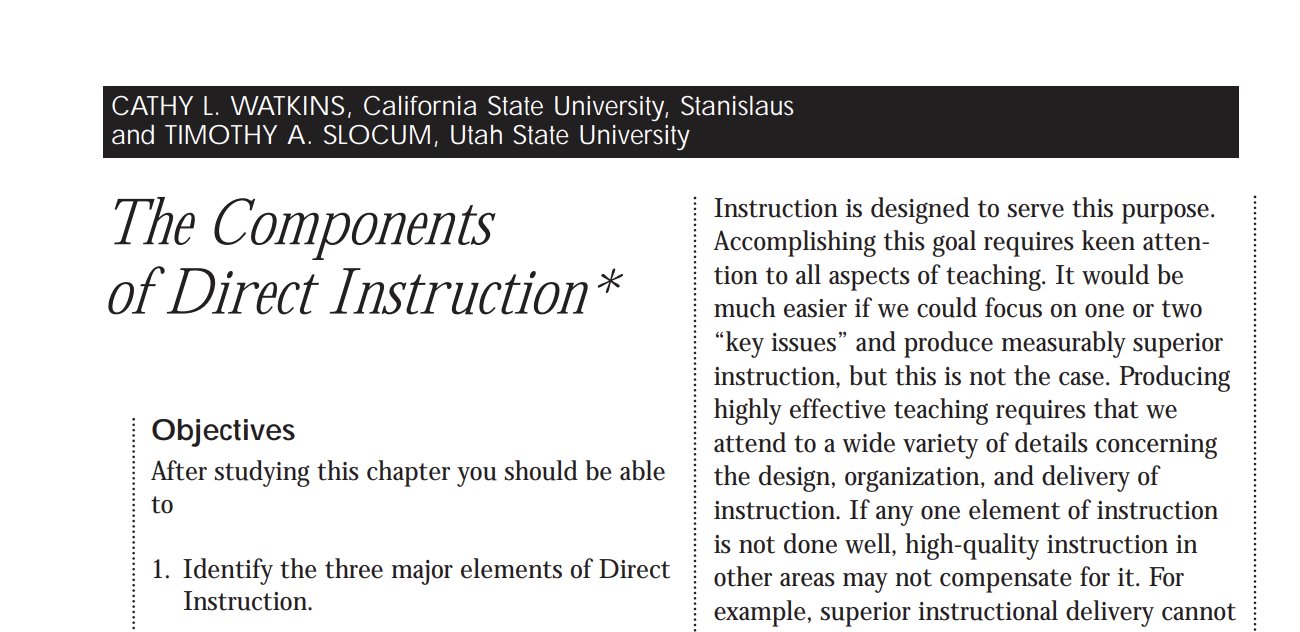
This 36-page summary of Direct Instruction (DI) is excellent. And free, from: nifdi.org/research/journal-o…
Thanks @Kris_Boulton for the recommendation, in the equally excellent podcast (Progressively Incorrect) by @MrZachG recently.
Victoria Hall FCCT MEd NPQH retweeted

Teenage sensation Luke Littler has won the World Darts Championship after comfortably beating Michael van Gerwen in the final at Alexandra Palace.
🔗 Read more trib.al/NWCFm6B

Victoria Hall FCCT MEd NPQH retweeted

Some news: Alongside my (amazing) co-authors @EricaWoolway & @ColleenDriggs I've just finished a new book, "The TLAC Guide to the Science of Reading." Here's a bit more about it:
Victoria Hall FCCT MEd NPQH retweeted

A reminder our offices are currently closed and will reopen from 2 January 2025.
We hope you are enjoying a well-earned rest, however if you do need to get in touch with us, our Hotline service for #ASCLmembers is still available - details at ascl.org.uk/hotline

Victoria Hall FCCT MEd NPQH retweeted

I'm super interested in shouting discourse
I don't advocate shouting, and never shout personally. But I do use my diaphragm voice a lot, to make a sound which is very loud, but deep. There's no throat sound in it, and it (hopefully) sounds commanding rather than angry.
I imagine some would call that shouting
Victoria Hall FCCT MEd NPQH retweeted

‘A strong school culture is taught not caught’
@LHS_HighSchool we have codified our core routines so that we can build consistency to create our social norms 😊
Our culture playbook provides guidance for the following:
Longdendale phrases ✅
Line ups ✅
STAR ✅
STEPS ✅
Corridor transitions ✅
Rewards ✅
Appreciations ✅
Aspiration briefings ✅
@mel_mwicks
#TheLongdendaleLegacy


Victoria Hall FCCT MEd NPQH retweeted
1 in 3 support staff verbally abused every day. Yet frequently they are the lowest paid and least trained members of staff, despite being responsible for the most challenging students. A predictably chaotic situation. theguardian.com/education/20…

Victoria Hall FCCT MEd NPQH retweeted

Anyone else have an issue with the idea that highly effective leaders are mysteriously not found in large numbers in 'low attaining or disadvantaged schools'. Like the Ofsted framework, it finds if you measure effectiveness without context then...
tes.com/magazine/news/genera…


Victoria Hall FCCT MEd NPQH retweeted

'Overcrowded special schools are being pushed towards crisis point', the latest damning Ofsted SEND inspection has revealed
buff.ly/3UPPLAF
Victoria Hall FCCT MEd NPQH retweeted

I really like rock hyraxes:
✔️small- to medium-sized mousey-bear-deer
✔️occasional hairy head tufts
✔️look as tho a 5 yo drew their front teeth
✔️stand on rocks looking quite relaxed
✔️elephants' closest land-dwelling relative
✔️AmAZing eyebrow whiskers
✔️bona fide disney eyes


Victoria Hall FCCT MEd NPQH retweeted

How learning happens in seven general principles ⬇️
1. Working Memory Capacity is Limited: Our working memory, responsible for holding and processing information in real-time, has a limited capacity. This limitation means that when learners are exposed to large amounts of new information simultaneously, they may struggle to process it effectively. Focusing attention is essential because distractions or overload can lead to cognitive strain, reducing the ability to learn. Teachers can support this by breaking information into manageable chunks, allowing students to engage deeply with smaller parts before moving on to the next concept.
2. We Learn Through Meaning and What We Already Know: Learning is enhanced when new information connects to existing knowledge. When learners relate new content to things they already understand, they create a stronger foundation for retention and comprehension. This process, known as schema-building, helps students make sense of complex ideas by fitting them into an established framework. Teachers can facilitate this by introducing new concepts through familiar examples or linking them to relevant prior knowledge, making learning more meaningful and long-lasting.
3. Novices Think Differently Than Experts: Novices often approach tasks with means-end analysis or trial-and-error methods or simple strategies because they lack the knowledge to recognize patterns or apply sophisticated approaches. In contrast, experts draw on rich mental models, using prior experiences and refined techniques to solve problems more efficiently. This difference means that novices need structured guidance to develop these mental models over time. Teachers can help by gradually introducing students to expert strategies, enabling them to progress from basic skills to more advanced understanding.
4. To Remember, We Need to Forget: Storage strength is the measure of how well information is embedded in long-term memory, indicating its durability over time.
Retrieval strength is the ease with which information can be accessed from memory at a given moment, which fluctuates based on recent use and context. Unlike storage strength, retrieval strength is influenced by context and interference from other information. To remember something long-term, it’s essential to boost its retrieval strength, which can be achieved by actively retrieving the information. Unlike passive studying, retrieval requires you to recall the item on your own, strengthening memory more effectively, especially when the retrieval is challenging. This principle explains why strategies like interleaving (alternating topics) and spacing (spreading out sessions) are so effective. By allowing time for slight forgetting, these methods make retrieval harder, ultimately enhancing memory retention. This “adaptive forgetting” is crucial for retaining core concepts.
5. Learning ≠ Performance: A high test score or good performance in the classroom doesn’t necessarily mean that true learning has occurred. Learners might perform well temporarily by memorizing facts or rehearsing specific methods without understanding the underlying concepts. This principle highlights the difference between short-term performance and deep, long-term learning. Effective assessment should look beyond scores to evaluate true comprehension. The rate of assessment matters which is why regular checking for understanding is so important. Teachers can use open-ended questions, application tasks, and reflective discussions to gauge whether students genuinely understand the material.
6. Achievement Leads to Motivation: Success in learning (however small) can foster a positive cycle of confidence, self-efficacy, and motivation. When students achieve their goals, even in small steps, they are more likely to believe in their ability to succeed in future learning tasks. This sense of accomplishment encourages them to take on new challenges and persist through difficulties. Teachers can support this cycle by setting attainable goals, providing regular feedback, and celebrating incremental progress to reinforce students’ confidence and motivation.
7. Learners Are Bad at Knowing How to Learn: Many students are unaware of effective learning strategies, often relying on passive techniques like re-reading, highlighting, or cramming. These methods feel productive in the short term but are less effective for long-term retention. Evidence-based strategies like retrieval practice, spaced learning, and interleaving have been shown to improve memory and understanding, but students may need guidance to adopt these methods. Teachers can enhance learning outcomes by teaching students about these techniques and encouraging their use, helping students develop more efficient and powerful study habits.
(Thanks to @MrAlexKoks for the design)

Victoria Hall FCCT MEd NPQH retweeted

🚨 NEW POST 🚨
‘Disciplinary Literacy: 50 Years of Failure’
“Various curriculum updates over the last 50 years have paid too little heed to the difficulty of mediating the complex reading, writing, & talk moves undertaken in the different disciplines.”
alexquigley.co.uk/disciplina…
