
Aspiring civic artist working to develop opportunities for the creation of enduring aesthetic, economic and social value.
Charleston, SC
Joined June 2009
- Tweets1.4K
- Following106
- Followers1.8K
- Likes209


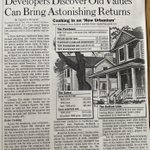




Agree! Especially with Geoff, his lovely daughter Rhea, and the building’s architect standing in front of it!


Vince Graham retweeted

Moses also told Charleston, "Don't try to compete with other cities. Let other cities which do not have as much tradition use more modern structures. The most important thing is not to move away from the colonial architectural values. Traditional things should be emphasized."

“The medium is the message.” ~Marshall McLuhan
Settlement patterns shape how we live. Walkable places offer independence through proximity. Auto-centric places make it conditional on cars and the roads built for them. When daily life requires these media, consumption becomes a condition of independence.

Related…“Word spread quickly about how the tight quarters [of Newpoint] have their biggest benefits certain times of the year…’At Halloween, it’s maximum candy for minimum effort.’” The Wall Street Journal (Dec. 4, 1996).


If you have only one guiding principle in building a neighborhood, maximizing trick-or-treatiestness would be a pretty good one.
North Shelmore Boulevard in I'On ranked among the nation's best streets for trick-or-treating.
HT @VincentGGraham


Vince Graham retweeted

If you have only one guiding principle in building a neighborhood, maximizing trick-or-treatiestness would be a pretty good one.
North Shelmore Boulevard in I'On ranked among the nation's best streets for trick-or-treating.
HT @VincentGGraham
Vince Graham retweeted

If traffic engineering were an applied science, Paris would have more stop signs than Peoria.
But it doesn’t. Traffic engineering is politics.
On Double Take, @dakotadeady breaks down the politics of stop signs.
youtube.com/watch?v=Z7-ugL4L…

Nice piece on Mugdock Castle, Sullivan’s Island, SC. postandcourier.com/business/…

Cycle 1: the product offered, isolation, is scarce. Growth eats the product. An epidemic of loneliness & divisive politics results.
Cycle 2: Growth enhances the offer.
The modes do not share a gearbox. You can’t run Cycle 2 through Cycle 1 streets and expect belonging to appear.


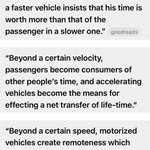
Perhaps the best, but least known work on transportation equity is Ivan Illich’s 1973 book, “Energy and Equity.” In it he postulates a “speed class” hierarchy within society.


Never thought I’d be saying this, but go SCDOT! A Traffic Calming Study underway at Doughty and Rutledge Street next to Ashley Hall School in downtown Charleston.
Vince Graham retweeted
Last week, @nntaleb welcomed me to his library for a casual @yeomanpodcast discussion. After a late afternoon Turkish coffee, we discussed books, techno-feudalism, immigration, China, AI, and more. Thank you, my friend, for another great conversation.
yeomanpodcast.com/2026/08/07…

Modernist SUBurbanism = AE (Artificial Environments). “There is a quality even meaner than outright ugliness or disorder, and this meaner quality is the dishonest mask of pretended order, achieved by ignoring or suppressing the real order that is struggling to exist and to be served.” ~Jane Jacobs


Brought to mind Frédéric Bastiat’s famous 1850 essay “That Which is Seen and that Which is Not Seen,” especially the section on Public Works. Despite clear failures of distortionary policies like zoning and road subsidies, they are perpetuated by special interests and bureaucratic inertia. Imaginations are stunted.
bastiat.org/en/twisatwins.ht…
“In his famed Fourth of July address, Frederick Douglass implored us to think critically:
“The feeling of the nation must be quickened; the conscience of the nation must be roused; the propriety of the nation must be startled; the hypocrisy of the nation must be exposed; and its crimes against God and man must be proclaimed and denounced” (p. 366).
Douglass argued that before a wrong can be righted, the wrong must be felt. A hundred years prior, Paine understood this, for he said that “A long habit of not thinking a thing wrong gives it a superficial appearance of being right.”
The job of a planner, and the job of a writer, which I feel compelled to do, is to question the familiar.”
- Billy Cooney, American Land Use at 250
Published at @SouthernUrb
southernurbanism.org/p/seein…
Vince Graham retweeted

QUOTE: When I began writing for Common Edge almost a decade ago, I resolved to let readers know when a significant book appeared that might change their view of architecture, urbanism, and landscape. I missed the publication of one book that I have subsequently used in my practice, and believe to be one of the best handbooks, histories, and teaching texts written in the present century. This year, a revised edition of Street Design: The Secret to Great Cities and Towns (John Wiley & Sons) was released. Co-authored by John Massengale and Victor Dover, I was delighted to have watched it emerge over several years as a friend of Massengale’s. commonedge.org/why-better-st…

Excellent! “The early 20th century planning movement drew on the same currents that produced scientific management, public-health campaigns, and, in some quarters, eugenic thinking about improving the human stock through social separation.” Along with zoning, the same progressive hubris produced misguided fiscal and transportation policies that plague us today.

AMERICAN LAND USE at 250: Essay 1/5
Euclid at 100
____
This November marks the centenary of Village of Euclid v. Ambler Realty Co. — the ruling that constitutionalized modern zoning and changed everything.
What started as a Cleveland suburb’s attempt to protect “residential character” became the legal foundation for restricting property rights, limiting housing supply, inflating prices, and entrenching exclusion. The majority opinion even labeled apartments “parasites.” Newton D. Baker, arguing for Ambler, warned it would lead to politicized control, outdated plans, and a slow erosion of the constitutional right to property — essentially “communistic ownership and control” by local councils.
A century later, the results are clear: #NIMBY power, housing shortages, reduced mobility for working families, and barriers that hit lower-income and minority communities hardest.
At America’s semiquincentennial, it’s time to revisit this precedent. The arc of justice is long — Euclid doesn’t deserve a bicentennial.
Was Euclid a necessary evil or a foundational mistake? 👇
Read Aaron Lubeck’s sharp, timely essay: (viaBio)
#ZoningReform #Housing #Urbanism #SCOTUS @IJ @pacificlegal #YIMBY
Many are dependably concerned about AI, while being completely unaware of and uncaring about the 100+ year-old set of distortionary fiscal, land use and transportation policies that enable and perpetuate AE (Artificial Environments).
“There is a quality even meaner than outright ugliness or disorder, and this meaner quality is the dishonest mask of pretended order, achieved by ignoring or suppressing the real order that is struggling to exist and to be served.” ~Jane Jacobs
