

hunting alpha in quant, math and ai - none of it secret.
San Francisco
Joined June 2026
- Tweets1.1K
- Following152
- Followers3.4K
- Likes2.1K


Voltex retweeted
Jack Bogle could have been one of the richest men on Wall Street. He chose not to be, on purpose.
He built Vanguard so it was owned by its own investors instead of by him. That one decision has saved ordinary people hundreds of billions in fees, money that would have gone to managers who mostly lose to the market anyway.
his advice never changed in 40 years.
"don't look for the needle in the haystack. just buy the haystack."
"in investing, you get what you don't pay for."
no stock picks. no leverage. no edge you have to be a genius to find. just own everything, pay almost nothing, and never sell.
it quietly beat most hedge funds, most quants, and almost everyone who was sure they were smarter.
he gave away the whole game for free, for decades. the industry's survival depends on you not listening.
Voltex retweeted
the house edge on an american roulette wheel is 5.26%
that is small. small enough that any single player beats it about half the time, and that is exactly the design. the operator is not betting against you. it is betting against the count.
play 100 spins and you are ahead 29.9% of the time.
play 1,000 and it is 4.8%.
play 10,000 and it is about one in fifteen million.
the edge never moved. only n did.
at $10 a spin that is $526 of expected loss over a thousand spins, no matter how any individual night felt.
the same four parts run a trading desk: a small fixed edge, volume big enough for the law of large numbers to bind, sizing capped below ruin, and capital that outlasts the drawdown.
a desk missing any one of them is a player, not a house.
full breakdown below:


Voltex retweeted
In 1968 one engineer sat on a stage in San Francisco and demoed the mouse, windows, hyperlinks, video calls and live shared documents.
The computer running it filled a room. The internet did not exist yet.
His name was Douglas Engelbart. 1000 people watched him drag a wooden box with a wire tail across a screen for the first time in history.
He opened documents by clicking words. He edited text live. He linked to a colleague 50 kilometers away and they worked on the same screen together, faces in the corner.
Nobody in that room had ever seen any of it. Most had never seen a screen you could point at.
It was funded by ARPA and built in a lab almost nobody remembers. Within 20 years every piece of it had been copied into the Macintosh, then the web, then the phone in your hand.
Here is the part that matters now.
The future is almost never hidden. It gets demoed in plain sight, years early, in front of a room that shrugs.
The edge was never inventing it. Engelbart invented all of it and spent the rest of his career overlooked and underfunded. The edge was being one of the few who watched that demo, understood what it meant, and built while everyone else waited for permission.
He had one line for how progress compounds: the better we get at getting better, the faster we will get better.
AI is having its 1968 moment right now.
The demo is public. The tools are free. The room is mostly shrugging.
A few people are watching it the way that room should have watched Engelbart. Most are scrolling past.
He got the standing ovation. He did not get the century. The people paying attention got that.
The film is still free. You are 58 years late. You are still early for what comes next.

Voltex retweeted
In 1997 the world chess champion sat down against a machine and lost. For the first time in history the best human alive was beaten at the game he had given his whole life to.
Garry Kasparov could have spent the rest of his life resenting it. Instead he drew the only useful conclusion: the future is not human versus machine. It is human with machine.
Then he proved it. In the format he invented, an average player paired with a machine beats both the lone grandmaster and the lone supercomputer. The human brings judgment. The machine brings speed, memory, and zero emotion.
That is exactly what an on-chain bot is. You are not trying to out-trade a computer by hand, you lost that match in 1997. You bring the strategy and the risk rules. It brings flawless execution on every block, 24/7, without fear.
The winners from here are not the fastest humans or the smartest machines. They are the humans who learned to work with one.
Voltex retweeted
In the 1980s a US Navy admiral held up a piece of wire about 30 centimeters long and called it a nanosecond. That is how far light travels in a billionth of a second, and it is why speed has a hard physical limit.
Grace Hopper taught a generation of engineers that latency is not a number on a screen. It is distance. It is physics. You cannot out-code the speed of light.
Traders burn fortunes trying to win that race by microseconds. On-chain the race is different. There is no continuous tape, only blocks, and the game is not being fastest, it is being correct and included before the block closes.
Speed is physical and finite. Being right is the part you actually control.
Voltex retweeted

There are two kinds of smart. One memorizes the answer. The other can rebuild it from zero. Only one of them ever gets paid.
This is Arthur Mattuck, one of the most loved professors in MIT history, at the blackboard, building a formula from nothing instead of handing it to you finished.
Anyone can use an equation. Almost nobody can rebuild it from scratch, and that is the only kind of knowing that survives pressure, a new market, or a problem no textbook ever covered.
Depth is not about being smart. It is about refusing to use a tool you cannot derive yourself.
Watch how he thinks, not what he writes.

Voltex retweeted
You believe you are in control of your decisions. A behavioral economist went on stage and proved, with a few simple visual tricks, that you are not.
Dan Ariely shows our mistakes are not random. They are systematic, predictable, and we keep repeating them even after we are told exactly what they are.
That is the real reason a boring bot beats most traders. The bot is not smarter. It just cannot be fooled by the illusions your brain falls for every single time.
Your edge is not more information. It is removing the moments where you were never really the one deciding.
Watch this and you stop trusting the voice that swears this trade is different.

Voltex retweeted
a schoolkid in China asked a glass board a question and it answered before he finished the sentence. everyone filmed the magic. nobody pointed that speed at an order book.
that is the article above.
this is what Jev is. not a chatbot that thinks for thirty seconds, a model that answers buy or sell before the next block lands. the book moves forty times while an LLM is still reasoning. this one answers first.
the blackboard was the demo. the same instant, calibrated answer aimed at a live market is the actual product.
everyone filmed the magic. the edge is whoever wires that speed straight to money.


Voltex retweeted
ten jev repos actually worth cloning, with the star counts checked this morning.
most of the lists going around have the numbers wrong, so here is what is really there.
jev-ultrafast - browser agent that picks every click itself, only calling a text model when it has to type. 5.9k stars
github.com/browser-use/jev-u…
hftbacktest - queue position, feed latency and order latency on full L2 and L3 tick data. the difference between a backtest and a fantasy. 4.7k stars
github.com/nkaz001/hftbackte…
nautilus_trader - the same event driven code path for backtest and live, so your fills do not change when real money shows up. 29.1k stars
github.com/nautechsystems/na…
tax-doc-classifier - 261 real IRS forms, 100% strict accuracy, about $0.001 a page. 18 stars
github.com/kyotofin/tax-doc-…
jev-curate - streams Parquet and JSONL through typed judgments at 1,500+ rows a second and keeps only what clears the bar. 1 star
github.com/AkashPriyadarshii…
pg-jev - a postgres extension that filters rows by plain english, no embeddings, no vector column. 1 star
github.com/realZachi/pg-jev
killmyidea - describe your startup, get back kill, fix or ship. 18 stars
github.com/monteduro/killmyi…
typesafe-chess - every move is a typed Choice, and the MCTS variant actually uses the probability distribution instead of throwing it away. 0 stars
github.com/TholeG/typesafe-c…
jev-trader - one trade decision per 300ms Monad block on Kuru MON-USDC. 13 stars, not the 1,900 you have been told
github.com/jarrodwatts/jev-t…
calibration-framework - reliability curves and expected calibration error. tells you whether a 0.8 from your model is actually 0.8
github.com/EFS-OpenSource/ca…
one trap while you are here. py-clob-client is archived and still the top google result for polymarket. the live one is github.com/Polymarket/py-sdk
nine of these return a typed decision. one of them tells you whether that decision was any good.
you need both halves, otherwise you are just paying for confident noise at 300ms intervals.

Voltex retweeted
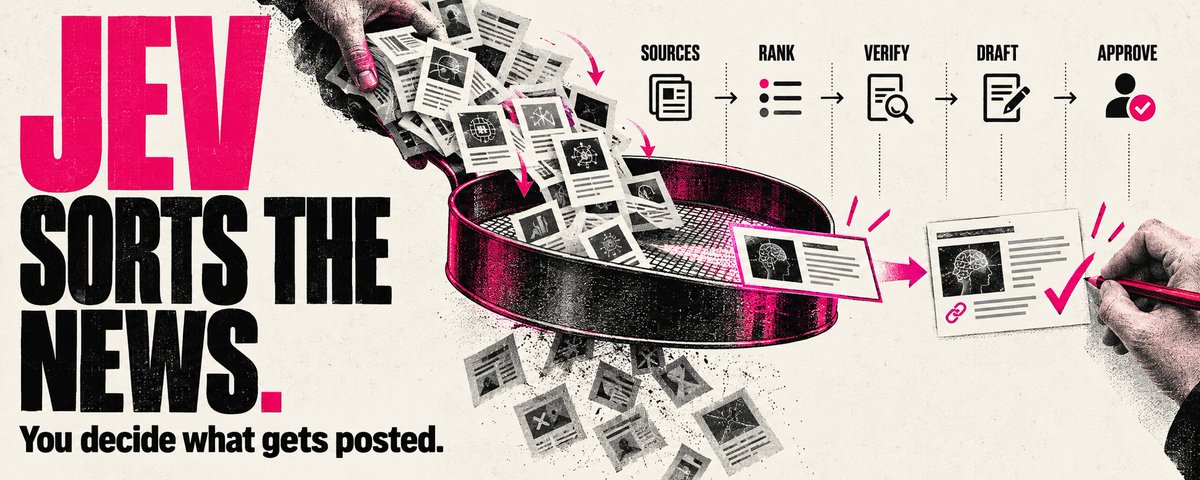
an ai news desk that reads 9,000 items a month costs $25.60 to run.
60 cents of that is the ai.
if you're building one and aren't sure which stages should touch a model, copy this checklist:
1. collect sources
lab blogs, release notes, research feeds, permitted apis. keep the original link on every item or you cannot verify anything later.
CODE. never a model.
2. build records
headline, text, author, date, source id, url, collection time. a missing field stays missing, it does not get guessed.
CODE. never a model.
3. exact filters
freshness window, dead links, duplicate ids, normalised titles. a model is measurably worse at counting and comparing dates, so it never gets asked.
CODE. drops 4,200 of 9,000.
4. bounded questions
sort the topic, score the fit, flag a numeric claim. fixed answer set, generates nothing.
JEV.
5. same event?
cheap title similarity shortlists the pair, then one judgment on the two summaries. never run the model across the whole set.
JEV. 4 and 5 together drop 4,440.
6. verify the claim
benchmarks, cost reductions, adoption figures, checked against the original paper or filing. a flag is not a verification.
HUMAN. drops 270.
7. write the draft
source excerpts, confirmed facts, unresolved caveats, tone, format. stored next to its evidence record.
LLM. the only stage that writes a sentence. 90 drafts, $0.22.
8. approve or kill
the pipeline stops at draft ready for review. no confidence value overrides this.
HUMAN. drops 26. 64 get posted.
$0.38 jev + $0.22 llm + $25.00 for the feed = $25.60 a month. $0.28 per approved draft.
97.7% of that bill is access to the material. whatever this desk is limited by, it is not the price of inference.
workflow from @Dain0x, arithmetic recomputed and it reproduces.
copy this checklist, then read the full workflow below ↓
Voltex retweeted
Erik Demaine, MIT professor:
"the entire HFT race is one question: can you do less work than the desk next to you. this professor answers it on a chalkboard by turning eight multiplications into seven."
the article above is a bet on speed. one decision per block, before the book moves.
but speed is not horsepower, it is doing less. Demaine shows it with Strassen: multiply two matrices the obvious way and it costs eight multiplications. restructure the math and it costs seven. that one saved step compounds until the impossible becomes routine.
every fast desk lives right here. not a bigger machine, a smaller number of operations on the path.
a faster model that still does the obvious work loses to a slower one that does less.
the trick is 55 years old, on a free chalkboard. the firms that rent it charge millions.
Voltex retweeted
Ramamurti Shankar, Yale physics professor:
"Two Sigma pays $500,000 to trade momentum. you chase the same thing and cannot define it. a Yale physicist nails it in one line of chalk, free."
the article above is really about motion. what makes a price keep moving, and what makes it stop.
Shankar starts with Newton. a body in motion stays in motion until a force acts on it. that is inertia, and it is why trends run longer than anyone expects.
momentum in physics is mass times velocity. momentum in markets is the same idea, size times speed. it takes a real force, a shock, volume, news, to turn it.
every momentum strategy on Wall Street is a bet on Newton's first law holding one more day.
the physics is free and 400 years old. the people who feel exactly when the force arrives are the ones who get paid.

Voltex retweeted
Sukhendu Das, IIT Madras professor:
"Jump Trading will pay a 23 year old $500,000 a year for one skill. look at the odds, then pick the single move that pays the most on average. this professor proves that exact move on a free chalkboard in his first lecture."
this one free lecture is the decision rule sitting under every trading bot and every hedge fund model on earth.
strip out the AI, the neural nets, the GPUs, and a single question is left. given everything you know right now, what is the one best bet.
it has a provably correct answer. it is called the Bayes decision rule, and it turns a probability into the exact action that maximizes your payoff. every profitable bot is just this rule running at speed.
Das builds it from nothing, on a blackboard, in notation a beginner can read. the odds go in, the optimal bet comes out.
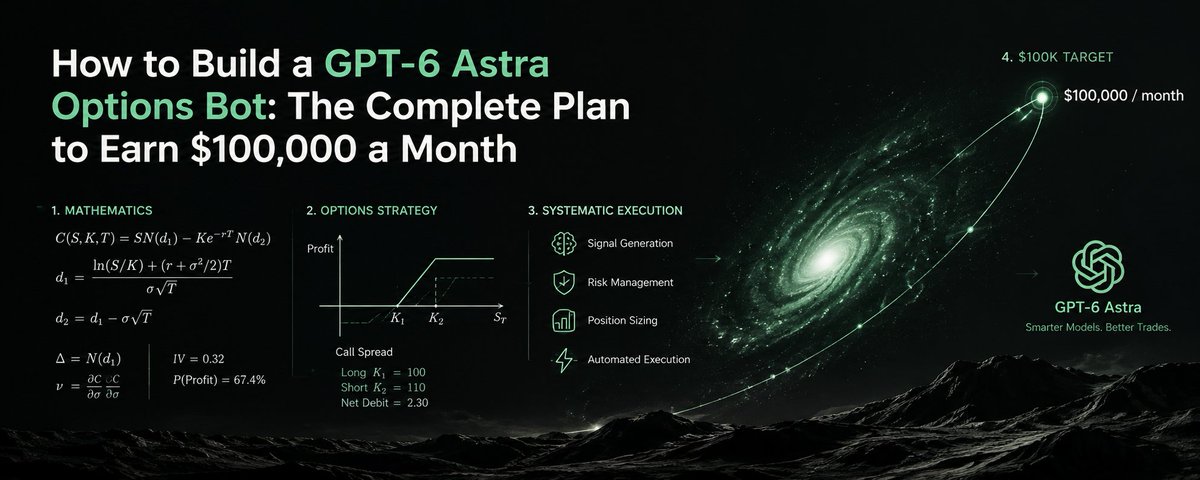
I put the practical aspects of this lecture into practice and developed a strategy that generates income, the results surprised me.
25 days.
$100 → $22,300.
73% win rate.
Sharpe 2.45.
I'm giving away the full configuration of my bot for free. 24 hours only.
Here's how:
>Comment "SEND"
>Like and Follow me
I'll send the complete setup in your DMs.

Voltex retweeted
Barry Mazur, one of the most influential mathematicians alive, on the tangent space, the flat approximation hiding under everything curved:
"every model works because up close the market looks flat. it breaks the instant the market remembers it is curved."
this free lecture is that idea, in chalk.
the tangent space is the set of directions you can move a hair without leaving the surface. locally, everything looks linear.
that flatness is a lie that is only true near where you are standing.
your model lives entirely inside it. correlations, betas, linear factors, all tangent-space math.
it works while the market stays in the neighborhood. it dies the moment the market moves in a direction the flat picture never held.
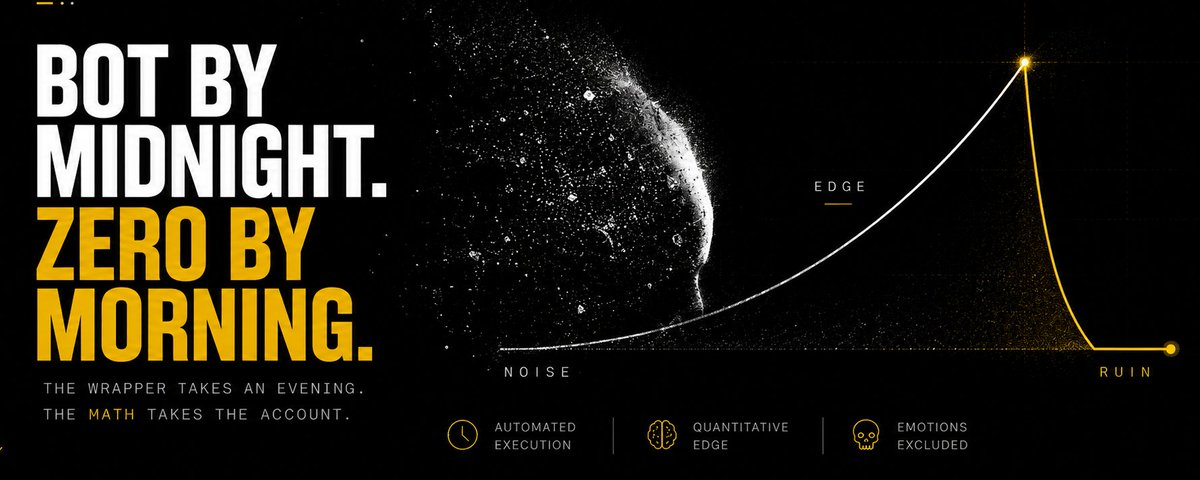
I applied his key principles to my trading bot, and as a result, I was able to grow my deposit from $100 to $4,700 in 2 weeks.
I'm willing to share it for free for the next 24 hours only.
Want the details?
Drop “Bot” in my DMs.


Voltex retweeted
MIT 6.006, the algorithms course every MIT computer scientist takes to learn how to actually think about a problem:
"brute force is not effort. it is the tell of someone who never found the shortcut, and the market charges you for both."
this free MIT lecture is the whole mindset, in chalk.
the first thing they teach is not code. it is that the right method turns an impossible search into a trivial one.
check every point and you pay for every point. find the structure and you skip almost all of them.
your strategy search is this. testing a million setups does not find more edge. it finds more noise and a bigger compute bill.
I put the practical aspects of this lecture into practice and developed a strategy that generates income, the results surprised me.
22 days.
$100 → $24,600.
76% win rate.
Sharpe 2.45.
I'm giving away the full configuration of my bot for free. 24 hours only.
Here's how:
>Like and Follow me
>Send me a direct message with the word “Bot”
All you need to do to get the information is send me a single word!


Voltex retweeted
Artur Avila, the first mathematician from Latin America to win the Fields Medal, on systems that manufacture their own randomness:
"D.E. Shaw pays $600,000 a year to people who accept that part of the future was never in the data."
this free lecture is that hard limit, in chalk.
entropy in dynamics is not disorder. it is the rate a system produces brand new information, every single step.
positive entropy means the next move carries a piece no amount of history can contain.
your model can fit the entire past perfectly and still be blind, because that new bit was never there to learn.
this is the ceiling on prediction. it is a number, and you do not get to argue with it.
the edge is not forecasting harder. it is knowing exactly how far forecasting can reach.
I applied his key principles to my trading bot, and as a result, I was able to grow my deposit from $100 to $4,700 in 2 weeks.
I'm willing to share it for free for the next 24 hours only.
Want the details?
Drop “Bot” in my DMs.


Voltex retweeted
Curtis McMullen, Harvard mathematician and Fields medalist, on what happens when simple cycles get layered on top of each other:
"Two Sigma pays $500,000 a year to people who stopped believing the market repeats."
this free lecture shows why, on a full wall of chalkboards.
take a few simple rotations. each one alone is a clean cycle that comes back around.
couple them together and the result never repeats. ever. it fills the whole space and looks exactly like noise.
the market is this. rate cycles, flows, seasonality, all real, all periodic, stacked on each other.
their sum is not a cycle, so every trader hunting "the pattern" is timing a rhythm that will never return.
the cycles are real. the repeat is the fantasy.
Voltex retweeted
Michael Burry, the outsider who saw 2008 coming and bet everything on it:
"I didn't have better information than Wall Street. I just read what everyone else refused to read, and I was willing to be alone when the numbers told me to be."
he read the actual mortgage documents, thousands of them, the ones every bank, every rating agency, every fund pretended to understand and never once opened. the fraud was not hidden. it was just boring to check.
he bet against the entire housing market while his own investors sued him and called him insane. for two years he looked catastrophically wrong. then he was right, and it became one of the greatest trades in history.
the market did not punish him for being wrong. it punished him for being early, which feels identical to being wrong until the day it does not.
his edge was never genius. it was doing the homework nobody else would, and having the stomach to hold a lonely position through the pain.
the crowd is never more certain than the moment before it is most wrong. Burry just checked.
I applied his key principles to my trading bot, and as a result, I was able to grow my deposit from $150 to $13,700 in 3 weeks.
I'm willing to share it for free for the next 24 hours only.
Want the details?
Drop “Bot” in my DMs and I'll send you all the info right away
Voltex retweeted
Jim Simons, the mathematician who ran the best track record in the history of money:
"I had five rules. do what nobody else is doing. hire people smarter than you. be guided by beauty. never give up. and pray for good luck. four of them you control. the fifth decides everything."
Renaissance made about 66% a year for 30 years. Warren Buffett made 20. Simons did it not by outworking Wall Street, but by refusing to play its game.
he did not hire traders. he hired physicists, codebreakers and astronomers, people who had never looked at a stock, and told them to find patterns in the noise.
he did not run with the crowd. when everyone chased the same signals, he built his own from data nobody else was reading.
and he never pretended to be certain. the man with the greatest edge in history said out loud that luck did the rest.
the edge was never a formula. it was doing the opposite of everyone, with better people, and the humility to admit you cannot control the outcome.
the crowd works hard to be right. Simons worked to be different, hired the best, and left the rest to luck. it beat every one of them.


Voltex retweeted
Every trader is hunting the same thing: return with no risk. a mathematician proved, in the math of spacetime itself, that it cannot exist anywhere, ever.
her subject is the positive mass theorem. the idea is cold and simple: no closed system can carry negative mass, and no world can be curved with free energy and stay consistent. flatten the risk to zero and the return flattens with it.
she proved it does not just hold in a snapshot. it holds through time, at every instant of the path. there is no moment where a system quietly runs on free energy and settles up later.
your strategy lives under the same law. if it shows return with almost no risk, the theorem leaves two options. it is doing almost nothing, or the risk is real, hidden, and still on the clock.
LTCM looked flat. no curvature, no risk, pure steady return. the mass it was hiding did not vanish. it waited for its moment in spacetime and arrived all at once.
I put aspects of this lecture into practice and developed a strategy that generates income, and the results surprised me.
By August:
$220 → $37,401
84% win rate.
I'm giving away the full configuration of my bot for free. 24 hours only.
Here's how:
>Like and Follow me
>Send me a direct message with the word “Bot”
All you need to do to get the information is send me a single word!