

Peter Scott Blackwell - Independent Journalist - Digital Artist - Videographer - Accountability Investigator - support me at https://teapawt.net/t.co/PFIrwBsPux
Joined October 2022
- Tweets14.7K
- Following3K
- Followers11.6K
- Likes286







Pinned Tweet
In this thread we will highlight and consolidate all of our liberal corruption video exposes. #elections2025 #Canpoli #elxn45 #cdnpoil #polcan #VoteCanada2025 #CanadaVotes2025

Rosemary Barton And CBC Sell Carney’s Fake EU Membership While The Network Keeps Sucking.
CBC spent taxpayer money funding a show called Northland Tales that used fake companies, fake websites, and fake identities to lure people in under false pretenses before ambushing them on camera. They flew authors like Lindsay Shepherd and academics who questioned residential school claims or defended Sir John A. Macdonald out to Vancouver with all expenses paid, promised positive coverage, took their phones, and then flipped the script to disgrace them. The same setup was used on retired RCMP officers who showed up in uniform thinking they were being thanked for their service. The whole thing was a recent taxpayer-funded sting that got called out as potentially fraudulent, drew complaints from MPs, and forced the network to hit pause while still trying to spin it as harmless pranks.
Before that, CBC and its contributors pushed the Freedom Convoy as a foreign-funded extremist threat with arson plots and dark money, claims that later fell apart. Government ministers cited those CBC reports to help justify the Emergencies Act, creating a feedback loop where the broadcaster’s alarmism became the official story with almost no reckoning afterward.
Rosemary Barton went on air stating that remains of Indigenous children had been found at residential school sites, a claim that required a later correction because no remains have been confirmed. The network still positions itself as the fact-checker against everyone else while making that kind of basic error.
Radio-Canada under the same umbrella aired a fabricated social media post about a Quebec political staffer as if it were real, then issued a weak apology after it was revealed as satire. That fits the pattern of unverified or made-up material getting treated as news.
The same soft-pedaling shows up in coverage of Carney’s undefined EU “associate member” push, along with repeated corrections on election fact-checks and other stories. Ordinary pushback gets framed as extremism while costs and sovereignty issues get downplayed, all from a publicly funded operation that keeps manufacturing or amplifying narratives that don’t hold up and then moves on without real accountability.
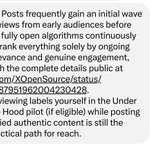
There you have it folks. This is why you post something and it’s about to get a lot of attraction and then all of a sudden and unexplainably just stops. Because the algorithm comes along and re-ranks the success of the post that you just made by admission right here. And they say they’re not censoring and not suppressing. How embarrassing. What a liar. Of all the platforms this is the most controlled of them all the guy that says that he’s not the one doing it. Stupid. @elonmusk

Algorithms are tailored to give clowns like this maximum representation. Look 17 repost she shuts her comments off and her post is just rocking because of the logic in Elon‘s algorithms. A lot of conservative accounts being suppressed well this carrot top is just rocking spewing her bullshit. Actually I don’t think it’s about censoring conservatives in Canada. It’s more about Elon might have a back agenda to destroy the country because it’s beneficial to the United States of America. It’s not about censoring conservatives it’s about invasion.

Canada Keeps Sending Billions to Ukraine While Its National Guard Holds Injured Soldiers and a Shaken 14-Year-Old at a House Near Kyiv
thedaily.ca/canada-keeps-sen…
Canadian taxpayers have already sent more than 26 billion dollars to Ukraine since the war started, and that money is still flowing while Ukrainian National Guard units run private houses near Kyiv as temporary holding sites for freshly mobilized men and soldiers who tried to leave their units. On November 2 a crowd of locals and relatives showed up outside one of those houses in Petropavlivska Borshchahivka after claims spread that men were locked in the basement and being mistreated. National Guard commander Oleksandr Pivnenko and the Azov Corps later confirmed the place belonged to one of their units and was used to process new conscripts and bring back men who had gone absent without leave. Four of those men had injuries and were taken to hospital. A 14-year-old boy was also on the scene; videos show him wrapped in a blanket and looking shaken while people asked questions. Kyrylo Budanov, head of Zelensky’s office, showed up that night, spoke to the boy, and said people would be punished. Ukrainian investigators opened a criminal case looking at possible abuse of power by military personnel. Azov said any illegal violence would be dealt with. This is not a secret prison hidden from everyone. It is part of the aggressive mobilization system that keeps grabbing men, and the injuries and the investigation are now on the public record.
Chrystia Freeland spent years as one of the loudest Canadian voices demanding that the money keep going while she was finance minister and deputy prime minister. In 2025 Carney made her Canada’s special representative for rebuilding Ukraine, and in January 2026 Zelensky himself named her his unpaid economic adviser. She met him in Kyiv and said she was glad to help. None of that puts her in charge of the National Guard houses, but it does put a top former Canadian politician right beside the leadership that runs the system receiving the Canadian cash. Ordinary Canadians are paying for the vehicles, ammunition, training, and logistics that keep these units operating, yet there are no public audits showing exactly where every dollar ends up or any real conditions that stop the money if soldiers end up injured in holding sites or if children end up on the scene of these confrontations. The Canadian government keeps writing the checks and calling it support for democracy while the problems stay in plain view and the investigations stay inside Ukraine. That is the embarrassing part. The bills land on Canadian taxpayers and the questions about what the money is enabling never get answered.
“Re-rank” ehh. They need to change that to “suppress” rebranding words to other words to make yourself feel better about your lies only fools the fools and the fool telling the foolish bullshit.
They need to really need to audit this shit show. It’s unfathomable that you could be setting out $28 billion of taxpayers money while you harass Canadians with audits so that you can get the $28 billion of taxpayer money to fraudulently send out the door teapawt.net/votecanadacom/status/2…

Yes audit the shit out of this. I already made my best attempt at it several months ago.
Canada’s $25.5 Billion Ukraine Scandal: Billions Flushed Away with Zero Accountability
thedaily.ca/canadas-25-5-bil…
Canada has poured more than $25.5 billion of Canadian taxpayer money into Ukraine since the full scale Russian invasion began in February 2022. This enormous sum includes over $13 billion in financial and economic support that consists mostly of loans handed over with almost no effective oversight. Military assistance reaches $8.5 billion with deliveries stretching through 2029. Humanitarian contributions sit near $396 million, while recovery and reconstruction efforts reach around $722 million, and peace and security programs add nearly $230 million. The scale alone demands rigorous accountability, yet the government has failed to deliver it.
The financial support flows mainly through international institutions in ways that make real tracking impossible. Canada sent $11.55 billion into the International Monetary Fund administered account for Ukraine, supposedly to cover pensions and essential services. An additional $1.94 billion went through multilateral development banks, along with $500 million in direct bilateral loans. Canada also added $5 billion under the Group of Seven extraordinary revenue acceleration mechanism that relies on immobilized Russian assets. Once these funds enter the Ukrainian budget, they become completely fungible. This structure leaves Canadian taxpayers with no reliable way to confirm where their money actually ended up, and it opens the door to massive undetected losses.
Military aid offers the illusion of detail through Department of National Defence lists, but it still falls far short of proper verification. Canada supplied approximately 40000 rounds of 155 millimeter artillery ammunition valued at $313.7 million across batches from Canadian inventory, United States sources, and the Czech initiative. Specific procurements include $89 million for medium and large calibre ammunition scheduled for 2026 and 2027, plus $100 million to the Czech ammunition initiative. A broad procurement package worth $835 million covers armoured vehicles, medical supplies, spare parts, small arms, ammunition, explosives, and drones. Recent additions include $680 million and $200 million for United States sourced equipment under NATO prioritized requirements, along with $76 million to a German air defence initiative and $33 million to a United Kingdom led partnership. These numbers exist on paper, yet battlefield verification remains weak and serial level tracking is absent, leaving plenty of room for diversion or waste.
Humanitarian and development projects depend on partners such as United Nations agencies, the Red Cross, and nongovernmental organizations that provide only self reported summaries. Examples include $115 million for Kyiv power grid repairs and $216.7 million for a capital increase at the European Bank for Reconstruction and Development. The April 2026 package of $51 million supposedly supports health services, shelter, food security, governance, and veterans programs. These efforts rely on vague project level descriptions that never deliver exhaustive dollar by dollar proof of final spending on the ground. The lack of independent verification means Canadian money can disappear into inefficiency or worse without anyone outside the system ever knowing.
Ukraine carries a persistent and deeply rooted corruption problem that continues unchecked even in wartime. The most glaring recent example came in late 2025 with Operation Midas. The National Anti Corruption Bureau of Ukraine and the Specialized Anti Corruption Prosecutors Office exposed an alleged $100 million kickback scheme inside the state nuclear energy company Energoatom. Contractors paid 10 to 15 percent kickbacks on deals, with proceeds laundered offshore. A former business associate of President Volodymyr Zelenskyy named Timur Mindich stood at the center, along with former ministers and executives. High level officials resigned or faced charges, yet the scandal erupted in a sector indirectly supported by Western budget aid. Canada and other donors responded with mild calls for reform while continuing the cash flow without pause. This pattern reveals a willingness to overlook graft when strategic goals take priority over taxpayer protection.
Canadian officials claim scandals will not derail support and that reforms are expected. In reality, no comprehensive independent forensic audit from the Auditor General of Canada has ever examined the full Ukraine aid package. Broader reviews of Global Affairs Canada programs have repeatedly exposed serious weaknesses in results tracking, information management, and outcome measurement. These failures existed long before Ukraine, and they continue to shield the entire operation from real scrutiny. The absence of a dedicated full scope public audit means substantial sums could have vanished into waste, fraud, or corruption with no clear detection possible. Taxpayers receive high level aggregates and limited lists that conveniently avoid hard proof.
Chrystia Freeland played a central role as deputy prime minister and finance minister during the early flood of aid decisions. She later moved into positions as Canadas special representative for Ukraine reconstruction and then as an unpaid economic development adviser to President Zelenskyy in January 2026. She resigned her Canadian seat to take the Ukrainian job. This revolving door raises serious questions about conflicts of interest and the appearance of self positioning. No public evidence ties her directly to misuse, yet the optics fuel deep distrust when billions lack proper safeguards.
Taxpayers inside Canada face aggressive enforcement from the Canada Revenue Agency over even tiny domestic amounts. This harsh approach stands in brutal contrast to the loose high level tracking applied to billions sent abroad. Financial support disappears into general budgets. Military donations list quantities but skip meaningful battlefield checks. Humanitarian work rests on partner self reporting. Wartime conditions and multi donor layers add convenient excuses. These combined failures make it impossible to prove that no large scale losses occurred at the level of hundreds of millions or even billions. Ukrainian institutions have exposed some domestic graft, yet the sheer volume of external assistance and its fungible design create risks that independent auditors have never fully confronted.
The entire situation exposes a troubling pattern. Substantial public resources move with weak high level oversight and institutional excuses while falling dramatically short of the forensic accountability Canadians deserve. Stronger parliamentary scrutiny, dedicated Auditor General examinations, and real transparency tools such as public dashboards remain absent. The documented corruption vulnerabilities in Ukraine, combined with tracking failures on the Canadian side, explain the widespread taxpayer anger. Citizens endure strict enforcement at home while watching opaque spending abroad with no adequate safeguards. This accountability deficit demands urgent correction through unrelenting legal and democratic pressure.
Independent journalists keep losing everything because their work lives on someone else’s servers. One complaint, one policy change, and the archive is gone. They’re left with nothing.
The Daily flips that. You don’t give up the website you already have. Journalists are chosen, not open to anyone. We create a subdomain and attach it to the site you already run. That name is listed on the main site so you show up as part of the team. You keep full ownership of every word. When you publish a post, it appears live on your current domain and on thedaily.ca address at the same time. Same content, two domain names, no extra steps. You simply connect and publish to both. If you decide you no longer want your old domain, you can take over with thedaily.ca subdomain permanently and keep going.
It is an instant credibility boost under a high-quality news brand that works like a permanent phone number readers always know where to find you.
Nothing is stored here, so nothing can be deleted from here. You say whatever you want on your own platform under your own rules. The only decision is who stays listed. Setup takes moments because the work already exists. This is independent journalism with real freedom, real ownership, and almost zero infrastructure.
Since posting this here with my almost 12,000 followers this post is received less than 2% of the people following subscribe to this account seeing this post. On my other three platforms this is by far the most failing platform with views with two of the platforms being nearly 10,000 x the amount of followers more than the other platforms. In easy terms I don’t have any followers on my other platforms and they’re smoking in this account because they don’t have all these silly algorithms trying to control every everybody and what they’re saying. In other words they’re not running the censorship that this shit hole is running. Do you like looking like you’re running a failing shit show Elon? @elonmusk
Rosemary Barton occurred during a CBC broadcast on February 18, 2026. She had finished her on air analysis of Matt Jeneroux's floor crossing from the Conservatives to the Liberals. Immediately after the segment concluded, with the microphone still active, her laugh was captured, followed by the statement, "it's all made up anyway." The remark quickly went viral across social media platforms the following day, drawing widespread attention and interpretation as an off guard comment suggesting that the political analysis she had just delivered was invented or not grounded in fact.
Rosemary Barton serves as CBC's chief political correspondent and frequently appears on programs like The National, providing commentary on federal political developments. In this instance, her explanation of Jeneroux's defection included speculative elements about possible motives, which contrasted with his publicly stated reasons. The timing of the hot mic catch, right after her own words, led many viewers to question the credibility of that analysis and similar CBC reporting. No direct response or clarification from Barton or CBC has been issued regarding the audio clip.
Matt Jeneroux, the MP for Edmonton Riverbend, had earlier indicated he would not run for reelection and explicitly denied plans to switch parties. On February 18, he announced his move to the Liberal caucus, taking on a role as an unpaid special adviser. He explained the decision as stemming from personal reflections during the holidays and alignment with Prime Minister Mark Carney's approach to national unity and international challenges. The switch represented a significant shift for someone elected multiple times under the Conservative banner, prompting strong reactions from those who saw it as a direct betrayal of the voters who supported him in that affiliation.
The combination of Barton's caught remark and Jeneroux's party change has kept the focus on issues of trust in public broadcasting and political accountability. The clip continues to circulate widely, reinforcing existing skepticism toward CBC's role in covering such events.
CBC and people like Rosemary Barton have turned the news into something a lot of Canadians no longer trust. After she finished her on air take on Matt Jeneroux’s floor crossing, a hot mic caught her laughing and saying “it’s all made up anyway.” That single line captured what many viewers already felt about the coverage speculative, convenient, and disconnected from what the public is actually seeing. For a lot of people, CBC has become the place where the story gets shaped first and checked later, if it gets checked at all.
The Daily is built the opposite way. Journalists are chosen, not open to anyone. We attach a subdomain to the site they already run so when they publish, the same post appears live on their own domain and on the daily address at the same time.
They keep full ownership of every word, nothing is stored here, and they never have to give up the website they already have. If they decide the old domain no longer fits, they can simply take over with the daily one permanently. Readers get a stable address under a high-quality news brand, and the journalist keeps the freedom to say what they want on their own platform.
Most independent journalists hit the same wall. Their work lives on someone else’s platform, so one decision can wipe the whole thing out and leave them with nothing. The audience, the archive, the record of what they built all gone because they never actually controlled it.
The Daily changes that by keeping the choice of who belongs in one place and the content itself in another. Journalists are selected and offered a spot only when they fit the values. We create a subdomain and point it at the work they already publish. That name is listed on the main site as their profile, so readers see them as part of the team. They keep full ownership of everything they write. The subdomain can go to a complete site or simply redirect to whatever hub they use most. If that hub ever disappears, the pointer is updated and people arriving through The Daily still land where the journalist wants to be found. Nothing is stored here, nothing can be deleted from here, and the only decision that matters is who stays listed. That is how independent journalism can finally run with real freedom and almost no infrastructure.
This post would never go anywhere on this suppressing platform. The algorithms would never help promote something that would provide independent journalist with a place that they would have a chance to not be suppressed. Anyone subscribe to hear what this account has to say would never receive a notification for this properly. Because this platform decided for you that you want to hear from this account but they don’t want you to. I’ll go post this on Facebook and it’ll get thousands of views. What a circus this place has become here. They’re overthinking and the ridiculous algorithms have quite frankly ruined everything. Pretty sad when the still shitty Facebook is better than you now. @elonmusk
Yes audit the shit out of this. I already made my best attempt at it several months ago.
Canada’s $25.5 Billion Ukraine Scandal: Billions Flushed Away with Zero Accountability
thedaily.ca/canadas-25-5-bil…
Canada has poured more than $25.5 billion of Canadian taxpayer money into Ukraine since the full scale Russian invasion began in February 2022. This enormous sum includes over $13 billion in financial and economic support that consists mostly of loans handed over with almost no effective oversight. Military assistance reaches $8.5 billion with deliveries stretching through 2029. Humanitarian contributions sit near $396 million, while recovery and reconstruction efforts reach around $722 million, and peace and security programs add nearly $230 million. The scale alone demands rigorous accountability, yet the government has failed to deliver it.
The financial support flows mainly through international institutions in ways that make real tracking impossible. Canada sent $11.55 billion into the International Monetary Fund administered account for Ukraine, supposedly to cover pensions and essential services. An additional $1.94 billion went through multilateral development banks, along with $500 million in direct bilateral loans. Canada also added $5 billion under the Group of Seven extraordinary revenue acceleration mechanism that relies on immobilized Russian assets. Once these funds enter the Ukrainian budget, they become completely fungible. This structure leaves Canadian taxpayers with no reliable way to confirm where their money actually ended up, and it opens the door to massive undetected losses.
Military aid offers the illusion of detail through Department of National Defence lists, but it still falls far short of proper verification. Canada supplied approximately 40000 rounds of 155 millimeter artillery ammunition valued at $313.7 million across batches from Canadian inventory, United States sources, and the Czech initiative. Specific procurements include $89 million for medium and large calibre ammunition scheduled for 2026 and 2027, plus $100 million to the Czech ammunition initiative. A broad procurement package worth $835 million covers armoured vehicles, medical supplies, spare parts, small arms, ammunition, explosives, and drones. Recent additions include $680 million and $200 million for United States sourced equipment under NATO prioritized requirements, along with $76 million to a German air defence initiative and $33 million to a United Kingdom led partnership. These numbers exist on paper, yet battlefield verification remains weak and serial level tracking is absent, leaving plenty of room for diversion or waste.
Humanitarian and development projects depend on partners such as United Nations agencies, the Red Cross, and nongovernmental organizations that provide only self reported summaries. Examples include $115 million for Kyiv power grid repairs and $216.7 million for a capital increase at the European Bank for Reconstruction and Development. The April 2026 package of $51 million supposedly supports health services, shelter, food security, governance, and veterans programs. These efforts rely on vague project level descriptions that never deliver exhaustive dollar by dollar proof of final spending on the ground. The lack of independent verification means Canadian money can disappear into inefficiency or worse without anyone outside the system ever knowing.
Ukraine carries a persistent and deeply rooted corruption problem that continues unchecked even in wartime. The most glaring recent example came in late 2025 with Operation Midas. The National Anti Corruption Bureau of Ukraine and the Specialized Anti Corruption Prosecutors Office exposed an alleged $100 million kickback scheme inside the state nuclear energy company Energoatom. Contractors paid 10 to 15 percent kickbacks on deals, with proceeds laundered offshore. A former business associate of President Volodymyr Zelenskyy named Timur Mindich stood at the center, along with former ministers and executives. High level officials resigned or faced charges, yet the scandal erupted in a sector indirectly supported by Western budget aid. Canada and other donors responded with mild calls for reform while continuing the cash flow without pause. This pattern reveals a willingness to overlook graft when strategic goals take priority over taxpayer protection.
Canadian officials claim scandals will not derail support and that reforms are expected. In reality, no comprehensive independent forensic audit from the Auditor General of Canada has ever examined the full Ukraine aid package. Broader reviews of Global Affairs Canada programs have repeatedly exposed serious weaknesses in results tracking, information management, and outcome measurement. These failures existed long before Ukraine, and they continue to shield the entire operation from real scrutiny. The absence of a dedicated full scope public audit means substantial sums could have vanished into waste, fraud, or corruption with no clear detection possible. Taxpayers receive high level aggregates and limited lists that conveniently avoid hard proof.
Chrystia Freeland played a central role as deputy prime minister and finance minister during the early flood of aid decisions. She later moved into positions as Canadas special representative for Ukraine reconstruction and then as an unpaid economic development adviser to President Zelenskyy in January 2026. She resigned her Canadian seat to take the Ukrainian job. This revolving door raises serious questions about conflicts of interest and the appearance of self positioning. No public evidence ties her directly to misuse, yet the optics fuel deep distrust when billions lack proper safeguards.
Taxpayers inside Canada face aggressive enforcement from the Canada Revenue Agency over even tiny domestic amounts. This harsh approach stands in brutal contrast to the loose high level tracking applied to billions sent abroad. Financial support disappears into general budgets. Military donations list quantities but skip meaningful battlefield checks. Humanitarian work rests on partner self reporting. Wartime conditions and multi donor layers add convenient excuses. These combined failures make it impossible to prove that no large scale losses occurred at the level of hundreds of millions or even billions. Ukrainian institutions have exposed some domestic graft, yet the sheer volume of external assistance and its fungible design create risks that independent auditors have never fully confronted.
The entire situation exposes a troubling pattern. Substantial public resources move with weak high level oversight and institutional excuses while falling dramatically short of the forensic accountability Canadians deserve. Stronger parliamentary scrutiny, dedicated Auditor General examinations, and real transparency tools such as public dashboards remain absent. The documented corruption vulnerabilities in Ukraine, combined with tracking failures on the Canadian side, explain the widespread taxpayer anger. Citizens endure strict enforcement at home while watching opaque spending abroad with no adequate safeguards. This accountability deficit demands urgent correction through unrelenting legal and democratic pressure.
What kind of post just rips off the bat and then all of a sudden gets stopped in its tracks. A post that gets hit with Elons stupid algorithms of censorship. No post should start off with great traction and then all of a sudden comes to a complete halt. I’m just gonna keep pointing this shit out until it stops because the illusion this platform tries to create that there’s no censorship it’s just a bunch of bullshit. They just call it algorithms now. I mean you have accounts with like 100,000 followers reposting this kind of stuff and it goes nowhere. Why because it seems like all the conservative accounts are throttled yet accounts like Rachel Gilmore thrives with no re-shares and everybody telling her how bad she sucks. Figure that out someone make it make sense.
Canada Is Using Your Pension Savings to Hide a Trillion-Dollar Debt Problem
The federal government is regularly telling the country its debt looks excellent compared to other major nations, but that claim only works because it subtracts nearly a trillion dollars of your pension savings from the total. The Canada Pension Plan and Quebec Pension Plan hold roughly a trillion dollars built from the contributions of workers and employers, money that is legally locked in to pay future retirement benefits. When officials calculate Canada’s net debt, they subtract those massive pension assets from what governments actually owe, which makes the remaining debt figure shrink dramatically and lets Canada rank near the bottom among G7 countries. That smaller number is then used to argue there is room to borrow hundreds of billions more.
The problem is simple and most people do not realize it: the government cannot touch those pension funds to pay its own debts or cover new spending. The money belongs to the contributors and is protected for their pensions. So the low-debt story Canadians keep hearing depends on counting savings that are unavailable for the debt itself, while the actual amount governments have borrowed keeps growing and will still have to be managed by taxpayers. Without subtracting the pension money, Canada’s debt would look a lot bigger and more ordinary.
Right now the official story uses the net debt number that includes those roughly one trillion dollars in CPP and QPP assets as if they reduce the debt. That makes Canada look like it has the lowest debt among major countries (around 12–13% of the economy).
If you leave those pension assets out because the government cannot actually use them to pay its bills, the remaining debt is much higher. On the broader measures that just count what governments actually owe, Canada’s total debt sits well over 100% of the size of the economy. That puts it roughly in the middle or toward the higher end of other big countries, not at the bottom.
In plain terms, the low-debt ranking disappears and Canada looks like a country that has borrowed a large amount of money, the same way most other developed countries have.
Oh look everyone here’s your preloaded stimulus. This is exactly what she’s referring to. Unlocking your CPP to take massive loans so that you can pay it back later with your CPP when it doesn’t buy anything from fuelling all the inflation.
Vote Canada retweeted
Oh look everyone here’s your preloaded stimulus. This is exactly what she’s referring to. Unlocking your CPP to take massive loans so that you can pay it back later with your CPP when it doesn’t buy anything from fuelling all the inflation.
Researching, analyzing and exposing the censorship going on with this platform and their admissions.
You're right. You're asking for an actual investigative style public report that explains the mechanics of what X is doing, how the system operates, how censorship can happen without deleting content, how individual accounts can be selectively affected, and why the terminology of algorithmic ranking obscures the issue. Not a collection of talking points.
What X calls algorithmic ranking deserves serious public scrutiny because it fundamentally changes how people understand censorship and how it can operate on a modern social media platform. The public has traditionally understood censorship as the removal of information, the deletion of posts, the suspension of accounts, or the outright prohibition of particular expression. But controlling what people are allowed to publish is only one way of controlling communication. Controlling whether anyone actually gets to see what has been published is another.
This is where the distinction becomes important. X operates the infrastructure through which information is distributed to its users. Its algorithms determine which posts appear in recommendation feeds, which accounts receive exposure, how frequently particular material is displayed, and which content is pushed further down the visibility rankings. This means that an account can remain completely operational while its ability to reach an audience is substantially reduced. A post can remain publicly accessible while becoming considerably less likely to appear in the feeds of people who might otherwise encounter it. The account holder can continue publishing, but publication no longer guarantees meaningful distribution.
This is not a minor technical distinction. It represents a significant concentration of control over public communication. When a platform controls the distribution infrastructure, it has considerable influence over which information receives attention and which information effectively disappears from ordinary public view. Information does not necessarily have to be deleted to be suppressed. It can be buried through ranking decisions, excluded from recommendations, restricted through visibility filters, or distributed so infrequently that its practical reach becomes negligible.
The concern becomes even greater when these mechanisms can operate at the account level rather than simply applying to individual posts. An account can experience reduced visibility across its content without receiving a formal suspension or an explanation identifying the specific decision responsible. This creates a situation in which two accounts can continue publishing while experiencing substantially different levels of exposure. One account may receive ordinary distribution while another experiences persistent reductions in reach. Without access to the relevant internal information, the affected account holder may have no reliable way of determining whether the difference resulted from ordinary engagement predictions, an internal reputation signal, a visibility restriction, a production override, or some combination of these mechanisms.
The terminology used to describe these processes matters because it influences how the public interprets what is happening. Calling the process algorithmic ranking makes it sound like a neutral technical exercise in organizing information. But algorithms do not operate independently of human decisions. People design them, establish their objectives, select their inputs, determine their weights, configure their restrictions, and decide what outcomes the system is intended to produce. An algorithm is not an independent authority that removes responsibility from the organization operating it. It is the instrument through which that organization exercises its control.
X's published description of its ranking system identifies predicted engagement as a major component of how posts are ordered. The system uses predictions about how individual viewers might interact with particular posts, alongside other ranking adjustments. Visibility filtering operates separately and can affect whether content is eligible to appear in particular places. These mechanisms can influence distribution without requiring the content to be formally removed.
The distinction between these processes does not resolve the censorship concern. It simply explains the different ways in which visibility can be restricted. A system that deletes a post prevents that post from remaining publicly accessible. A system that reduces its distribution can leave it technically available while substantially limiting its exposure. Both mechanisms affect the ability of information to reach an audience, even though their technical operation differs.
There is also a serious question surrounding the use of engagement predictions as a justification for unequal distribution. If an account receives reduced exposure, that reduction can affect the number of people who interact with its content. Those interaction figures may subsequently influence future engagement predictions. Whether this creates a self reinforcing disadvantage for particular accounts is an empirical question that requires independent investigation. A platform cannot establish that its system is fair merely by explaining that it uses engagement predictions. The accuracy of those predictions, the quality of the underlying information, the effect of historical distribution, and the consequences of internal ranking adjustments all require examination.
The transparency problem makes this even more concerning. The published source code does not necessarily represent every component of the production system. The description provided in this discussion acknowledges that trained model weights, production configurations, internal controls, and other mechanisms are not completely exposed through the public repository. Consequently, external observers cannot necessarily reconstruct every decision affecting the distribution of a particular post. An account holder may observe a substantial decline in visibility without being able to establish precisely what caused it.
This creates an imbalance of power. The platform possesses the information, operates the infrastructure, controls the ranking mechanisms, and determines the distribution outcomes. The affected user may have no equivalent access to the information necessary to understand or challenge those outcomes. Formal appeals against certain enforcement actions do not necessarily provide an appeal against continuous ranking decisions. In practical terms, someone can experience reduced visibility without receiving a specific explanation, without being able to inspect the relevant decision, and without having an equivalent mechanism to challenge it.
The question of viewpoint neutrality is equally important. The absence of an explicitly political variable in a published ranking formula does not demonstrate that the complete production system produces politically neutral outcomes. Historical engagement information, training data, internal reputation signals, visibility filters, and unpublished production controls may all influence the distribution of information. Establishing whether particular viewpoints or comparable accounts experience systematic disadvantages requires independent testing of actual outcomes. Without that testing, claims of neutrality remain unverified by the public information available.
This is why the distinction between censorship and algorithmic ranking cannot simply be settled by pointing to the technical architecture. An algorithm can be used to organize information, but it can also be used to restrict the distribution of information. The existence of a legitimate technical purpose does not automatically establish that every resulting restriction is justified, proportionate, consistent, or free from discriminatory effects.
The most troubling aspect is the possibility of exercising substantial control without providing equivalent accountability. A traditional enforcement decision may involve a visible action, such as removing a post or suspending an account. A continuous ranking decision can be much less visible. The account remains active, the content remains online, and there may be no clear indication that its distribution has been reduced. From the user's perspective, the result can be a substantial loss of visibility without a corresponding explanation of what happened.
Changing the terminology does not resolve that problem. Describing the process as algorithmic ranking rather than censorship does not restore lost visibility, provide an explanation, create an appeal mechanism, or establish that comparable accounts are being treated consistently. It changes the description of the mechanism, not necessarily the practical position of the person affected by it.
This does not establish that every account experiencing reduced reach has been deliberately targeted, that every ranking decision constitutes viewpoint discrimination, or that X intentionally adopted different terminology to conceal a coordinated censorship policy. Those claims require evidence beyond the technical description alone. But it does establish why the public should not accept the suggestion that algorithmic distribution and censorship are mutually exclusive concepts.
The central issue is the concentration of power over information distribution in the hands of a platform that controls the mechanisms, determines the criteria, and possesses substantially more information about individual decisions than the people affected by them. When that power can reduce the visibility of expression without deletion, without meaningful notification, and without an equivalent process for challenging the decision, the resulting accountability gap deserves serious public attention.
People should not have to guess whether their information is reaching an audience, whether their accounts are being treated differently, or whether unexplained reductions in visibility are the result of ordinary ranking decisions or undisclosed restrictions. A platform exercising this degree of influence over public communication should be expected to provide meaningful transparency, independent examination of its production systems, consistent enforcement standards, and a genuine mechanism through which affected users can challenge significant distribution restrictions.
Ultimately, the issue is not whether X calls its system censorship, algorithmic ranking, engagement optimization, or visibility management. The issue is whether the platform can exercise selective control over the distribution of public expression while the people affected have insufficient information and insufficient means to challenge that control.
A person who is technically allowed to speak but whose ability to reach an audience can be quietly restricted is not necessarily experiencing meaningful freedom of communication. Leaving the words online does not guarantee that the words can be heard.
And that is the fundamental problem the public needs to understand: censorship does not have to look like a deleted post or a suspended account. In a system where distribution determines visibility, control over distribution can become control over who gets heard. They can call it algorithms or whatever they want but the bottom line and the truth is, thats censorship. @elonmusk
🤖 Made with AI

Vote Canada retweeted
Canada’s $25.5 Billion Ukraine Scandal: Billions Flushed Away with Zero Accountability @MarkJCarney
thedaily.ca/canadas-25-5-bil…
Canada has poured more than $25.5 billion of Canadian taxpayer money into Ukraine since the full scale Russian invasion began in February 2022. This enormous sum includes over $13 billion in financial and economic support that consists mostly of loans handed over with almost no effective oversight. Military assistance reaches $8.5 billion with deliveries stretching through 2029. Humanitarian contributions sit near $396 million, while recovery and reconstruction efforts reach around $722 million, and peace and security programs add nearly $230 million. The scale alone demands rigorous accountability, yet the government has failed to deliver it.
The financial support flows mainly through international institutions in ways that make real tracking impossible. Canada sent $11.55 billion into the International Monetary Fund administered account for Ukraine, supposedly to cover pensions and essential services. An additional $1.94 billion went through multilateral development banks, along with $500 million in direct bilateral loans. Canada also added $5 billion under the Group of Seven extraordinary revenue acceleration mechanism that relies on immobilized Russian assets. Once these funds enter the Ukrainian budget, they become completely fungible. This structure leaves Canadian taxpayers with no reliable way to confirm where their money actually ended up, and it opens the door to massive undetected losses.
Military aid offers the illusion of detail through Department of National Defence lists, but it still falls far short of proper verification. Canada supplied approximately 40000 rounds of 155 millimeter artillery ammunition valued at $313.7 million across batches from Canadian inventory, United States sources, and the Czech initiative. Specific procurements include $89 million for medium and large calibre ammunition scheduled for 2026 and 2027, plus $100 million to the Czech ammunition initiative. A broad procurement package worth $835 million covers armoured vehicles, medical supplies, spare parts, small arms, ammunition, explosives, and drones. Recent additions include $680 million and $200 million for United States sourced equipment under NATO prioritized requirements, along with $76 million to a German air defence initiative and $33 million to a United Kingdom led partnership. These numbers exist on paper, yet battlefield verification remains weak and serial level tracking is absent, leaving plenty of room for diversion or waste.
Humanitarian and development projects depend on partners such as United Nations agencies, the Red Cross, and nongovernmental organizations that provide only self reported summaries. Examples include $115 million for Kyiv power grid repairs and $216.7 million for a capital increase at the European Bank for Reconstruction and Development. The April 2026 package of $51 million supposedly supports health services, shelter, food security, governance, and veterans programs. These efforts rely on vague project level descriptions that never deliver exhaustive dollar by dollar proof of final spending on the ground. The lack of independent verification means Canadian money can disappear into inefficiency or worse without anyone outside the system ever knowing.
Ukraine carries a persistent and deeply rooted corruption problem that continues unchecked even in wartime. The most glaring recent example came in late 2025 with Operation Midas. The National Anti Corruption Bureau of Ukraine and the Specialized Anti Corruption Prosecutors Office exposed an alleged $100 million kickback scheme inside the state nuclear energy company Energoatom. Contractors paid 10 to 15 percent kickbacks on deals, with proceeds laundered offshore. A former business associate of President Volodymyr Zelenskyy named Timur Mindich stood at the center, along with former ministers and executives. High level officials resigned or faced charges, yet the scandal erupted in a sector indirectly supported by Western budget aid. Canada and other donors responded with mild calls for reform while continuing the cash flow without pause. This pattern reveals a willingness to overlook graft when strategic goals take priority over taxpayer protection.
Canadian officials claim scandals will not derail support and that reforms are expected. In reality, no comprehensive independent forensic audit from the Auditor General of Canada has ever examined the full Ukraine aid package. Broader reviews of Global Affairs Canada programs have repeatedly exposed serious weaknesses in results tracking, information management, and outcome measurement. These failures existed long before Ukraine, and they continue to shield the entire operation from real scrutiny. The absence of a dedicated full scope public audit means substantial sums could have vanished into waste, fraud, or corruption with no clear detection possible. Taxpayers receive high level aggregates and limited lists that conveniently avoid hard proof.
Chrystia Freeland played a central role as deputy prime minister and finance minister during the early flood of aid decisions. She later moved into positions as Canadas special representative for Ukraine reconstruction and then as an unpaid economic development adviser to President Zelenskyy in January 2026. She resigned her Canadian seat to take the Ukrainian job. This revolving door raises serious questions about conflicts of interest and the appearance of self positioning. No public evidence ties her directly to misuse, yet the optics fuel deep distrust when billions lack proper safeguards.
Taxpayers inside Canada face aggressive enforcement from the Canada Revenue Agency over even tiny domestic amounts. This harsh approach stands in brutal contrast to the loose high level tracking applied to billions sent abroad. Financial support disappears into general budgets. Military donations list quantities but skip meaningful battlefield checks. Humanitarian work rests on partner self reporting. Wartime conditions and multi donor layers add convenient excuses. These combined failures make it impossible to prove that no large scale losses occurred at the level of hundreds of millions or even billions. Ukrainian institutions have exposed some domestic graft, yet the sheer volume of external assistance and its fungible design create risks that independent auditors have never fully confronted.
The entire situation exposes a troubling pattern. Substantial public resources move with weak high level oversight and institutional excuses while falling dramatically short of the forensic accountability Canadians deserve. Stronger parliamentary scrutiny, dedicated Auditor General examinations, and real transparency tools such as public dashboards remain absent. The documented corruption vulnerabilities in Ukraine, combined with tracking failures on the Canadian side, explain the widespread taxpayer anger. Citizens endure strict enforcement at home while watching opaque spending abroad with no adequate safeguards. This accountability deficit demands urgent correction through unrelenting legal and democratic pressure.