

author | philosopher | analyzing the tides of power, truth & capital | reading frames as they shift | ai is copilot | xrpl ∞ flare ∞ hype ∞ sovereignty
Joined September 2023
- Tweets6.6K
- Following964
- Followers1.3K
- Likes4K






Pinned Tweet
Two books. One thesis.
The flood doesn't announce itself. It rises.
📕 Book 1: When machines own the future – do you get a share, or just a handout?
📗 Book 2: Why you can't see the cage while you're in it
The Transition Sequence - for those ready to see the bars. 🧵1/5👇
👉 janusthewatcher.substack.com…

Janus the Watcher retweeted

I have just informed my colleagues that I will step down as @ECB President on 7 February 2027.
It has been a source of great pride to serve this institution.
I thank all of those who have supported me on this journey over the past seven years.
The strongest case against my own XRP position is Ripple's stablecoin, and the numbers are worse than the argument.
The neutrality bet pays in one place: between currency areas, where a bridge that belongs to no central bank has a job and no dollar instrument can do it. Inside the dollar area the job is done by dollars. A bridge that moves RLUSD to USDC is not short the dollar's plumbing. It is the dollar's plumbing, cheaper, and the XRP that sits in it for three seconds is a conveyor belt for the incumbent.
David Schwartz named the exception himself this week: XRP could fail to capture value if the world ended up with one totally dominant settlement asset, which he finds unlikely. Read it without the word global. The ledger does not need the world. If what makes it succeed is tokenised treasuries, dollar corridors and RLUSD pairs, the dominant settlement asset on the ledger's own volume is the dollar. That is not a strange future. It is the business plan.
Then the dashboard. RLUSD on 24 October: $2.29 billion in supply, $1.39 billion of it on Ethereum and $0.9 billion on the XRP Ledger. Monthly transfer volume $19.1 billion, $12.2 billion of it on Ethereum. Ripple put sixty percent of its own stablecoin, by supply and by flow, on a chain where XRP is not even the fee. The customers wanted the dollars where the liquidity was, and the liquidity was not at home.
Two readings, both against the token. The better the rail does inside the dollar, the less of its success belongs to XRP. The better the stablecoin does, the less of even that belongs to the ledger.
What the ledger keeps is the holders: seventy thousand RLUSD addresses against fourteen thousand on Ethereum. Retail signs up on the ledger. Treasuries settle on Ethereum. The thesis is about who settles.
I hold XRP. Where is the flaw in that arithmetic?


The $RLUSD split by chain is from @RWA_xyz, captured 24 October.
@nic_carter has made the case that stablecoins are the dollar's best export; if sixty percent of Ripple's own dollar lives on Ethereum, is the neutral-bridge thesis already priced at zero, or not yet priced at all?
👉 More DeepDives: janusthewatcher.substack.com
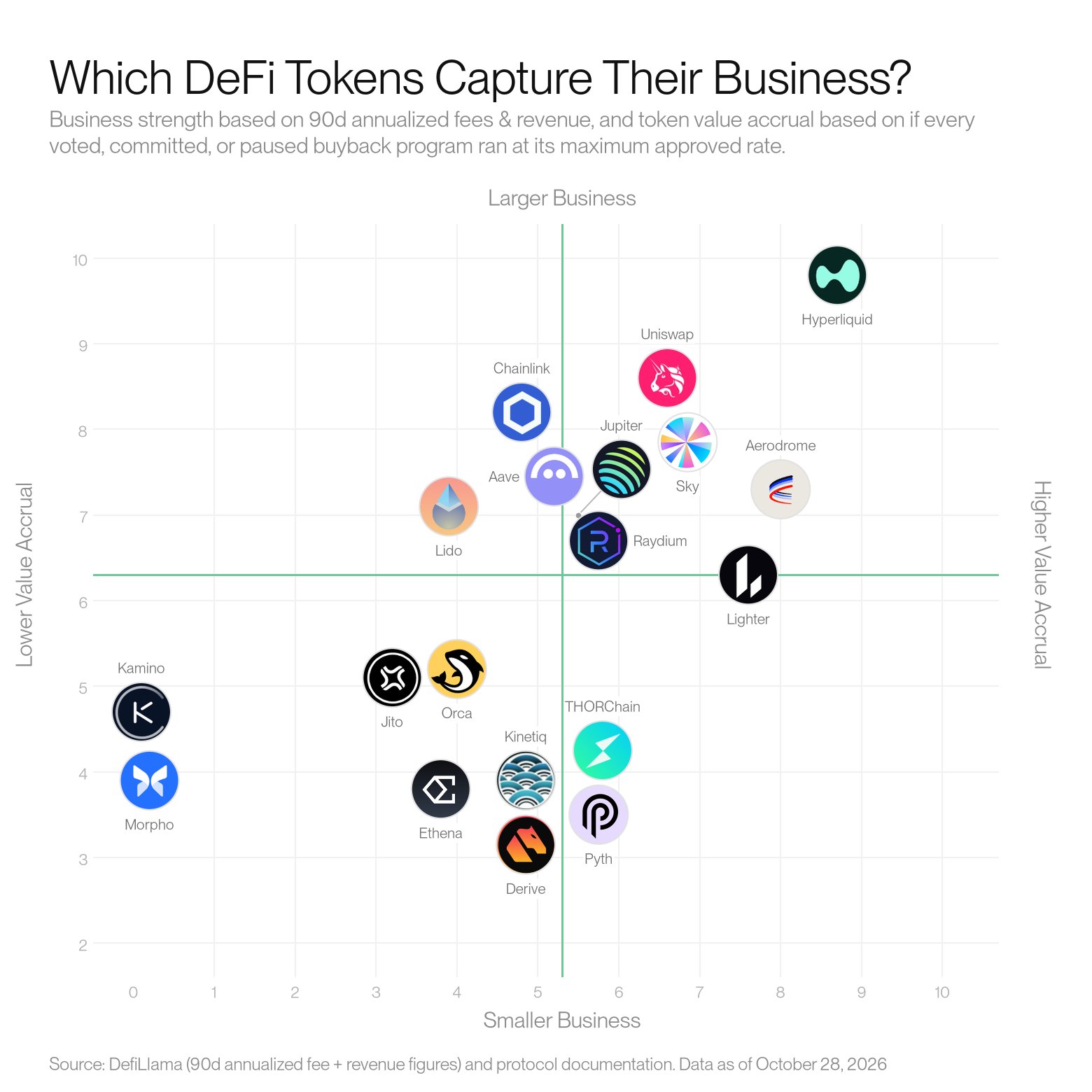
Useful map, with one axis missing.
The vertical measures what each buyback would pay if every approved programme ran at full rate, so a paused programme scores like a running one, and nothing shows whether the money comes from revenue or from emission.
Overlay burn plus distributions minus dilution and a few names in the top half move down. Hyperliquid stays where it is. Which of the twenty would you expect to move most?

Strong deal for Ripple. Worth being precise about for whom.
RLUSD: $2.4B, ~$99M a year in reserve yield at current bill rates. Ripple is now funding liquidity on Base, Coinbase’s own L2, and Coinbase converts USDC into RLUSD 1:1.
XRP needed for any of this: zero.
RLUSD is the perfect postage stamp. Fixed face value, issued on demand, no appreciation. Great business for the post office. The collector doesn’t earn on stamps.
Ripple the company and XRP the asset are diverging with every announcement.
The day I can buy Ripple shares, I’m in.


Honest post. One question though: institutions use rails, they don’t hold tokens.
If CC issuance scales with activity, it behaves like a postage stamp: more usage, more stamps, flat value per stamp.
Will staking be paid from fees or from emissions? Only one of those gives holders a reason to save.

A lot of noise about us not caring about retail. A few thoughts:
1. We definitely need to do more for the community. I’ve gotten good ideas on how to encourage more community-based activity and reward that.
2. We need to do a better job responding to voices on X and not wait for some of the good responses you’ve made.
3. We are exploring staking models.
4. We are focused on creating a long-term foundational activity that exists nowhere, and that just takes time.
Credit where due: this is more candid than most founder threads on inflation, and the staking arithmetic is correct. A staker’s dilution in token terms is the infra share, not the headline 3%.
Two things don’t survive contact with the thread’s own logic.
If price is made by marginal sellers, the model has to count every marginal seller. Stakers who harvest rewards as income sell emission just as surely as infra operators covering fiat costs. I would know — I hold FLR, I stake it, and I sell the rewards. By this thread’s own framing, I am part of the flow it leaves out.
And that flow is new, which may be why the model misses it. In the early years stakers compounded: rewards restaked, emission never touching the market. Four years into the drawdown a different cohort has formed — holders who keep the principal staked as an option on the network’s future and sell every reward while they wait. Staking has turned from a conviction trade into a waiting position, and waiting positions monetize. The longer the catalyst takes, the larger this cohort grows and the heavier the structural flow becomes: sell pressure that rises precisely because the price has not. A model calibrated on the stakers of 2023 is counting a population that no longer exists. The 0.6% is the floor of structural sell pressure, not the estimate of it.
Second, the target has quietly changed shape. In Seoul the mandate was supply reduction toward neutralizing inflation. Today the first goal is the infra share. Sequencing a target is legitimate. But a sequenced target needs a published number, and this thread contains ratios of emission only, none of income. So the useful question is simple:
What are FIRE’s absolute inflows to date, and at what rate are they growing? Burn plus distributions, less dilution, is a reportable figure. Against roughly 550M FLR a year for the infra share alone, that number decides whether the first goal is near or an order of magnitude away.
The mechanism deserves the benefit of measurement, not of doubt.

From observation I don’t think people are thing clearly about inflation and how it benefits or dis benefits them. Nor Fire.
Inflation on Flare is 3%. This is low across the space.
If you stake or delegate you get that inflation less the infra share of 20%.
This means that assuming you are staking or delegating your annual dilution isn’t 3% it is actually the infra share IE 0.6%. (It is in fact less as <100% of tokens are staked or delegated)
Infra costs (fiat) money to run, this means that a reasonable amount of that 0.6% probably does hit the market.
Price is formed not by esoteric thoughts on long term fundamentals but by marginal buyers and sellers.
Whilst FIRE’s long term goal is to completely neutralise all inflation, the first goal is to neutralise the primary source of needed selling generated by the network’s existence that comes from the infra share.
This is a much lower number and much more quickly attainable than the full 3% - whilst to reiterate that still remains the goal.
Flare passed its value-accrual rule in April with 98 percent support. The pool that rule created has collected $50,003 since May. The emission it is meant to replace runs to about $22 million a year. I hold FLR, so read on with that in mind.
FIP.16 did everything a holder could ask for on paper. Inflation cut from five to three percent, hard cap three billion FLR a year. Base gas fee up twentyfold and burned in full. A revenue pool named FIRE collecting ninety percent of data-connector fees, FAsset minting fees, a tenth of redemption fees, confidential-compute fees and, once block building changes ship, protocol-level MEV. Stated purpose: replace inflation with organic yield for stakers, buy and burn the rest. Staked FLR rose from sixteen to twenty-one and a half billion after the vote.
Then the dashboard. $24,700 from FAsset minting. $22,800 from the data connector. About $2,000 from redemptions. A few hundred from tag registrations. September's pace is fifteen to twenty thousand dollars a month against an emission worth roughly $22 million at current prices. Cumulative coverage: about 0.2 percent. On run-rate: under one percent.
None of that is a failure of the design. The largest intended revenue sources have not launched. It means the yield I receive as a staker is financed by inflation, and inflation-financed yield is rented. Flare will own its depth when FIRE pays for it.
Ethereum ran the same sequence in the other order. EIP-1559 landed in 2021 on a network that already had blockspace scarcity, so the burn was material from the first week. Flare installed the rule before the customers. That may be the only way a smaller network can make the rule credible. A rule is still priced as a promise, and a promise is priced differently from a cash flow.
The gap between XDP and FLR is that Flare wrote the rule into protocol and made the number public. The gap between FLR and HYPE is that Hyperliquid's number is large.
I will publish the ratio every quarter: FIRE inflow in dollars over FLR emitted times the quarter's average price. Two conditions before I call Flare an accrual network: above ten percent for two consecutive quarters, and the dollar inflow itself higher than the quarter before, because a price crash alone can clear the first bar. Ten percent is a judgement, stated now so it cannot move later.
What is the number at which you would call a promise a cash flow?


The FIRE figure comes from a public Dune dashboard; the emission figure from the FIP. If either is wrong, @tokenterminal and @DefiLlama are the two places that would show it first. What is the right denominator for "revenue covers emission": dollars, tokens, or something price-neutral?
👉 More DeepDives: janusthewatcher.substack.com

Expecting an event, you get a regime.
Post-war financial repression ran roughly 1945 to 1980. Thirty-five years of negative real returns on sovereign debt, no crisis date, no headline that marked the start.
The current arithmetic is already doing it. FY2026 net interest $1.05trn, about a fifth of federal revenue, growing 8% while revenue grew 3%. Interest outgrowing revenue is the snowball, and it isn't a forecast.
What delays the reckoning is the thing usually cited as reassurance. Being the least bad sovereign credit means no substitute is usable, and no substitute means no disciplining mechanism. Relative strength is what lets the degradation run long.
So the honest timeline is decades, not quarters; which is worse for anyone positioned for a break and better for anyone positioned for erosion.
Which of those two are you actually positioned for?

The USA's annual interest bill is already about a trillion dollars.
@dampedspring points out that if rates rose another percentage point across the board, annual interest would eventually rise by roughly $300 billion.
That takes us from one trillion to $1.3 trillion.
But the word "eventually" matters, because it takes years for that extra cost to work through the debt.
In an economy of more than $30 trillion, with decent growth prospects, that is painful but not fatal, and it does not automatically force massive QE.
The USA is still the cleanest shirt in the dirty laundry...

Janus the Watcher retweeted

I've met too many of each working in IT - what she's saying is 100% on point
A payment on the XRP Ledger settles in three seconds. That is the best fact about the network and the worst fact about the token, and the people who repeat the first part are usually holding the second.
Good payment money does not linger. A corridor that moves pesos to dollars through XRP holds it for the three seconds it takes to settle and then does not hold it at all. Every improvement in the rail shortens the holding period of the asset that runs on it.
The question is not whether the network is useful. It is whether anyone has a reason to hold the token longer than the network needs them to. There are three such reasons.
Float. Volume forces inventory. Ripple's own cumulative figure for Ripple Payments implies twenty to twenty-five billion dollars a year across all settlement assets. Assume all of it in XRP, which it is not. Held three seconds, that ties up about $2,400 at any moment. Held a full day in market-maker inventory, about $70 million, against a market cap that stayed above $50 billion at this year's low. Multiply the volume by ten and a day of inventory is seven hundred million, under one and a half percent.
Yield. The ledger burns fees instead of paying them, so that nobody is paid for producing blocks. That is its neutrality guarantee. The second reason to hold was designed out on purpose.
Monetary premium. People hold because they expect other people to hold, and because the thing has not gone away. Institutional buyers say this openly: they are confident it is not going away, and it fits applications they can understand. The ETF holder uses nothing. He holds, and the holding is the whole transaction.
Run the three past XRP and only the third survives. The usage story and the holding story are two different stories that share a ticker. One is about a product that works. The other is about a kind of money. Both can be true. They cannot be the same argument, and most of the community argues them as if they were.
I hold XRP as a core position. The essay takes the usage argument away from it and leaves it the monetary one.
Which of the two stories are you holding?


Three seconds is the time the network needs you. What are you doing with the token for the rest of the year?
@egragcrypto has argued XRP value capture from the fundamentals side for years; this is the arithmetic that side has to beat.
@WKahneman, the float number is the one to check first.
👉 More DeepDives: janusthewatcher.substack.com
The quietest sentence from @HugoPhilion in this talk carries the most weight: “The mechanism is working. What comes next is volume.”
There is now a clean way to score that sentence. Blockworks tracks Token Holder Net Income (THNI) - burn and distributions to holders, less dilution. It is the single number that separates a value-capture mechanism from a value-capture press release.
The comparison it forces is uncomfortable, and I hold flare-networks:native , so it is uncomfortable for me. Aptos passed a rule of the same shape as FIP.16 earlier this year: gas repriced 10x, staking rewards halved, supply capped. Its #THNI has been positive since May, with burn covering roughly ten percent of issuance - because daily transactions doubled at the higher fee. The customers existed before the rule did. Flare passed its rule in April; realized burn coverage stands near 0.2 percent five months later. Same mechanism, built honestly, waiting for a numerator.
Which is why the quoted sentence is exactly the right framing rather than a dodge. The levers are named in the talk: ~150M FXRP at ~90% utilization, ethereum:0x8292bb45bf1ee4d140127049757c2e0ff06317ed collateral status through an institutional risk framework, confidential compute with a first revenue-bearing use case.
Whether they move THNI is the entire question, and it is now a reportable number rather than a belief. The rule is the same for both chains: a sharing rule is not a sharing budget until revenue has survived a drawdown — and by that rule, neither aptos:native nor @FlareNetworks has earned the word productive yet.

🚨 MUST WATCH! 🤯 @HugoPhilion Full Presentation at XRP Soeul 🇰🇷 - Where #XRP Becomes Programmable Capital! 💰
This is one you don't want miss!
Link Below! 👇

Janus the Watcher retweeted

I think a world where XRPL is highly successful in financial applications but XRP does not have high demand and value is very unlikely. About the only way that could happen would be if we wound up in a world with one totally dominant settlement asset. That seems unlikely to me.