

WFLA-TV (Tampa Bay) Chief Meteorologist and Climate Specialist. BS Atmospheric Sciences Cornell U. MA Climate Columbia U. Past CBS News NY and Miami, Tampa, WPB
Tampa, FL
Joined November 2012
- Tweets44.9K
- Following9.6K
- Followers61.8K
- Likes82.9K





“Highest on record: The modelled urban area mortality toll for this year’s summer is
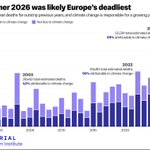
the highest in the 26 years since 2000, far in excess of the next highest in 2022
(about 29,000) and 2003 (about 28,000).” 2/

Of the estimated 50K deaths, 2/3rds were caused by carbon pollution driven warming. Link to papers… imperial.ac.uk/grantham/publ…

New: #Europe’s worst #heatwave on record comes with great consequence.
Two new peer-reviewed studies find: “Climate-driven impact: About 50,000 excess heat deaths are estimated to have occurred in 854 #European urban areas during summer 2026. About two thirds of the expected mortality total is attributable to climate change, primarily as a result of burning fossil fuels.” 1/

💨 Watch as the remnants of #Josephine slingshot a surge of wind from New England all the way down the Eastern Seaboard to #Florida. It’s going to be another #windy weekend with gusts 30-45 mph and rough surf on the East Coast especially on Sunday.
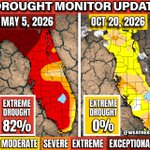
Fingers crossed 🤞 we’re done with the threat of a #hurricane for 2026!
November Gulf hurricanes are very rare. Honestly, given super El Niño #Isaias prob should not have happened - it defied the odds, partly due to record-warm water.
So the map is now updated to add Isaias. And boy, #Florida has really taken a beating over recent decades. And the #Gulf side especially over the past 10 years.
We’ve become a hardy folk!


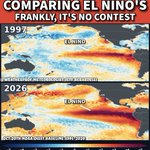
😮 Comparing El Nino’s Current State: 2026 makes 1997 look like Child’s Play!
Who lived in #Florida in 1997-1998? I was a whipper-snapper weatherman in #Tampa back then.
It was a crazy winter. The strongest El Niño on record brought Florida’s worst #tornado outbreak and more than triple the normal winter rainfall. 🌧️
In the image below I made an apples to apples comparison of sea surface temperature anomalies on Oct 20th. I thought it would reveal a closer comparison. Instead it shows 2026 is simply in a league of its own. Thus we expect big impacts on the winter weather. It’s important to note though that every El Niño event is different. We know it will be very active and wet in Florida, but we simply don’t know exactly how and where it will materialize. Tornadoes are more likely, but not guaranteed. It will be rainier than normal, but 3-4X like 1997? We just don’t know yet. #elnino #elniño

There's no doubt climate stresses are adding stress to various aspects of our lives, especially in certain places, whether it be economic, health, anger, anxiety, etc...
As with spikes in migration it is typically a mix of many factors, and unfortunately it is very hard to parse out how much each contributes individually.
For example: We never go to the grocery store and wonder if climate stresses are partially to blame for why certain goods have spiked in price. We should. Because in many cases it is reality.


As Eric mentions this is the most East-Based El Nino we know of - by a long shot. That dictates how much of an impact it will have on winter weather globally. Typically some of the biggest impacts are in the Southern US from CA to FL. The intensity and position of the El Nino determines how big/ where those impacts will be. Given how huge the impact was in 1997, it will be interesting to see how this episode varies. For certain we expect an oversized impact but one thing you can be sure of: no two events are alike - they all have their own character.


This is 100% correct.

I don’t think Europeans fully appreciate what is happening to the European Union right now.
The EU is under an extraordinary, multi-front assault, both from outside and from within. And I struggle to think of another period in its history when so many powerful actors had an interest in weakening it simultaneously.
Russia has spent years waging hybrid warfare against Europe. Weaponised migration, sabotage, cyberattacks, coordinated disinformation campaigns, bot networks and political interference. The objective is clear: undermine trust in democratic institutions, deepen social divisions and weaken European unity.
China has different motivations, primarily economic and geopolitical. A fragmented Europe is easier to pressure, easier to negotiate with individually and less capable of defending its economic interests.
And then there is the United States. Perhaps the most disturbing development of all.
Under Trump and MAGA, a country that helped rebuild the old continent and then spent decades supporting European integration now has an administration openly hostile to much of what the EU represents. Its own National Security Strategy even calls for cultivating resistance to Europe’s current political direction.
Think about that for a moment.
Meanwhile, within Europe, parts of the far right and far left amplify these divisions, whether through ideological alignment, political opportunism or outright sympathy for authoritarian regimes.
This doesn’t mean Russia, China and MAGA are all following some jointly coordinated master plan. They don’t have to. Their interests increasingly overlap, and Europe’s internal divisions make their work considerably easier.
What makes this particularly alarming is what is actually at stake.
For all its flaws, the EU remains one of the world’s most consequential projects built around liberal democracy, the rule of law, individual freedoms and cooperation between nations.
At a time when authoritarianism is gaining ground and even longstanding democracies are showing disturbing tendencies, that matters enormously.
Europe is far from perfect. Its bureaucracy, indecision and inability to act decisively are real problems. But the answer cannot be to retreat into 27 competing nation-states, each too small to meaningfully influence a world increasingly dominated by continental powers.
Quite the opposite.
Europe needs deeper integration, stronger common institutions, genuine strategic autonomy and the political courage to defend its interests and values.
Because fragmentation is precisely what so many external actors want.
And perhaps that’s the central irony of our time: people are being deliberately manipulated into believing that the reverse is true — that national identity and sovereignty can only be protected by weakening European cooperation. In reality, a divided Europe is less sovereign, less secure and far easier for outside powers to pressure. Therefore the very thing that will make Europe stronger is the thing its adversaries are working hardest to prevent.
A united Europe is a geopolitical power. A divided Europe is a collection of countries waiting to be played against one another.
See that buoy in red? It’s on the far SW edge of the eye wall. Far away from the lowest pressure. It still measured 909mb! #Champi


A heroic drifting buoy recorded quite the deep pressure of 909.4 mb in the southwest edge of #Champi’s eye, implying a central pressure <900 mb.
Satellite presentation is at the very upper end for a ~30-35 nm diameter eye — given fast movement, 165 kt is a reasonable estimate!


Jeff Berardelli retweeted

Matt, here is the dirty weather content you ordered. Please tip appropriately, this is my only income source.

Jeff Berardelli retweeted

Subsurface temperatures in the equatorial Pacific have soared 12°C (21.6°F) above average, the highest of this El Niño, with actual temperatures reaching 33.4°C (92.1°F).
The y-axis maximum was raised again to accommodate this extreme warmth.
We are witnessing climate history.

“The instrument changes were partly motivated by a push to narrow the satellites’ applicability to weather forecasting, rather than conducting climate research as well. Among the instruments that were nixed: a tool to monitor air quality, including hourly monitoring of wildfire smoke; as well as one meant to study water quality and ocean currents, along with harmful algae blooms.”

The Trump administration’s cuts to weather satellites will set the country back nearly a decade, experts say. The loss of data used to observe, forecast and research extreme weather could prevent the US from making major advances in weather prediction in the coming years. cnn.it/4k6eD4o


Jeff Berardelli retweeted

“The best climate change documentary I’ve ever seen.”
That’s what Jeff Masters wrote about Weather Under Fire in Yale Climate Connections, and I’m still trying to find the words for how much that means to me. Jeff co-founded Weather Underground and flew into hurricanes with the NOAA Hurricane Hunters, and I grew up reading his work as a weather geek, so hearing that from him is something I am blown away by.
I may be the one on the film poster, but this film is much bigger than my story. It’s about the meteorologists across the country who are being threatened and silenced for explaining the science, and about the cuts to the National Weather Service that leave all of us less safe. It’s also about what happens to a nation when the people trying to warn us about extreme weather are pushed out.
The film is complete - what’s left are the final touches. We’re raising this last bit of money now, because keeping Weather Under Fire independently funded has been a goal from the start so that we never had to give up our editorial independence. If you’d like to help get it over the finish line, contributions are tax-deductible: donate.mazloweb.com/donate/t…
This Wednesday, October 21, at 7:30 PM ET (4:30 PM PT, 6:30 PM CT), director Sarah Gibson, Jeff and I are hosting a 30-minute Zoom. We’ll share clips from the film and take your questions live, and Jeff will close with a preview of what the strengthening Super El Niño could mean for California this winter.
To get your invite, RSVP at [email protected]
Please share/pass along!

The sea was angry that day, my friends… like an old man trying to send back soup at the deli!
Nor’easter/ Potential Subtropical Storm Stirring up an Angry sea. Waves up to 40 Ft offshore. Rough surf, rip currents and coastal flooding along Florida’s East Coast this week. #florida
