
I advocate for what is good.
Joined November 2024
- Tweets177
- Following162
- Followers131
- Likes172


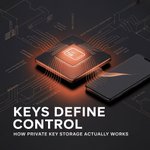


There is a quiet problem that shows up when power cuts or networks go down for hours.
People can still see their balances on a phone if they have any charge left.
But moving anything becomes difficult or impossible if the only place the keys live is that same device.
The money
🤖 Made with AI

review and tap when signing is needed. The keys stay on the card.
This does not solve every problem.
It does change one specific risk: the moment the phone is offline, lost, or compromised, the keys are not automatically lost with it.
In places where electricity and internet
🤖 Made with AI
1
12
The phone doesn't have to do everything.
It can show you what you're about to approve, while another device handles the actual signing. Simple distinction, but it makes you think differently about how wallets should work.

Software wallet vs hardware wallet
The difference isn’t only what they look like. One of the most important differences is where transaction signing happens.
With a software wallet, the keys live on the device running the wallet.
That makes access convenient — but the same device is also exposed to apps, websites and other software.
A hardware wallet creates separation. The interface can live on your phone while the private key remains on dedicated hardware.
With United Network, that dedicated hardware is the card.
You review the transaction on your phone and tap the card to authorize it.
The signing happens on-chip. Your phone handles the interface.
Your card handles the key.
That separation is the point of hardware security. 👉united.network

1
19
Blessing Frank retweeted

Most people don’t lose funds because crypto is complex.
They lose them because they trust the wrong interface.
Extensions.
Pop-ups.
Blind signing.
At some point, you stop verifying.
You just click.
That’s the real risk.
Self-custody isn’t about doing more.
It’s about removing everything you can’t trust.
That’s why United Network is built around hardware-level trust.
Check 👉united.network

Blessing Frank retweeted

It was a swell time that we had at Do_Action Uyo 2026.
The faces of the participants is proof that we had fun.
It was honour to serve as the Emcee for this event.
Anyways "beans is Overrated"🙂↕️
#Emcee_in_Uyo
#Do_Action2026
#TechforGoodeverytime
self-custody to win, the friction has to disappear.
We can’t expect everyday users to manage clunky USB setups and multiple passphrases without eventually making a fatal human error.
Cold storage needs to feel as easy and thoughtless as using a bank card.
This is why the
1
6
industry needs more passive, low-friction options.
Things like the @UN_wallet NFC card approach (offline cold storage that works with a simple phone tap) are the kind of direction that starts removing the complexities.
Make self-custody simple enough.
6
Bull market preparation isn't just about picking the right tokens; it's about making sure you don't lose them.
If you are actively connecting your wallet to multiple new platforms right now to farm airdrops, your exposure to wallet drainers is incredibly high.
Please

1
16
sense for highly active users: it completely solves the "convenience vs. security" dilemma.
Traditional hardware wallets are incredibly clunky, nobody wants to carry a bulky device around all day or deal with Bluetooth pairing errors during a fast-moving trade.
A secure
1
1
Blessing Frank retweeted
📉 When volatility hits, your hardware wallet shouldn't be the bottleneck
Missing a critical swap because your cold storage device is out of battery, lost its cable, or requires a mandatory 15-minute firmware update is unacceptable.
The United Network card is always awake.
Zero boot time. Just an instant NFC tap the exact second you need to execute a move.
Execute at the speed of a tap 👉 united.network

Blessing Frank retweeted
🛂 Stop calling it a "hardware wallet". It’s your physical passport to Web3
The United Network card it’s about moving freely through the decentralized internet. No software borders. No App Store gatekeepers.
Tap into 14+ networks, sign transactions, and interact with dApps instantly – all from a single, bank-grade NFC card in your pocket.
Claim your access 👉 united.network

Has anyone else actually tried these NFC setups yet like the one from @UN_wallet, or are we all still fighting with Bluetooth?
I’ve been thinking about this a lot because traditional hardware lag honestly punishes every tier of the market.
For arbitrage players, a 15-second

1
14
can now just tap a card to your phone to authorize a transaction instantly, while keeping keys entirely offline, completely changes the dynamic.
When you remove that physical bottleneck, it gives the necessary edge back to the arbitrage guys, protects the active traders,
1
7