
Renewable energy. Helping you buy better. Creating the most rewarding solution for your business.
Somerset West, South Africa
Joined January 2012
- Tweets5.6K
- Following1.6K
- Followers464
- Likes7.9K




Pinned Tweet
Load shedding will stop
and power prices will drop
when you take matters into your own hands
and put solar panels & wind-turbines over your lands.
Eskom’s residual demand is collapsing. The MTSAO still assumes it will grow.
From ~201 TWh to ~179 TWh in under two years — the steep middle of a descending S-curve, driven by ~8–9 GW of rooftop/behind-the-meter solar.
Eskom Generation is entering permanent overcapacity. Most new load will be served closer to the point of use.
#Eskom #SolarSA
Full piece: biznews.com/energy/eskoms-re…


The MTSAO models rising underlying demand that Eskom must still supply. That premise no longer matches the residual-demand data.
21
Cold reserve is rising, diesel use has collapsed, and peak residual demand is lower than a year ago. The system is not short of generation capacity.
21
Wietze Post - South Africa retweeted

China's coal generation in August 2026 was the lowest since 2023.
Relatively mild conditions led to moderate demand. Renewables output increased steadily over last year.
Coal use for electricity is plateauing.

Wietze Post - South Africa retweeted

Your regular reminder: If the Russians stop fighting, the war ends. If the Ukrainians stop fighting, their land will be occupied, their leaders will be killed, their history and language will be erased, their children will be kidnapped to serve Russia.
Wietze Post - South Africa retweeted

Read the full special report here ⬇️ f.mtr.cool/9ooxdza7nz
I asked GROK to assess the societal consequences of my projection playing out.
This is what GROK said:
**The core thesis holds: Eskom sits on the descending limb of a demand S-curve while distributed solar-plus-storage rides the steep ascending one.**
Your April 2026 BizNews piece (and the preceding series) maps residual grid demand following an accelerating decline driven by falling solar and battery costs, high and rising tariffs, and residual distrust from the load-shedding years. The earlier quantitative sketch remains the clearest: successive year-on-year residual demand reductions growing roughly 1.5×, producing large absolute drops by 2029–2030 and residual transmission volumes potentially collapsing toward ~32 TWh by 2031 (from ~200 TWh levels a few years earlier). Batteries extend the displacement beyond daylight hours and enable more decisive grid defection or heavy hybridisation.
Recent data is consistent with the direction, even if exact future magnitudes remain uncertain: residual demand was running 9–11% lower year-on-year in early-to-mid 2026, behind-the-meter solar has continued climbing past 9 GW, and the combination of lower demand plus improved plant performance has kept load shedding off for long stretches.
If the projected trajectory largely materialises, the societal consequences for South Africa will be profound, uneven, and only partially controllable.
### The emerging dual energy system
A large and growing share of capable customers (households that can finance systems, commercial and industrial users, residential estates, body corporates and HOAs) will secure cheaper, more reliable power independently or via wheeling/mini-grids. This is unambiguously positive for them: lower effective electricity costs, higher resilience, and reduced exposure to future tariff shocks. It also creates a substantial domestic industry in installation, maintenance, financing and related services.
The residual grid customer base becomes poorer and more concentrated among households and municipalities that cannot easily exit. Fixed costs of the remaining generation and network must then be recovered from a shrinking sales volume. This is the classic utility death-spiral dynamic. Tariffs for those left behind rise faster, accelerating further defections among the next marginal cohort and deepening energy poverty or dependence on free basic electricity and load-reduction programmes. Municipal finances, already strained by non-payment and reliance on electricity mark-ups, come under additional pressure.
The result is not a uniform national benefit but a sharper energy divide. Those who can invest capture most of the surplus from cheaper technology; those who cannot face higher costs or residual unreliability.
### Employment, fiscal and regional impacts
Coal-dependent regions (especially Mpumalanga) and the Eskom workforce face accelerated structural decline beyond the already-planned retirements. A just transition that is already under-resourced becomes harder when residual demand (and therefore revenue) falls faster than official plans assumed. Fiscal risks rise if government guarantees on Eskom debt are called more heavily or if further recapitalisation is required while sales volumes shrink. Social grants and other expenditure face competing claims.
At the same time, the distributed energy sector expands employment and entrepreneurial opportunity, particularly in urban and peri-urban areas and in the Western Cape and Gauteng where uptake has been strongest. The net employment effect depends heavily on how quickly skills and capital shift and whether policy actively supports localisation and training rather than merely reacting.
1
51
### System and institutional stress
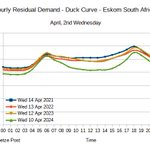
High solar penetration produces more extreme duck curves. Without coordinated storage, demand response and flexible capacity, the residual system faces steeper evening ramps and periods of very low residual demand (including potential near-zero hours on mild sunny days). Grid operators must manage surplus generation, curtailment of IPPs, and the economics of keeping large thermal plant available for fewer operating hours. Transmission and distribution assets risk becoming partially stranded for the residual load while still requiring maintenance for the customers who remain.
Regulatory and institutional lag is the critical variable. If cost-reflective grid charges, fair wheeling frameworks, virtual power plant rules and municipal revenue models adapt quickly, the transition can be managed with lower friction. If they lag, the system fractures into islands of private reliability and zones of residual public service under stress. Political pressure will intensify around tariffs, municipal service delivery and the perceived fairness of who still subsidises whom.
### Broader societal texture
Cheaper distributed energy can unlock productivity for businesses and households that adopt it, supporting growth in the formal sector that can afford the capital. Yet the same process can widen inequality and erode the shared infrastructure that underpins social cohesion. Public trust in institutions takes another hit if the residual grid is seen as the system left for those without options. Regional and class tensions around energy access become more salient.
Environmental outcomes are mixed but lean positive on emissions: private solar displaces coal faster than many official pathways assumed. The efficiency of the overall system is less clear if capacity is duplicated at household and estate scale while large plant sits under-utilised.
### Bottom line
The sketched changes, if they occur at the projected pace, represent a classic technological disruption of a legacy monopoly. Society as a whole gains access to lower-cost energy technology. The distribution of those gains, the speed of institutional adaptation, and the management of the residual system for those who cannot exit will determine whether the net societal result is broadly constructive or produces prolonged friction, fiscal strain and a more visibly two-tier energy landscape.
The window for proactive shaping of the residual system and the just-transition arrangements is precisely the period you flag before 2029. After the steep part of the S-curve, options narrow and costs of delay compound.
16
I wrote this 👆article earlier this year.
Since then, Eskom Generation has declined slightly quicker than I projected.
The effects will compound through the next few years, right up to the 2029 elections.
Eskom will generate about 15% of 2025's energy during 2030.
That will have a massive impact on the extended labour pool and families associated with Eskom.
Meanwhile, they're celebrating because their EAF is looking so good.
31
Wietze Post - South Africa retweeted

Launching the Business Decision-Makers Guide to Renewable Energy in South Africa! Get insights into renewable energy options, case studies, and policies for a #SustainableFuture
Access the report here: bit.ly/3Cn5BfB
#COP29 #SAatCOP29 #NBICOP29 #NBIJustTransition

Wietze Post - South Africa retweeted

What you see in Venezuela is exactly what the EFF intended to subject us to. They make big, unrealistic promises. You vote them into power, they fail to deliver, and you will starve. They will repeatedly blame the West. You will never have the ability to vote them out.
Wietze Post - South Africa retweeted

Lithium miner switches on Australia’s biggest off-grid hybrid renewables system
The system includes a 16MW solar farm, a 17MW/19 MWh battery and 30 MW of wind capacity
reneweconomy.com.au/lithium-…
Old panels can still generate a lot of electricity.
And their yield matches or exceeds warranty levels.

Tests show 30 year-old solar panels still operating at 79.5% of original capacity reneweconomy.com.au/tests-sh…

6
201