

With your help, we rescue and care for orphaned, injured and exploited wildlife. To notify about an animal in need please call hotlines listed on our website.
INDIA ० USA ० UK
Joined August 2008
- Tweets14.9K
- Following8.7K
- Followers49.9K
- Likes20.8K




Pari once knew nothing but a life of begging and long hours in chains. Today, she is discovering the joy of living life!
The infinite amount of joy it brings us to see Pari express herself so freely! She absolutely loves her pool and could spend hours in it, splashing around with childlike joy, making bubbles with her trunk, and showing off her amazing dives! Watching her enjoy herself like this makes our hearts so full.
Every elephant deserves to experience this kind of freedom, where they can play, explore, and simply be themselves. 💚
Did you know elephants have a built-in windshield wiper for their eyes? 👀
And that’s just one of the many fascinating things about elephant eyesight! From seeing the world in shades of blue and yellow to having blind spots right between their front legs, these gentle giants experience the world quite differently from us.
Curious to learn more? From the science behind their vision to the incredible ways our veterinary teams care for their eyes, discover the secrets hidden in those beautiful eyes.
Read our latest blog: news.wildlifesos.org/keeping…

Have you ever seen a house with a board reading: ‘Beware of the Dog’?
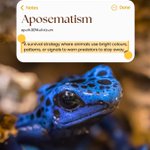
Aposematism works just like that, but with a little twist. In nature, the language of danger isn’t written on signboards, it’s boldly painted on the beings themselves. Simply put, aposematism is a survival strategy where animals display bright colours, bold patterns, or unique sounds to warn predators that they’re dangerous, toxic, or just unappetising. It’s the biological equivalent of delivering the critical message: “Approach at your own risk.”
Stay curious with Wildlife SOS’s Word of the Week as we explore the language of the wild!

Jasmine once spent her days begging on the streets. Today, she is rediscovering her childhood. 💚
Jasmine spent decades giving rides to people, begging on the streets, and being paraded at events and ceremonies. Now, her days look a lot different. She loves spending time in the pond or pool (she's a total water baby!), spraying water with her trunk, digging little holes in the ground to scoop up mud, and taking mud baths.
It’s heartwarming to see Jasmine enjoy these simple pleasures and embrace the little things that make her happy. After decades of being made to work for people, she now has the time and space to explore, play, and do the things she enjoys most.
Jasmine’s story reminds us that elephants belong in the wild, not on busy streets, carrying people or being made to perform for entertainment. Watching her splash around in the pond is a reminder of all the natural behaviours they are forced to suppress when kept in captivity for human use, and of the joy they deserve to experience.
What if a squirrel scurried past an elephant from behind? Would the elephant see it?
Despite their wide field of vision, elephants have blind spots both in front of and behind their bodies. While they’re good at noticing movement around them, something sneaking through these areas might go unnoticed!
From binocular vision to a special third eyelid and long, protective eyelashes, discover how elephants see the world through this little glimpse into their fascinating anatomy!

It melts our hearts to see Manu, a blind elephant, finding his own way now, all by himself.
When Manu came into our care last year, he was severely weak, with painful joint issues and wounds after decades in the begging trade. We knew that helping him would take time, patience and, most importantly, trust. We had to let him move at his own pace, give him the space to explore, and make sure he always had the care and support he needed.
Today, watching Manu make his way to the pool is a joy in itself. He takes his time, carefully feeling his surroundings with his trunk and checking each step as he moves forward. He has learnt to navigate his world in his own way, one step at a time.
His caregivers are always close by, ready to guide him if he loses his way or needs a little help. But seeing him find his own way to a place he loves, with growing confidence, makes all those little steps feel so special.
We couldn't be happier for you, Manu.
This six-foot-long python was found inside a government waterworks pump house in Agra, a place no one quite expects to find a wild snake.
When the Indian rock python was spotted, Wildlife SOS’s Rapid Response team was called in to help. The team carefully rescued the snake and, in the presence of Forest Department officials, released it into a suitable natural habitat.
Sometimes, wildlife finds its way into spaces we share with them, and these encounters can catch us by surprise. But with a little caution and the help of trained rescuers, they don't have to end in conflict. The right response can make all the difference, keeping both people and wildlife safe.


#DidYouKnow? The word Lepidoptera comes from Greek, combining lepis (scale) and pteron (wing), referring to the tiny scales that cover the wings of butterflies, moths, and skippers!
The natural world is full of fascinating discoveries, and sometimes, even the words we use to describe it have a story of their own.
Introducing Word of the Week, a new series by Wildlife SOS where we explore interesting wildlife terms, uncover their meanings, and learn more about the incredible world around us.
How many of these wildlife terms have you come across before? Follow along to discover more fascinating words from the world of wildlife!

Some scratchy-scratchy time for Tara!
When you have an itch and no one around to scratch your back, find yourself a good tree! 😂
A deep pit. Five hours of draining. And a tiny crocodile hiding beneath the water.
Recent monsoon showers in Agra left a wastewater pit behind a home in a village in Etah filled with rainwater, and brought an unexpected visitor, a young crocodile measuring just three feet long.
When locals spotted the crocodile in the deep, murky pit, they reached out for help. The Wildlife SOS rescue team arrived and began carefully draining the water, but there was one problem: no one knew exactly where the crocodile was hiding.
For nearly five hours, the team worked through the water, keeping a close watch for any movement. Then, a glimpse of the crocodile in one corner gave the team the chance they were waiting for.
The crocodile was safely rescued and released into the nearest suitable water body, where it could return to the wild.


Wildlife SOS hosted a session for a Forest Department training batch from the Chikhaldara Training Centre, Maharashtra, at the Manikdoh Leopard Rescue Centre (MLRC), run in collaboration with the Maharashtra Forest Department.
The session offered a closer look at wildlife rescue and rehabilitation, from understanding animal behaviour and health to learning about rescue processes, rehabilitation, and the care provided to animals post rescue.
We deeply appreciate the Maharashtra Forest Department’s continued efforts towards strengthening wildlife conservation and building knowledge among the frontline teams working to protect both people and wildlife.


This black kite should have been soaring over Delhi. Instead, it was found grounded and unable to fly. 🪶
Concerned locals spotted the injured bird at Jawaharlal Nehru Stadium and alerted the Forest Department, who contacted the Wildlife SOS Rapid Response Unit.
Our rescuers found the kite with a severe wing injury that appeared consistent with a string-related cut. It was carefully rescued and brought to our transit facility, where our veterinary team is treating the bird and closely monitoring its condition.
We’ll continue to monitor its recovery and provide the care it needs.

Happy 12th Rescueversary, Lilly! 🌸🐘
Playing in the mud, sharing fruit with her friends, finding the perfect spot for a quick nap, and, of course, stretching her trunk towards the tallest branch she can reach, Lilly has certainly mastered the art of enjoying the little things in life.
Playful and curious, Lilly always seems to find a little mischief wherever she goes. But 12 years ago, Lilly’s life looked very different.
In 2014, she was rescued from Sirsa with the Haryana Forest Department after being used as a begging elephant. She had been made to walk the streets, carrying the burden of a life she had never chosen.
If there’s one thing Lilly continues to remind us, it’s that there is always time for a little fun!


This #WorldWildlifeWeek, 350 students got to know their neighbours a little better!
During the monsoon, snake encounters often increase, making awareness especially important in communities living close to wildlife.
At Otur village in Maharashtra’s Junnar Forest Division, our team held an interactive snake awareness session for students, covering what to do (and what not to do) during an encounter, precautions to take if a snake enters a home, and how to respond safely.
The students had plenty of questions of their own, making the session a conversation rather than just a classroom lesson.
In places where people and wildlife share the same landscape, knowing how to respond can make all the difference. Spreading awareness in remote communities is an important step towards safer, more informed coexistence with wildlife.


Everyone likes a good toy!
And if, along the way, you get to sharpen your instincts, exercise your brain, and burn off some energy, that’s an added bonus!
For our resident bears, enrichment works much the same way. It gives them new ways to explore, problem-solve and stay engaged throughout the day.
The hanging disc enrichment is a particular favourite. Wooden discs with small holes are stacked together and filled with dates, while a drizzle of honey adds an irresistible scent to draw the bears in.
But getting to the treats isn’t quite so simple! The bears have to use their strong, curved claws, adapted for digging into ant and termite mounds, to either dig out the dates or use the powerful suction of their specially adapted muzzles to slurp them out.
And there’s another challenge: the entire enrichment hangs from a rope that swings and moves as they interact with it. So, while reaching for their treats, the bears also have to find their balance and figure out the best way to tackle the moving discs.
What looks like a simple enrichment item therefore becomes a full workout for both body and mind, a chance for our bears to follow their instincts, put their problem-solving skills to work and, of course, enjoy a few delicious rewards along the way!

What does it really take to end a cruel practice that has been part of a community’s livelihood for generations?
For the Kalandar community, moving away from the ‘dancing’ bear practice was never simply about ending an exploitative tradition. It meant creating new possibilities for families whose lives and incomes had long been connected to it.
That is why lasting conservation must go beyond rescue. Through the Tribal Rehabilitation Programme, Wildlife SOS has worked alongside Kalandar families to support children’s education, build sustainable livelihoods, and create opportunities for women to gain greater financial independence.
By addressing the circumstances that once pushed people towards wildlife exploitation, we can help create change that lasts, where children can grow up with new opportunities, families can build secure futures, and animals are no longer part of a livelihood.
Because sustainable change begins with systemic transformation.


Keystone species. Umbrella species. Ecosystem engineers. Biodiversity protectors.
From dispersing seeds and finding hidden water sources to creating pathways, feeding insects and even making tiny habitats with their footprints, elephants play a role in keeping the forest alive.
They may be the giants of the wild, but their impact reaches far beyond themselves. In so many ways, elephants are the life of the forest.
This Elephant Appreciation Day, we’re celebrating the remarkable ways these gentle giants help an entire ecosystem thrive.
