

Catalyzing responsible innovations for disaster resilience. Science, strategy, and talent solutions. @ShefJL @AnukoolLakhina
San Jose, California
Joined May 2021
- Tweets244
- Following342
- Followers142
- Likes305






Pinned Tweet
Seasonal forecasting is not the constraint on El Niño preparedness. Translation is.
Forecasts are being issued by dozens of agencies on different cadences, at different scales, in different confidence languages, and with horizons that mostly stop short of the lagged consequences that arrive a season or a year after the event peaks. The work of reconciling them falls on the local coordinator/ agency with the least time to do it.
To help with local planning, Wonder Labs' El Niño Hazard Board and accompanying Action Briefs provide a regional synthesis covering 23 regions of North America for 14 hazards across two horizons, with every cell sourced, confidence-marked and evidence-tiered wonder-labs.org/initiatives/…
A method note now documents how a regional hazard synthesis for North America separates the strength of the El Niño signal from absolute risk, carries a second horizon for hazards that arrive a year late, and publishes an evidence tier for every hazard it covers — including the ones where the honest answer is that no forecast exists.
Other regions are invited to adapt it. Reach out, we're here to help!
#ElNiño #preparedness #NorthAmerica #disaster #resilience

Five featured roles, five completely different ways to work in fire, forestry and conservation — contract, seasonal, state, startup and the federal frontline.
INDUSTRY
Hydrologist (Contract) · Blumen · Remote
FEDERAL AGENCY
Youth Conservation Corps Coordinator · National Park Service · Acadia NP, ME · GS-07, seasonal
STATE AGENCY
Forest Legacy Program Manager · Arizona Dept of Forestry & Fire · Statewide, AZ
FIRETECH
Senior Product Manager · Technosylva · Boston, MA
FEDERAL AGENCY
Wildland Firefighter, Fire Effects & Fuels Monitoring · U.S. Wildland Fire Service · El Portal, CA / Marblemount, WA
There's a path for every stage. Explore these and 3,700+ roles at jobs.fire-up.net
#WildfireJobs #Forestry #Conservation #FireTech #PublicService #FireUp #CareerPathways #GreenJobs

Also check out FireUp's Career Pathways Toolkit for 30+ career pathways into fire, forestry, conservation work with 10+ employer types: career-pathways.fire-up.net/
Wonder Labs retweeted

For years, governments and communities have poured money into fighting wildfires and recovering from them.
But often overlooked are the benefits of reducing the risk that wildfires become catastrophic in the first place. A decade ago, Forest Resilience Bonds was developed as a solution.
Ten years in, its benefits are taking shape on the ground👉 go.wri.org/forest-resilience…

Wonder Labs retweeted

California, prepare for gusty winds and elevated fire risk.
Strong winds are possible Thursday through Saturday, including a moderate Santa Ana wind event in Southern California. The Los Angeles and Ventura valleys and San Gabriel Mountains could see particularly strong gusts.
⚠️ Stay safe:
- Secure outdoor furniture and loose items.
-Avoid activities that could create sparks and start a wildfire.
-Sign up for local emergency alerts and follow guidance from local officials.
Stay alert and get the latest wind and fire weather updates at weather.gov.
Fire, forestry and conservation careers run wider than you'd think — from the work of natural resource specialists to the engineers building wildfire-detection satellites. Some of this week's highlights from the FireUp job board:
STATE AGENCY — Service Forester (NRS2)
Washington Dept. of Natural Resources · Spokane County, WA · $4,517–$6,075/mo
NON-PROFIT — Marine Conservation Director
The Nature Conservancy @nature_org · Honolulu, HI · $119,500–$129,500/yr
STATE AGENCY — Deputy State Fire Marshal III
State of California · Humboldt County, CA · $8,773–$11,882/mo
INDUSTRY — Natural Resources Team Lead
SWCA Environmental Consultants · Albuquerque, NM
FIRETECH — Mission Lead Systems Engineer, EO/IR
Muon Space · Northern Virginia, VA · $177K–$246K/yr + equity
Different entry points, shared mission. These + 3,600 more → jobs.fire-up.net/jobs Apply today! #fire #forestry #conservation #jobs #careers

Need your job featured next week? Submit your job link here: fire-up.net/employers

Wonder Labs retweeted

Do you have flood insurance? NOAA projects a record year of US coastal flooding this winter, and at the worst-hit stations it runs past 40 days. Not from one storm. It's forty+ separate days of salt water in the street.
Flood insurance takes 30 days to start working, and the date to make it work for you is 31 October. The standard NFIP waiting period is 30 days, with narrow exceptions mostly tied to loan closings. A policy bought in late November does not cover a loss in early December. Coverage has to be in force before the water arrives, which means buying by roughly 31 October if you want to be covered for what this winter is most likely to do.
There is a second clock, and it is the less well known of the two. NFIP authorization expires at midnight on 11 December 2026. During a lapse FEMA cannot write new policies or renew expiring ones, and the program has lapsed twice in the past year — for six weeks from 1 October 2025, and briefly in February 2026.
Policies already in force are unaffected: they run to their expiration date plus a 30-day grace period, and claims continue to be paid. That is exactly why the date matters. Buying by 31 October puts you in force ahead of both clocks rather than hoping Congress clears the second one in time.
Why December specifically? A record-strength El Niño drives an enhanced subtropical jet across the southern tier of the United States. That means river and urban flooding across the Southern Plains, the Gulf Coast and the Southeast, and atmospheric rivers on the West Coast.
Two things people get wrong.
The first is burn scars. If you are downslope of a recent fire, debris flow is a different question from flood, and it runs with far less rain than you would expect. That is the Southern California hazard this winter. Check both exposures rather than one. And if you are a county or a district rather than a household: CW3E’s atmospheric river alert service opened on 1 October and runs to 1 May. An AR3-or-higher forecast is the cleanest pre-positioning trigger available, and it is free.
The second is the flood map. Being outside a mapped high-risk zone is not the same as being outside the risk, and it is also where coverage is cheapest. If you have been letting the map answer the question for you, this is the month to double check your exposure.
If you own property in the Gulf Coast, the Southeast or near a recent burn scar in California, this is the week to look at your flood insurance.
#flood #insurance #disaster #resilience #ElNino
🧑💻 Delighted to feature UBC's Faculty of Forestry & Environmental Stewardship open position for a tenure-track Assistant Professor of the Social Dimensions of Wildfire on the FireUp job board!
🎓 ABOUT: The UBC Faculty of Forestry and Environmental Stewardship is one of the world’s leading academic institutions in forestry, conducting both national and international research, and providing undergraduate education encompassing Forest Resources Management, Forest Operations, Urban Forestry, Forest Science, Natural Resources Conservation, Bioeconomy Sciences and Technology, and Wood Products Processing.
🌲 JOB: The Department of Forest Resources Management in the University of British Columbia’s Faculty of Forestry and Environmental Stewardship invites applications for a tenure-track Assistant Professor position at the UBC Vancouver campus. The successful applicant is expected to conduct research and teach in fields related to the social dimensions of wildfire. The costs and impacts of wildfire are growing in Canada and are disproportionately affecting rural and Indigenous communities. Further research is needed to better understand these impacts and to identify effective ways of coexisting with fire, including mitigating the risks that wildfire poses to communities and to other forest values and ecosystem services.
📌 LOCATION: Vancouver, BC, Canada
💲 PAY: $130,000–$150,000 CAD
Apply by November 12, 2026.
⚡ Interested? Head to the FireUp job board for next steps: jobs.fire-up.net/companies/t…
#forestry
#wildland
#wildfire
#fire
#restoration
#academic
#jobs
#careers

Extreme Heat Warnings are in effect across parts of California this week, and El Niño is not directly responsible.
So what is driving the heat, and what should we expect next?
Warnings cover the LA and Ventura coast and valleys, and much of San Diego, Orange, San Bernardino and Riverside.
Eight locations broke or tied daily records on 5 Oct.
The cause, per NWS forecasters:
High pressure aloft, sinking air, plus offshore and downsloping flow — Santa Ana winds in the south — compressing and warming as it descends the mountains.
A weather pattern measured in days, not an ocean forcing measured in seasons.
Why ENSO is not the immediate cause:
El Niño's pathway into California is the subtropical jet and N Pacific storm track — a winter precipitation mechanism.
Not "no connection": the Pacific is warm and El Niño shapes background conditions.
Background influence is not attribution. A hot, dry early October is not evidence.
On the Wonder Labs El Niño Hazard Board, southern California's winter warm anomaly is rated 1 on a 0–3 scale.
The strong signal there is wet, not hot.
The board carried the same off-signal note through September's heat episode.
California's heat waves have shifted since the early 1990s toward humid, nighttime events that don't cool after dark.
What we're seeing here is climate-scale, not ENSO.
Where El Niño IS showing up is a different variable.
A Kelvin wave is raising CA sea level 6–12 inches as it runs north.
Coastal Flood Advisories are up for the San Diego and Orange County coasts, high tides to 6.5–7.0 ft. Here we're dealing with water, not air.
On exposure: Researchers have found inland valleys carry the worst overnight heat stress; coastal marine-layer moisture moderates it. San Bernardino and Riverside, not the beach cities.
The fuels are curing regardless and will need to be treated before next summer.
Communities need to begin planning for the cascade.
Wonder Labs' Heat Playbook and El Niño Hazard Board are designed to help translate these signals into operational decisions ahead of summer 2027.
Want to go deeper on what comes next?
🔥 Fire + heat trends: The Wonder Labs El Niño Hazard Board tracks where heat, fuel loading and wildfire potential may diverge — and what that could mean for the 2027 fire and water year wonder-labs.org/initiatives/…
🌡️ Operational heat planning: The Wonder Labs Heat Playbook translates extreme-heat risk into practical planning actions wonder-labs.org/initiatives/…
#extreme #heat #disaster #resilience #ElNiño #Hazards
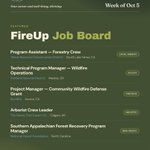
There are many pathways into fire, forestry, and conservation work. This week, we're featuring five roles (see many more on the job board):
LOCAL AGENCY — Program Assistant, Forestry Crew
Tahoe RCD · South Lake Tahoe, CA · $25.08–$35.11/hr
UTILITY — Technical Program Manager, Wildfire Operations Portland General Electric · Madras, OR · pay not listed (P3 / Grade 7)
FIRETECH — Project Manager, Community Wildfire Defense Grant. BurnBot · Sonora, CA · $90K–$115K/yr
INDUSTRY — Arborist Crew Leader
The Davey Tree Expert Co. · Calgary, AB · CAD 25–37/hr + equity
NON-PROFIT — Southern Appalachian Forest Recovery PM. National Forest Foundation · NC · $95K–$118.75K/yr
Different entry points, shared mission. These + 3,600 more → jobs.fire-up.net/jobs
#fire #wildfire #forestry #conservation #jobs #career #resilience #firetech

Public service looks like showing up for the commons and it takes all of us. This week we feature roles honoring four kinds of stewards who protect and tend our shared lands, from emergency management to cultural fire that keeps communities and landscapes safe.
FEDERAL
Park Ranger — Emergency Services Coordinator · U.S. Department of the Interior · Glacier County, MT · $76,745–$119,583/yr
STATE
Fire Operations Specialist — Training · State of Wyoming · Pinedale/Kemmerer, WY · $29.76/hr
LOCAL
Forestry Director · Placer Resource Conservation District · Auburn, CA · $97,356–$151,032/yr (apply by Oct 16)
TRIBAL
Silviculture & Fire Grant Technician · The Confederated Tribes of Grand Ronde Ronde · Grand Ronde, OR · $24.60–$31.84/hr
Different badges, same calling: caring for the places we all depend on.
Explore these and 4,000+ roles on the FireUp Job Board. Apply today! jobs.fire-up.net/jobs
#Stewardship #WildlandFire #Forestry #Conservation #jobseekers


The 2026–27 El Niño event is on track to be the strongest in the instrumental record. @NOAA just raised the odds this morning. A 75% chance this El Niño ends up the strongest since records began in 1950, up from 69% a month ago.
This Wonder Labs resource is free and updated daily. Please comment with corrections or resource suggestions. This is not an agency product, verify with listed sources before making operational decisions. Stay safe! #ElNiño #Hazards #DisasterResilience @UNDRR_Americas @ShefJL
Wonder Labs retweeted
In depth analysis here linkedin.com/pulse/call-resp…

Wonder Labs retweeted
Twelve days after the catastrophic flooding in Nepal, we are still learning why warnings failed and what actions helped get some people to safety.
We know this: On 26 August, the warnings that reached people in time to act were human—phone calls, word-of-mouth, and a school bell.
08:40 — flood crosses into Nepal.
08:50 — upstream gauge destroyed.
08:56 — downstream gauge operator calls it in.
09:16 — 679,295 SMS alerts sent.
11:20 — first automatic warning.
At 09:10, school principal Rajendra Dawadi was teaching when his accountant warned him by phone about the flood. Dawadi rang the bell and evacuated about 900 students and 16 staff. Fourteen minutes later, the flood destroyed the school.
Nepal's official system sent 679,295 SMS alerts at 09:16. But the school was already being evacuated through a human warning network.
The event was a cascading mountain hazard: glacial rock collapse, mass flow, then a devastating flood debris cascade.
That matters because a warning system designed around conventional river flooding can miss the hazard entirely or lose its sensors before they trigger.
This is not simply a story about missing technology. It is a story about systems failing at the moment the hazard becomes most dangerous.
Nepal's flood warning thresholds were based on water level. But a rapidly rising, debris-laden cascade can destroy the gauge before the water reaches the threshold. A sensor that sits in the path of the hazard can become the first casualty of the warning system.
Nepal is now planning a new architecture: seismic sensors, cameras and satellite/VSAT connectivity, plus better real-time information from upstream in China. The proposed system is designed to withstand sensor and communication failures.
But there is another failure mode: The warning reaches people, but does not tell them what to do.
Reporting from Nepal found that the official SMS alert was late, in Nepali only, and lacked actionable, location-specific instructions.
Meanwhile, community networks warned people directly. The community warning worked because it was trusted, specific and connected to someone who could act.
It also exposed a critical communication gap. People outside those local networks—including tourists and construction workers—could be left out. They may not have the relatives, neighbors, local language, WhatsApp groups or institutional relationships that made the informal warning chain work.
The real metric is not:
“Can the system send an alert?”
It is:
“Can people still receive and act on a warning when the system is failing or responding to a cascading event?”
The Nepal tragedy points to the need for investing in a few low-cost system-wide decisions and actions with immediate effect.
For national agencies:
• Trigger on rate of rise, not only absolute water level.
• Recalibrate rating curves after major channel changes.
• Build independent communication paths.
• Establish named duty officers and alert-to-action protocols.
• Define what happens when the automated system goes offline.
For local authorities and operators:
• Assume sensors will fail. Build redundancy.
• Pre-authorize action when decision-makers cannot be reached.
• Publish evacuation destinations and routes, not just alerts.
• Drill through schools, hospitals and communities.
• Build independent egress and refuge capacity for tunnels and other high-risk worksites.
• Treat community networks as communication infrastructure—not as an informal backup to the “real” system. They are part of the system.
For funders:
Stop measuring success by equipment installed. Instead, report on installed vs operational and tested.
And let's fund the operational life of the system.
Responsible capital commitments must come with years of:
• maintenance
• calibration
• communications
• spare parts
• staffing & training
• drills/exercises
• independent testing
An early warning system is not simply live when the sensor is installed. It has to work at 3 a.m., during a power failure, after a landslide, when the network is down and the sensor has disappeared.
Finally, early warnings must be treated as a transboundary issue, especially for fragile mountain ecosystems experiencing cascading hazards.
#EarlyWarningsForAll needs a cross-border data-sharing architecture for cascading cryosphere hazards.
This requires stress-testing the entire warning chain across cascading scenarios:
Assume the sensor fails.
Assume the power fails.
Assume the network fails.
Assume the decision-maker cannot be reached.
Then measure whether people can still be warned and know where to go for safety in a complex cascading event.
The lesson from Nepal is not that we need more flood gauges. It is that a multi-hazard warning system must detect the cascade upstream, survive the cascade, and still deliver an actionable warning downstream, with people at the center of its design and delivery.
#EarlyWarningsForAll #EW4All #DisasterRiskReduction