


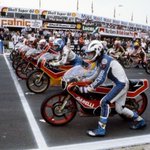


Ostres @Santi0111681101 la teva Suzuki gsx-r venia tant ben equipada? 🤣 Una abraçada amic 🫂


Bon dia @SansalvadorJM un altre viatge té està esperant... 😉 Que passis un bon dimecres. ✌🏼👍🏻✊🏼

La marca del águila inaugura un fabuloso museo para conmemorar su 105 aniversario, que será de obligado peregrinaje. Ya era hora...
mundodeportivo.com/solomoto/…


Hola, @SansalvadorJM . T'haig de donar les gràcies per la entrevista que li vares fer a l'Enric Xargay. He gaudit molt. He recordat vells temps, estades al Jarama de Madrid, Carreres a Montjuïc, muntar el circuït a Celrà... A l'època de la vespa. Després es va passar als ral.lis.

X3viVP retweeted

Not a V4, not an inline-four. This one’s a square-four.
In the mid-1970s Suzuki dropped a new engine on the 500cc class and basically ended MV Agusta’s long reign. They called it the RG500 — a liquid-cooled, 498cc two-stroke square-four that became one of the most successful engines in Grand Prix history.
The layout was clever: two parallel twins geared together, rotary disc valves, and a pair of counter-rotating crankshafts that kept the vibration surprisingly low. Factory race bikes were putting out somewhere between 110 and 124 horsepower while weighing only around 130–135 kg dry. Compact, light, and extremely fast.
The results speak for themselves. Suzuki took seven consecutive manufacturers’ titles from 1976 to 1982. Four riders’ championships came with it too — Barry Sheene in ’76 and ’77, Marco Lucchinelli in 1981, and Franco Uncini in 1982. The first-ever 500cc Grand Prix win for Suzuki also happened on this engine, when Sheene took the 1975 Dutch TT at Assen. In 1976, the first full year the production version was available, RG500s filled 11 of the top 12 places in the final championship standings. For years the grid was just a sea of these things — privateers loved them because they could actually compete with the factory teams.
The engine's advantages was obvious. Insane power-to-weight ratio, explosive top-end, excellent mechanical balance, and a compact size that made chassis design easier. Even privateers could go fast on them.
The downside? The power delivery was vicious — almost nothing below 7–8,000 rpm, then the power just exploded. Run the mixture a bit lean and it would seize without warning. Tuning four carburetors plus the rotary valves was a nightmare for mechanics. It drank fuel and smoked like crazy. And eventually the inlet design was difficult, which is why Suzuki later switched to a V4.
From the mid-70s right through early 1980s, Suzuki ruled two stroke era.
#SuzukiRG500 #SquareFour #TwoStroke #GrandPrix #500cc #BarrySheene #ClassicRacing #MotoHistory #VintageGP #SuzukiRacing
Sobre gustos, colors... Com les rodes, una slick i altra ratllada... 🤷♂️

This Spanish Bultaco Cafe' styled custom is unique and beautiful. I have never seen one like this one! #spanishmotorcycles #caferacer #bultaco #custommotorcycles #handmadecustommotorcycle #motorcycleenthusiasts #motorcycleenthusiast

Mira @Santi0111681101 m'han enviat una resposta i he pensat en tú.
Jolín, han Passat els anys i encara trobo preciosa aquesta moto.. 😍
Bon divendres Santi.


Podríais dos seguidores COPIAR y volver a publicar este tuit? Intento demostrar que siempre hay alguien ahí, especialmente en esta época del año.
Contra el suicidio, 914 590 050 / 914 590 055. (Teléfono de la Esperanza). Al menos dos.
COPIA, no RT.
Mira @FrancescFPC , un altre que es pregunta sobre el avantime... ✌🏼👍🏻✊🏼

X3viVP retweeted

Pure cult! There’s a Renault Avantime (2001) just around the corner from us. Only 8,557 were built, with 218 sold in the Netherlands. Unbelievable that this project was a failure. I love how the B-pillars are absent from the side windows. One big coupé. And Clarkson got it right.

