

I look for cheap, ignored and unpopular stocks, ideally trading below BV or Net-nets, like Walter Schloss & young Warren Buffett did | Not investment advice
Joined October 2015
- Tweets345
- Following396
- Followers4.7K
- Likes1.5K


A Polish tool brand you’ve probably never heard of sells in 120+ countries and trades at ~8x earnings.
Credits to @HolyFinance for this idea.
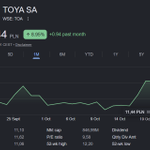
$TOA TOYA distributes hand tools, power tools and kitchen and garden products from its own brands, led by YATO (86% of sales). It has 14,000 products, sells to 7,600 B2B customers in 120+ countries, and has its own sourcing companies in China.
At PLN 11.44 per share:
· Market cap: PLN 747M (excluding the 8.75M treasury shares bought in July; PLN 847M including them)
· Net debt: ~PLN 88M (after the July buyback, before the warehouse payment)
· EV: ~PLN 834M
· EBITDA, last 12 months: ~PLN 134M
· EV/EBITDA: ~6.2x
· Net profit, last 12 months: PLN 89M
· P/E: ~8.4x
The numbers:
– Revenue has grown from PLN 151M in H1 2016 to PLN 522M in H1 2026 (3.5x).
– H1 2026: revenue +13%, gross margin 35.3% (vs 33.7%), net profit +4% to PLN 52M. Q2 net profit was +17%.
– FY25: revenue +11%, net profit +27%.
Capital allocation:
– In July it bought 8.75M shares (11.7% of capital) at PLN 10.00 in a tender, for PLN 87.5M.
– In August it cancelled another 1.0M shares from a 2025 buyback.
– In October it completed the purchase of its own 57,800 m² warehouse for €41.6M, to cut rental costs.
The risks:
– Inventory-heavy: PLN 466M of stock, ~62% of the market cap.
– The buyback and the warehouse take net debt from ~zero to roughly PLN 200M+.
– Romania was -7% in H1, on a weak local economy.
– The founders own ~50%, so the free float is limited.
No position. NFA.

A French net-net with half its market cap in net cash, and a new CEO since July.
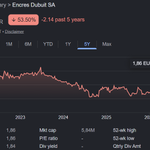
$ALDUB Encres Dubuit makes technical inks for screen, pad and digital printing, used in packaging, cosmetics, automotive and electronics. It sells in ~50 countries.
At €1.86 per share:
· Market cap: €5.8M
· Net cash: €2.9M (€0.93 per share, half the price)
· EV: ~€2.9M
· P/NCAV 0.77x
· P/BV 0.40x
Why it’s this cheap:
– 2025 revenue fell 12% to €17.7M. Asia was -21%, North America -42%.
– Operating loss of €2.2M before one-offs.
– It burned ~€1M in 2025 (-€0.4M operating cash flow, €0.65M capex).
– No dividend since 2022.
Signs of a turn:
– Gross margin rose to 64.3% from 58.0%.
– The company says Q1 2026 was back to operating profit, with growth in France, Europe and Asia.
– A new CEO, Jérôme Bracichowicz, was appointed in July. He has 25+ years in general management and transforming industrial companies.
– The founder, Jean-Louis Dubuit, stays as chairman, and a buyback of up to 10% of shares is authorized.
The risks:
– Still loss-making on a full-year basis, and cash keeps shrinking.
– Two CEO changes in two months.
– Tiny: €5.8M market cap.
No position. NFA.

Today’s idea is Ferrari.
No, not the one you’re thinking of.
This Ferrari doesn’t build supercars, it moves luxury goods around the world.
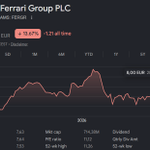
$FERGR Ferrari Group is an Italian logistics company founded in 1959 and built around luxury goods: freight forwarding, customs, transport, warehousing, and even red-carpet event security.
It IPO’d at €8.60 in Feb 2025. Today it’s 10% lower, even though EBITDA and the dividend have grown since.
Why is it a good business?
Brands don’t pick the cheapest carrier for a €2M necklace, they pick the one they trust.
Think about it.
Pricing is linked to the value of the goods, and when shipping costs 1% of that value, price doesn’t matter.
All clients care about is that it arrives in perfect condition.
It’s the leader in a fragmented niche, capex is only ~2-3% of revenue, and margins are ~26%.
At €7.64 per share:
· Market cap: €703M
· Net cash: €78M
· EV: €625M
· Adj. EBITDA, last 12 months: €93M
· EV/EBITDA: 6.7x
· EPS, last 12 months: €0.68
· P/E: 11.3x
· Dividend: €0.33, a 4.3% yield (56% payout)
The catches:
– Margins are slipping: 25.5% in H1, vs 26.6%.
– Asia was -10% in H1. China is weak, and it lost a China warehouse contract.
– It depends on luxury demand and is exposed to geopolitics (it has a Gulf presence).
No position, but it’s on my watchlist. NFA.

France had its worst riots in years this weekend: shops looted, banks vandalized and cars burned.
When a shop’s alarm goes off at 3 am, someone has to show up.
Could this tiny French company benefit from it?
$ALAQU $ALAQU.PA Aquila runs a 24/7 platform for alarm response.
When an alarm goes off at one of its ~1.4M protected sites, it dispatches a guard from a network of 300 independent local security firms covering 95% of France’s population.
How it makes money:
– Clients pay per intervention, or a monthly flat fee.
– Aquila pays the local partner and keeps the difference. No guards on payroll, no vans, just the platform and the network.
– H1 2026 revenue mix: alarm response 45%, guarding 44%, patrols 7%, subscriptions 3%.
– After paying partners, it keeps ~16% of revenue.
– Partner turnover is under 3%.
At €3.40 per share:
· Market cap: €5.6M
· Cash: €1.8M, vs a €1.7M bank loan
· EV: ~€5.5M
· Operating profit, last 12 months: €0.58M
· EV/EBIT ~9.5x
· Net profit, last 12 months: €0.53M
· P/E ~10.7x
· Dividend yield 7.4%
What happened:
– 2025 was its worst year in 25 years: revenue -5.2%, net profit -36%. Clients cut guarding and patrols. Alarm response kept growing.
– H1 2026 is a rebound: revenue +3%, operating profit +68%, net profit +76%. Alarm response is up >10%.
Red flags:
– Thin margins: a 2.25% operating margin in H1.
– The dividend was cut to €0.25 from €0.35, and it took ~100% of 2025 profit.
– Related-party dealings: it bought its HQ from its landlord (a regulated related-party agreement), and it lends to SC MARIS, which is co-managed by the CEO.
– Very illiquid.
No position. NFA.

Mont Blanc is one of the most famous mountains on earth.
The company that runs its lifts is worth €227M.
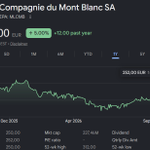
$MLCMB.PA Compagnie du Mont-Blanc operates 6 ski areas around Chamonix and Megève, plus the Aiguille du Midi and the Mont-Blanc Tramway.
At €252 (figures for the year to May 2025):
· Market cap: €227M
· Net debt: €48M (€150M cash, €198M debt)
· EV: €276M
· EBITDA: €52.5M (34% margin), so EV/EBITDA 5.2x
· EBIT: €30.2M, so EV/EBIT 9.1x
· EPS: €21.50, so P/E 11.7x
· Dividend: €8.50, a 3.4% yield
Who owns it: Compagnie des Alpes 37.5%, Chamonix Développement (a local public-private company) 18%, the Seydoux family 18%, employees 4%.
The free float is ~20%.
The good:
– Revenue +6.6% to €153.9M, EBITDA +6.1%.
– The Chamonix ski areas concession runs to 2053.
The catches:
– Heavy capex: €49.7M last year, vs €35.4M of operating cash flow. The Chamonix contract commits €743M of investment, including €149.5M to rebuild Grands Montets (full reopening delayed to Dec 2027).
– The Aiguille du Midi agreement ends on 31 Dec 2028.
FY26 results are due around November.
No position. NFA.

Down 67% from its high, Build-A-Bear trades at 6.3x earnings and keeps buying back its own stock.
$BBW runs 674 make-your-own teddy bear stores in 37 countries.
At $25.18 per share:
· Market cap: ~$315M
· Cash: $14M, no debt
· FY25 EBITDA: $81M, so EV/EBITDA ~3.7x
· FY25 free cash flow: $39.5M, or 13% of EV
· P/E: 6.3x on FY25, ~7-8x on FY26 guidance
· Dividend: $0.92 a year, a 3.7% yield
It returned $49M to shareholders in the last 12 months (~16% of the market cap).
Why it’s down:
– Revenue is falling: Q2 -7.2%, e-commerce -15.6%.
– Guidance was cut twice this year. Revenue is now $500-525M, and pre-tax income $60-68M.
– Tariffs cost ~$10-11M this year, and 51% of its goods come from China.
– Commercial revenue is now guided flat, from +20% before.
– Cash fell to $14M as capex rose to ~$25M and buybacks continued.
– About a third of revenue is tied to birthdays and parties, so it’s discretionary spending.
No position. NFA.

People who are afraid to invest because of the risk of losing the money they've worked so hard to earn
Do you know what I'm afraid of?
Working my whole life in an office from 9 to 6, while my money loses 4% a year in my bank account
Investing is mandatory
99.5% of its revenue is recurring.
68% of the market cap is cash.
The rest of the business is priced at ~5x operating profit.
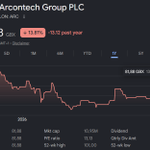
$ARC.L Arcontech sells software for banks’ market-data and trading infrastructure (its CityVision platform).
At 82p:
· Market cap: £11.0M
· Cash: £7.5M, no debt (56p per share)
· EV: £3.5M
· Operating profit (FY26): £0.70M, so EV/EBIT 5.0x
· Free cash flow, excl. interest: £0.57M, or 16% of EV
· P/E: 13.2x (EPS 6.25p)
· Dividend: 4.0p, a ~4.8% yield
Why so cheap?
It lost a large, long-standing customer to a competitor. FY26 revenue fell 11.5% to £2.75M, and profit before tax fell 11% to £0.88M.
What could turn it:
– A new 3-year, ~£800k contract with a major European bank. Revenue starts in Q3 2026.
– The board is “comfortable” that next year will see a return to growth, with recurring revenue back to last year’s run rate.
– Management says interest in its products is the highest in some time.
The catches:
– Tiny: £11M market cap.
– Lumpy: losing one client cut revenue by 11.5%. Customer concentration isn’t disclosed.
No position, but it’s on my watchlist. NFA.


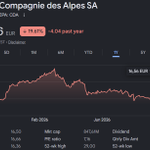
Today’s idea: ski resorts and leisure parks at ~4.2x EV/EBITDA, with a ~6% dividend yield.
$CDA.PA Compagnie des Alpes at €16.56, using the latest reported figures (31 March 2026):
· Market cap: €842M (50.8M shares)
· Net debt, excl. leases: €691M (1.9x EBITDA)
· EV, excl. leases: €1.53bn
· EBITDA excl. leases, last 12 months: ~€368M
· EV/EBITDA, excl. leases: ~4.2x
· Net income, last 12 months: €117M, so P/E 7.2x
· Dividend: €1.10 per share, paid in March.
Why is it down about a third this year?
– April: Q2 revenue missed expectations (€594M vs €613M consensus). The stock fell 6%.
– July: a wet May and record heatwaves in June and July hit the parks. Q3 revenue was -1.4% (parks -4.1%), and the company cut its EBITDA (incl. leases) growth outlook to 2-5% from ~10%. The stock fell 10%.
– Tignes: the ski area concession ended on 31 May. CDA gets ~€107M for its share, but loses the area’s yearly profit.
Meanwhile, the business keeps growing:
– FY25 (to 30 Sept 2025): EBITDA excl. leases +15% to €353M, net income +16%
– H1 FY26 (to 31 March): revenue +3.9%, EBITDA incl. leases +5%, net income €145M (+8%)
– Skiing had a strong season: 9-month revenue +5.7%
The catch is that it must reinvest ~20% of sales every year in lifts and rides. That spending is planned years ahead, so even if a summer goes badly, it’s the cash left for shareholders that shrinks.
No position, but it’s on my watchlist. NFA.

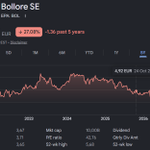
This holding trades at €3.67 per share.
And its listed stakes alone are worth ~77% of the market cap.
$BOL.PA Bolloré SE is the French holding behind big stakes in Universal Music, Canal+, Havas and Vivendi, plus an energy distribution business.
The Bolloré family controls it through Compagnie de l’Odet, which owns ~74% of it.
At €3.67 per share its market cap is ~€10.3bn, but the group owns more than that:
· Listed stakes: ~€8.0bn, of which UMG (at €14.90) is ~€5.0bn.
· Net cash €1.4bn at 30 June (after paying the €1.50 dividend):
· Plus ~€2bn of dividends paid or due after 30 June, since Odet is also Bolloré’s shareholder, so part of June’s payout flows back to Bolloré.
· Total: ~€11.4bn, before Bolloré Energy, Industry, real estate and its stakes in the holdings above it.
So why the discount? Three reasons:
· The holding structure.
· UMG is 63% of the listed portfolio, and it’s down about a third this year. The portfolio fell from €9.2bn at end-June to ~€8.0bn.
· The operating businesses don’t pay for themselves. EBITA was €104M: €181M from equity-accounted stakes, −€77M from everything else. Net income fell 45% to €133M.
No position. NFA.

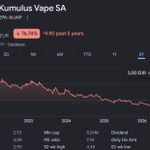
This stock has a market cap of €8M and trades at half of book value.
The CEO owns about a third of the capital.
$ALVAP Kumulus Vape is a French vape distributor based near Lyon, founded in 2012 and listed on Euronext Growth since 2021.
It sells 10,000+ products to retailers (85% of sales) and online (9%), and runs the Cigaverte shop network (6%).
At €3.00:
· Market cap: ~€8M
· Net cash: €3.26M (€1.20 per share)
· Enterprise value: ~€4.9M
· P/B: 0.5x
· P/NCAV: 0.67x
· P/E: ~7x
· Dividend: €0.10 per share, a 3.4% yield
So why is it cheap?
Because 2025 was bad.
Revenue fell 5%, gross margin slipped from 23.6% to 21.7%, and net profit dropped 62% to €1.0M as price competition squeezed wholesale.
The stock fell from around €5 in mid-2025.
Then H1 2026 turned around.
Gross margin jumped to ~27%, operating profit rose 17% to €1.43M and net profit 24% to €0.76M, even with revenue down 8%.
Net cash went from €1.7M to €3.3M in six months.
Management says H2 gets the full ramp-up of Labster, the bottling lab for its own brands that went live this year.
The risks:
· Wholesale is 85% of sales, and it's still shrinking under fierce price competition.
· The company itself gives a 30% probability to adverse vaping regulation, notably at EU level.
· The NCAV discount leans on inventory (€8.3M, 31% of assets).

I feel that the UK AIM market and French small-cap land are good places to find opportunities right now
I bought $GME today.
Yes, that $GME. The 2021 meme stock.
But this isn't 2021.
GameStop isn't just a video game store anymore.
Nearly half of its sales now come from collectibles.
This idea is from @leevalueroach of The Value Road. All credit to him.
Go check out his 34-slide deck.
At the deck's $22 price, $GME has a market cap of $11.1B:
· $4.7B of cash
· $4.7B of eBay stock (a 9.8% stake)
· 4,710 Bitcoin (~$0.3B)
· Minus $2.8B of convertible notes at 0%
That's ~$13.70 a share of net financial assets.
So what are you actually paying for the stores?
$11.1B market cap minus $6.9B of net financial assets leaves ~$4.2B, or ~$8.30 a share, for the entire operating business.
And this business has quietly changed since 2021.
Collectibles went from 6% of sales to 45%, driven mostly by Pokémon cards.
Gross margin jumped from 29% to 44% in twelve months.
Q2 operating income was a record, on revenue that fell 19%.
The part most people miss is the trade-in counter. GameStop buys hundreds of millions of dollars of cards and games from customers every year, about two-thirds paid in store credit.
That credit comes back as sales at full margin.
Management guides to "in excess of $650M" of EBITDA. The first half alone was $340M, and Q4 holds the holiday.
That $4.2B for the operating business, measured as EV/EBITDA:
· ~6.4x on management's guide
· ~4.7x on The Value Road's ~$885M estimate
· ~6.5x even in their own 2027 hangover scenario
Ryan Cohen, CEO and Chairman, takes no salary, no bonus, no options, and has never sold a share.
He bought $20.4M on September 10.
Then today, another 1,150,680 shares at $22.94, about $26.4M, in the open market. He now owns 40.5M shares, ~8% of the company and roughly 20% of his net worth.
The risks are real, though:
· The Value Road's own model assumes a post-anniversary hangover in 2027, with EBITDA falling to ~$646M.
· The Pokémon Company controls allocation.
· The grading program depends entirely on PSA, which has paused its cheaper tiers.
· Most of that $13.70 floor isn't cash. $9.38 of it is the eBay stake, which moves with eBay's share price.
· The biggest risk is capital allocation. The hostile bid for eBay, as structured, would need ~$22B of new debt and would spend the balance sheet that protects the downside.
Long $GME
Not financial advice.


GameStop $GME is one of the most misunderstood companies in the entire market. Wall Street has left the company for dead. Every sell side firm has dropped coverage and zero hedge funds will own this because of the former meme stock hair.
Now the stock trades dirt cheap with $5 billion of cash, $5 billion of ebay stock (10% of the entire company), $300 million of bitcoin and $2.8 billion of zero percent convertible debt.
You are buying the core business for $4.1 billion. The core business that has completely transformed itself into a highly cash generative card store.
Management has turned around the entire company and it is not a dying retailer anymore. It is a cash generative cash machine flipping Pokemon, Magic The Gathering and One Piece cards. Cards are one of the hottest markets in the entire world right now and Wall Street is asleep at the wheel.
Unit economics are stunning. There are 1,600 stores in the U.S. $1.9 million sales per store. 45% gross margins at the store level. Four wall EBITDA per store of $580k. This is a four wall margin of 30.6%. There is very little capex and inventory is mostly financed by vendors and there is a float business with the trade-ins with in-store credit zero percent debt.
Management is guiding to $650 million of EBITDA for the full year. They are sandbagging the number HARD. I am pulling data from ebay and GemRate and total Pokemon sales in August were up 30% m/m. The highest monthly sales ever recorded.
In addition, the 30th anniversary for Pokemon occurred on September 16th. It was the biggest coordinated Pokemon event in history. I went to a dozen of GameStop's and local card shops and they were all sold out. Lines out the door. The phone ringing off the hook. Wall Street is completely unaware that GameStop is flipping cards in size and has transformed their business model.
Finally, Q4 is the company's biggest quarter and there are more events for the 30th anniversary landing in the quarter. For the full year, I am modeling in excess of $850 million of EBITDA, $200 million ahead of management's sandbagged guide.
Management likely knows this. Ryan Cohen bought $20 million in the open market, and other C-Suite executives followed along with numerous buys, just days ago. And then the company announced they will be reopening stores, for the first time in many years. The payback on reopens should be less than a year.
I see the company trading at 4.7x EV/EBITDA, and over 90% of that EBITDA should convert into free cash flow, or a 20% free cash flow yield on the enterprise value. Wall Street is completely missing the story and asleep at the wheel with drool running down their big fat bellies.
There will likely be push back on the ebay acquisition, but I encourage everyone to actually dig into the deal. It could be transformative and there are many synergies that Wall Street idiots are missing. Wall Street suits have no idea how the card market has been gamified and turned into a lottery ticket system that has become extremely addicting on apps like Whatnot. In addition, Ryan Cohen is an All Star capital allocator and operator, an extremely rare combination, and a platform like eBay is right up his wheel house.
I built a website below that has a 34-deck slide, highlighting the thesis. Have fun and check out my analysis and website. I am long $GME and find the thesis asymmetric.
deepfuckingvalue.com

One of my main positions.
Class B shares offer it with a discount.
A great deal IMO.
xitter.cf/XIX_Value/status/20941…

A Hong Kong business sitting on more cash than its entire market cap.
Credit to @sammutgabi of Bilbel Capital for this one.
$1161.HK Water Oasis Group Limited.
· HK$844M market cap
· HK$917M of cash
· Zero bank debt
· Dividend yield ~6%
The cash alone exceeds the entire company.
This is a Hong Kong beauty and medical aesthetics group, listed since 2002.
55 centres under Oasis Beauty, Oasis Medical, Glycel, phMedic+ and the new InMedic brand.
Services are 93% of revenue and nearly all of the profit. That services profit has compounded at 14.9% a year since 2002.
H1 2026: revenue up 4.8% to HK$515.8M, net profit up 27.6% to HK$70.8M, gross margin 93.4%. Capex of HK$2.9M. Interim dividend raised 43%.
The objection you'll see first: HK$752M of that cash is a liability, treatments customers paid for but haven't received yet.
Here's why that's an edge, not a problem.
Customers buy treatment packages upfront for a discount.
The money is non-refundable.
Water Oasis owes them sessions, not cash, and delivering a session costs almost nothing extra at a 93% gross margin, because the clinic and staff are already paid for.
Meanwhile new customers keep prepaying. Their money covers the cost of treating the earlier ones. So the balance never actually gets drawn down, it just rolls forward.
It has grown from HK$220M in 2010 to HK$750M today, dipping only when Covid shut the clinics.
That's interest-free, permanent financing that funds itself.
Why the brand holds: you can't judge a facial treatment before buying it, so you pick on trust. Every good result deepens it and makes switching feel riskier.
Management has said outright they're ready to buy them. Precedent: Millistrong in 2021, roughly HK$29M net for a business earning HK$7-12M a year. A 25-40% annual return.
Capital allocation: 90% of all profits paid out as dividends since 2002, plus 11.5% of shares bought back. Further buybacks are capped by the 25% minimum float, so it's dividends and acquisitions from here.
Visit Gabriel's article for a deeper analysis.


$0327.HK Pax Global Technology Ltd is the largest position in my portfolio.
Although it is up 26% from its lows, I still think it's very undervalued.
At this price:
· Market cap: ~HK$4,311M
· Cash and equivalents: HK$3,907M
· Short-term deposits: HK$172M
· No debt
· P/E: 4.2x on annualised H1 earnings
· P/B: 0.50x
· P/NCAV: 0.59x
The market keeps ignoring it.

@HolyFinance I know you have some investments in HK, do you have an opinion on this one?
I have been followed by X accounts and value investors whom I've been following, listening to, and admiring for many years.
The internet is truly powerful.
Taking action is all it takes.
And this is just starting.
In March 2025 I wrote up a tiny French casino operator at €1.73/share, trading at 4.4x EV/EBIT with a 26% FCF yield.
Last week, it received an offer to be bought out at €6.19 per share.
$SFCA $SFCA.PA Société Française de Casinos.
It owns four casinos in French tourist towns plus hotels, restaurants and spas.
· €8.8M market cap when I wrote it up.
· Net cash on the balance sheet.
· Free cash flow matching reported profits, year after year.
The whole thesis was almost boring: a steady, profitable, well-run business, ignored because it was too small and too illiquid for anyone to bother with.
On August 27, Merkur Spielbanken signed a promise to acquire 95% of Casigrangi, the holding company that owns 81.21% of SFC.
The implied price: €6.19 per SFC share.
The premiums tell you how badly the market was pricing this:
· 157.9% over the previous close
· 145.2% over the 60-day VWAP
· 195.9% over the 240-day VWAP
The stock now trades at €5.90, a small discount to the offer price.
I am selling it here at €5.90.
That works out to +241% from my €1.73 write-up price.
More than a 3-bagger.
Another example that cheap, ignored and cash-generative businesses don't stay ignored forever.
Value always finds its way.
Follow for more.
Link to the original thesis below.

