
Practical, No BS, YC insights (Not affiliated with YC) Newsletter - https://xitter.cf/t.co/DVtutrRLmj
Joined March 2023
- Tweets4.5K
- Following213
- Followers5.2K
- Likes2.5K




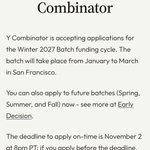

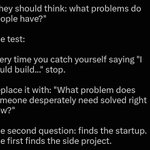


Pinned Tweet
I spent weeks reading everything YC has ever published about what they look for.
here are 9 things that would have changed how I thought about the application

YC Insights. retweeted

People keep asking to hop on calls asking me about how I got into YC.
It's been almost 18 months since we got into YC.
The world has changed so much lol 😭
The answer tho is pretty simple.
Just move as fast as possible to get traction.
Your first startup idea is a hypothesis, not a commitment.
Build the smallest useful version. Put it in front of real customers. Watch what happens.
If users reveal a better way to solve the problem, follow the evidence.
YC's Michael Seibel has made this point repeatedly: stay attached to the problem, not your original solution.
The goal is to build something people want.
YC Insights. retweeted

I love backing people before they're founders.
You're at a great company, building a product you're proud of. You helped it grow, and you have the proof points to show for it. Now you've seen something nobody else has noticed, and you're itching to go build it.
If that's you, reach out before you quit. I'd love to bet on you early.
My DMs are open.
Applying to YC?
Don't just tell them customers need your product. Show what you've learned from building it.
- Who uses it?
- What surprised you?
- What changed after customer feedback?
- Are users returning?
- What's still not working?
You don't need every answer. You need evidence that you're learning faster than your assumptions are failing.
Don't chase 1,000 signups before understanding your first 10 users.
- Who uses your product repeatedly?
- What problem brings them back?
- Would they be disappointed if you shut it down?
YC encourages founders to find 10–100 customers who love their product.
Start small. Find people who genuinely need what you're building.
Before you abandon your startup idea, talk to the people who tried your product.
- What made them try it?
- Where did they get stuck?
- What made them return?
- What would they miss if it disappeared?
YC's advice is to build, launch, and learn.
You might not need a new idea. You might need a better understanding of the problem.


YC Insights. retweeted

It's spooky season! 🎃
You know what's real spooky?
Building the next unicorn and being underfunded.
We're actively writing checks up to $500k
Want us to check out your company?

Your first sign of product-market fit might be a customer doing something you never planned for.
Watch how people actually use your product.
What they repeat, work around, and recommend tells you more than what they say they want.
Don't just track usage. Investigate it.
This is what PG meant by “Release early.”
Get a v1 out fast. Iterate from real users.
He’s seen startups die from launching too slowly but never from launching too quickly


Your YC application has a simple test:
Can a stranger understand what you're building without asking you to explain the jargon?
YC explicitly recommends describing your company in a few simple sentences.
If your answer needs a paragraph of buzzwords, simplify it until the problem and customer are obvious.
Rejected by YC?
Don’t assume the door is closed.
YC says about half the companies in a typical batch applied multiple times before getting accepted.
If you reapply, show what changed: product, customers, growth, or your understanding of the problem.
Come back with progress.
Preparing for your YC interview?
YC says making progress is the best way to improve your chances.
Launch the product. Get users. Increase revenue. Fix what’s broken.
Your startup improving between application and interview is a stronger signal than memorising perfect answers.
YC has said this for years, early revenue mostly proves the founders can sell and do unscalable work. It doesn’t prove pmf. The companies that actually take off are the ones that stay extremely close to users, keep experimenting & eventually hit the point where the market pulls the product out of their hands. Absolute numbers on day one are noise compared to that

Don’t write “our competitors have bad UX” in your YC application.
YC explicitly says founders should know existing products in their market and explain what’s specifically wrong with them.
Name the gap. Explain why it matters. Show how you’ll solve it.
“Better” isn’t an insight.
YC is not only for Stanford dropouts.
If you skipped the application because you didn't attend an elite university or drop out to build a startup, you might be ruling yourself out for the wrong reason.
Here's what YC's own data tells us:
- 40% of companies YC funds in a typical batch are just an idea. You don't necessarily need revenue or a fully built product to apply.
- Winter 2023: 52% of the batch was accepted with only an idea. They hadn't necessarily figured everything out before applying.
- Winter 2022: 42 countries represented. Around half of the companies were based outside the US.
- Summer 2024: 15% of companies had at least one founder with a PhD. Advanced degrees are part of the picture, but they're not the only path.
None of this proves that your background doesn't matter. It does show that YC funds companies at different stages and works with founders from different parts of the world.
You don't need to copy the path of a famous dropout.
You need a problem worth solving, a team capable of solving it, and a convincing reason to believe you can build a great company.
Don't reject yourself before YC gets the chance to.
Apply anyway.

You don’t need revenue to apply to YC.
YC says 40% of the companies it funds in a typical batch are still at the idea stage. Most have no revenue.
Your job isn’t to pretend you’re bigger than you are.
Show what you know, what you’ve built, and what you’ll do next.
YC Insights. retweeted

When I started investing in startups in 2021, the standard was 3x year-over-year growth. If you could show that, you were fundable.
Those days are over.
The standard today is 10x year over year.
For any other than the fastest-growing companies today, another round may not be there.
Stop assuming another round will be there. Whether they know it or not, many startups today have raised all the venture capital they ever will.
Money is concentrating into a handful of extremely high-growth startups.
I see it every day. A $50 million Series A at $500 million, not a $10 million Series A at $50 million.
That $50 million going to the fast-growing company means four other traditional Series A’s didn’t happen. That leaves those slower-growth companies out in the cold.

