
Ibn Mas’ood “The one who repents from a sin is like the one who did not commit the sin.”[Classed as hasan by al-Albaani in Saheeh Ibn Maajah, 3427)]
Joined July 2012
- Tweets2.9K
- Following31
- Followers1.1K
- Likes92



Al-Allāmah Ibn Bāz rahimahu'Allah said:
“From the calamities of this era is a man letting his garment down and a woman raising her garment.”
t.me/Gardensofknowledge

1
184
Inshaa’Allah, today we will be starting our new series of lessons entitled:
سلسلة في آداب المسلم
Series of Lessons on the Etiquettes of a Muslim
We ask Allah to make these lessons sincerely for His sake and to allow us to benefit from them. Ameen.
t.me/Gardensofknowledge
1
83
Recitation of Sheikh Ahmad Uthman al-Adani hafidhahu’Allah from over forty years ago, during the time of Imam Muqbil ibn Hadee al-Wadee rahimahu'allāh, in Darul Hadith in Dammaj.
t.me/Gardensofknowledge
152
Inshaa’Allah in today’s lesson of Tuḥfatul Mawdūd bi Aḥkāmil-Mawlūd by Imam Ibn al-Qayyim رحمه الله, we will be covering the following:
CHAPTER SEVENTEEN
The Stages of Human Growth since Being a Sperm-drop until Entering Paradise or Hell.
Section 1:
The Duration of Pregnancy and its Difference for Different Fetuses 294-314.
Section 2:
States of the Fetus after its Movement and Overturn after Six Months 326.
Section 3:
Reasons for resemblance of One or Both Parents, Reasons for the Child’s Sex, and whether there are Signs thereof during Pregnancy 327.
Section 4:
The Reason Why the Newborn Does Not Survive If Born After Eight Months 340.
Inshaa’Allah this will be our last lesson in the book. May Allah accept it from us and make it sincerely for His sake, Ameen.
t.me/Gardensofknowledge
75
Maymunah bint al-Harith, the wife of the Prophet ﷺ, may Allah be pleased with her.
Al-Tabari rahimahu’Allah said:
“The Messenger of Allah ﷺ married her at Sarif, ten miles from Makkah, and that was in the seventh year after the Hijrah, during the Compensatory Umrah (Umrat al-Qada).
And she was the last woman whom the Messenger of Allah ﷺ married. And Allah, The Most High, decreed that she died in the place where the Messenger of Allah ﷺ consummated his marriage with her, and she was buried there.
And that was in the year sixty-one. And it was said: sixty-three. And it was said: sixty-eight.”
[Al-Jami' li Ahkam al-Qur'an, p. 167.]
t.me/Gardensofknowledge
2
136
Abu Bakr al-Khab’azi rahimahu’Allah said:
“I fell seriously ill with a dangerous illness. A righteous neighbour of mine saw me and said: ‘Act upon the statement of the Messenger of Allah ﷺ: “Treat your sick by giving charity.”’
Time was tight, so I bought a lot of watermelons. A group of poor people and children gathered, so they ate and raised their hands to Allah, the Mighty and Majestic, supplicating to Him to grant me recovery.
By Allah, I did not wake up in the morning except that I was in a state of complete well-being from Allah, Blessed and Exalted is He.”
[Mu’jam al-Safar by Abu Tahir al-Salafi, 1/251]
t.me/Gardensofknowledge
2
121
Sheikh al-Allamah Ahmad al-Najmi rahimahu’Allah said:
“The servant may be afflicted with calamities and successive misfortunes may befall him, so he thinks that this is due to Allah’s hatred of him. It may be that Allah loves him and wants to test him with trials until the Day of Judgement comes, while he has been relieved of his sins.”
[Ash-Sharh al-Mujaz al-Mumahhad li-Tawhid al-Khaliq al-Mumajjad, p. 253]
t.me/Gardensofknowledge
Muhammad ibn al-Husayn said:
“I saw a madman whom the children had forced into a mosque. He came and sat in a corner. The children left him, and then he stood up, saying:
‘When a matter becomes constricted, then await relief.
For the most difficult part of a matter is the part nearest to relief.’”
[Al-Faraj by Ibn Abi al-Dunya]
t.me/Gardensofknowledge
127
Al-Allāmah Ibn Bāz rahimahu'Allah said,
"The Muslims must have one common goal, which is to follow the Book of Allah and the Sunnah of His Messenger ﷺ in all circumstances: in times of hardship and prosperity, in difficulty and ease, while travelling and while residing, and in all circumstances.
And when the people of knowledge differ, their statements should be looked at, and whichever of their statements agrees with the evidence should be supported, without partisanship towards any individual."
[Fadl al-Ilm wa Akhlaq Ahlihi, p. 30]
t.me/Gardensofknowledge
Al-Allāmah Abdul-Muhsin al-Abbād (hafidahu’Allah) said:
“The one whose name you do not know, then do not call him ‘Muhammad.’ Rather, call him ‘Abdullah.’ And this is how the Salaf were; they would call those whose names they did not know ‘Abdullah.’”
[Sharh Sahih al-Bukhari]
t.me/Gardensofknowledge
1
137
Throughly translate
سئل الشيخ محمد بن صالح العثيمين :
عن حكم ثقب أذن البنت أو أنفها من أجل الزينة ؟
فأجاب : [ الصحيح أن ثقب الأذن لا بأس به ، لأن هذا من المقاصد التي يتوصل بها إلى التحلي المباح ، وقد ثبت أن نساء الصحابة كان لهن أخراص يلبسنها في آذانهن ، وهذا التعذيب تعذيب بسيط ، وإذا ثقب في حال الصغر صار برؤه سريعاً .
وأما ثقب الأنف : فإنني لا أذكر فيه لأهل العلم كلاماً ، ولكنه فيه مُثلة وتشويه للخلقة فيما نرى ، ولعل غيرنا لا يرى ذلك ، فإذا كانت المرأة في بلد يعد تحلية الأنف فيها زينة وتجملاً فلا بأس بثقب الأنف لتعليق الحلية عليه ] . انتهى كلام الشيخ .
المصدر : "مجموع فتاوى ورسائل الشيخ ابن عثيمين" (4/137) .

A benefit related to our last lesson in the book Tuḥfatu’l-Mawdūd bi Aḥkām al-Mawlūd by Imam Ibn al-Qayyim rahimahu’Allah:
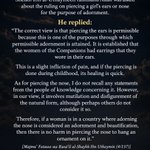
Sheikh Ibn al-Uthaymeen rahimahu’Allah was asked about the ruling on piercing a girl’s ears or nose for the purpose of adornment.
He replied:
“The correct view is that piercing the ears is permissible because this is one of the purposes through which permissible adornment is attained. It is established that the women of the Companions had earrings that they wore in their ears.
This is a slight infliction of pain, and if the piercing is done during childhood, its healing is quick.
As for piercing the nose, I do not recall any statements from the people of knowledge concerning it. However, in our view, it involves mutilation and disfigurement of the natural form, although perhaps others do not consider it so.
Therefore, if a woman is in a country where adorning the nose is considered an adornment and beautification, then there is no harm in piercing the nose to hang an ornament on it.”
[Majmu Fatawa wa Rasa’il al-Shaykh Ibn Uthaymin (4/137)]
t.me/Gardensofknowledge

Sheikh Ibn al-Uthaymeen rahimahu’Allah said :
“If merchants do not sleep until they review their business notebooks to see what they have exchanged, what they have spent and what they have earned, then verily the trade of the Hereafter should be given greater attention because it is greater than the trade of the people of this worldly life.”
[Liqaa al-Baab al-Maftuh 5/79]
t.me/Gardensofknowledge
107
Al-Allāmah Zayd al-Madkhalī (rahimahu’Allah) said:
“Just as charity is with wealth, it is also with the remembrance of Allah, with the various types of remembrance, such as reciting the Qur’an, glorifying Allah, praising Allah, declaring the oneness of Allah, declaring the greatness of Allah, seeking forgiveness, and other than that from the remembrance of the heart and tongue.
For all of that is multiplied charity, involving no burden, exhaustion, or hardship. Rather, it is light, easy, and facilitated for both the heart and the tongue. Along with that, it is heavy upon the Scale and beloved to Ar-Rahman.”
[Al-Manhaj al-Qawim fi at-Ta’asi bi ar-Rasul al-Karim, p. 234]
t.me/Gardensofknowledge
89
Allah The Most High says:
{فعسى أن يكون من المفلحين}
{So perhaps he will be among those who are successful.}
Ibn Abi Hatim narrated in his Tafsir (9/3001), on the authority of Ibn Abbas radiyAllahu anhuma, that he said:
“Perhaps, when it is from Allah, is obligatory.”
Al-Raghib said:
“The statement of the mufassireen, ‘Perhaps, when it is from Allah, is obligatory,’ means: when the Most Generous is hoped in, He fulfills [what is hoped for].”
t.me/Gardensofknowledge
105
Sheikh Muqbil ibn Hadee al-Wadee rahimahu'allāh said:
“I have seen that which breaks the backs of the people of innovation are two matters:
The first matter: al-Jarh wa at-Ta‘dil.
The second matter: al-Tamayuz, meaning separating oneself from them. They should not be sat with, nor should their lectures be attended.”
[Nubdhah Mukhtasarah min Nasaiih Walidi al-Allamah Muqbil, p. 61]
t.me/Gardensofknowledge
166
Al-Hafidh ibn Abdul-Barr rahimahullāh said:
“Indeed the last part of this generation, if they establish the religion, hold on to it, and remain patient upon the obedience of their Lord at a time where evil, immorality, widespread killing, disobedience and major sins are apparent, then they will at that time be strangers.
And their deeds will be purified during that time, just as the deeds of those who preceded them were purified.”
[At-Tamhīd 20/252]
t.me/Gardensofknowledge
88
Abdullah bin Amir purchased a house from Khalid ibn Uqbah ibn Abi Mu'ayt, located in the market, for ninety thousand dirhams.
When night fell, he heard the crying of Khalid's family. He asked his family members, "What is the matter with them?" They replied, "They are weeping over their house that you bought."
He said, "O boy! Go to them and let them know that the house and the money are all theirs."
[Al-Mustajad min Fi'alat al-Ajwād (p. 3).]
t.me/Gardensofknowledge
112
Sheikh Abu al-Hasan Ali al-Hajjaji hafidahu’Allah was asked:
“What is the ruling on making Tasbeeh with the right and left hands together?”
He replied:
“It is better for it to be done with the right hand because it has been reported from the Prophet ﷺ in Abu Dawood and others, with a chain of narration that al-Allamah al-Albani rahimahu’Allah considered good, from Abdullah ibn Amr رضي الله عنهما, who said:
“I saw the Messenger of Allah ﷺ counting the Tasbeeh.”
Muhammad ibn Qudamah, who is one of the narrators of the hadeeth, said: “With his right hand.”
Likewise, it has been reported in the hadeeth of Yusayrah رضي الله عنها, who was from the muhajiraat. She said:
“The Messenger of Allah ﷺ said to us: ‘You must adhere to Tasbeeh, Tahleel and Taqdees, and count with the fingertips, for indeed they will be questioned and made to speak, and do not be heedless, lest you forget the mercy.’”
Therefore, Tasbeeh should be done with the right hand and with the fingertips. The Prophet ﷺ used to like beginning with the right in everything: in his purification and in combing his hair.
It has also been reported from an-Nawawi that he said:
“The Prophet ﷺ used his right hand for everything that was good, and he used his left hand for everything that was from harm and other than it.”
Whoever makes Tasbeeh with his left hand, we do not object to him, but he has opposed what is preferable.”
[Taken from the telegram of the Sheikh question 432]
t.me/Gardensofknowledge