

Managing $4,900,000 in funded capital! 2-year verified track record! Sharing my growth! Private investor capital! AI/Tech/Inventor/Promethean!
Joined January 2024
- Tweets5.2K
- Following360
- Followers13.8K
- Likes11.5K






Pinned Tweet
#1 Sharpe ratio trader / prop trader from Romania.
1.68 Sharpe, 19.91% annualized return, 8.50% max drawdown.
Verified track record: €952,961.16 AuM, invest in RIAG here (36% capacity):
darwinexzero.com/darwin/RIAG…
All Weather approach applied to CFDs with a shorter time horizon, long + short.
Good diversification compared to the usual CTA approach.
Currently negotiating another €1M AuM deal + a €3M starting AuM hedge fund opportunity.
CAGR: 47.6%(Darwinex Signal account)
Max drawdown: 14.7%(Darwinex Signal account)
$315,000+ in verified profit across prop firms.
The only premium community in the industry focused on AI agents, with verified track record traders + an autonomous teaching course trained on my exact framework and data, my second brain (The AI Doppelganger).
22 strategies (Forum Strategies), 2 autonomous backtesting tools, TradingView Stellar template with GitHub access, secret War Rooms.
Not for lazy people/beginners who expect a plug and play solution!
Learning algo trading takes time.
whop.com/joined/zenomtrader-…
Annual plan: 44% off
whop.com/checkout/1PJ44jnNdr…


Most traders quit in the worst stretch, which is exactly where the best days are.
QQQ since 2010, held through everything: +1,440%. Miss only the 10 best days out of 4,228, and it drops to +666%. Miss the 30 best, under 1% of all days, and it's +238%.
And look where those days were. 19 of the 20 best days came while QQQ was already 10% or more below its high, and half of them within two weeks of one of the 20 worst days. April 9, 2025: +12% in a single day, a week after the tariff announcement. March 2020: five of the ten best days, in the middle of the crash.
So the trader who stops after a bad week doesn't skip the pain. He skips the recovery.
Bad weeks are the entry fee. The few big days pay for everything. You don't need to predict them. You just need to still be in the game when they come.


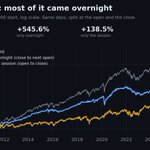
Most traders think the overnight edge is an NQ quirk. It isn't.
Since 2010, holding only overnight, from the close to the next open:
S&P 500 (SPY): +207%, against +122% for the session.
Russell 2000 (IWM): +526%. The session alone lost 29%.
Gold (GLD): +294%. The session alone lost 13%.
Dow (DIA): +158%, against +95% for the session.
Gold's last 12 months are the clearest case. Overnight made +17.7%, the session lost 17.5%, and gold held all day went nowhere, -2.9%.
Same pattern on every US index I checked, and on gold. The session, the part with all the setups, sweeps and fair value gaps, adds little or takes away. The repricing happens while New York sleeps: earnings, data, Asia and Europe. The open only tells you which way it went.
That's why my daily bias is the overnight move, not a 10-timeframe analysis. Keep it simple, and let the data pick the side.

ICT traders run a 10-timeframe analysis to find their daily bias. A year ago I said the best daily bias filter I've ever created for NQ is simply entering in the direction of the overnight move. The last 12 months made the case even stronger.
QQQ gained 14.1% over the last year. Split every day at the open and the close: holding only overnight, from the close to the next open, made +14.1%. Holding only the session, from the open to the close, made +0.1%. The hours with all the sweeps, order blocks and fair value gaps added nothing.
It's not just this year. Since 2010, the overnight part alone turned $10,000 into about $64,500. The session part, about $23,900.
And it actually makes sense from a macro perspective. Earnings, economic data and the rest of the world move while New York sleeps, and that's where the repricing happens. The open only tells you which way it went.
No need for a 10-timeframe ICT, CRT daily bias analysis. Just this. Any momentum or breakout system becomes more effective when you keep things simple.

I want to start more DARWINs and explore different ideas, maybe an ETF-only one, something focused on stocks, etc.
I’ll have to start researching alpha again.
I haven’t done it in a long time, but it’s about time.
It will also help decorrelate from my main DARWIN and offer investors different sources of alpha.

RIAG should probably become my main focus again.
I’m not going to lie, futures prop firms and the possibility of getting paid every week made me focus way too much on that side.
But the truth is that RIAG could get exponentially better from here.
I can add a lot more strategies, especially on the Forex side, and turn the entire thing into a fully agentic portfolio.
Loops constantly monitoring performance.
Adding new strategies.
Removing decaying ones.
Comparing live results against the backtests.
Searching for new uncorrelated edges.
Basically a portfolio that never stops evolving.
Prop firms are great for cash flow.
But RIAG is where I can build something that keeps compounding and improving for years.


Quants spend millions trying to predict direction. I stopped trying.
Look at this week. 4 days of pure chop where every breakout failed and every signal flipped, then one full bearish candle that paid for everything. Most traders get chopped out before the move comes, and the ones who survive are too scared to take it.
Chop is where accounts are lost, and almost never because of the market. It's the size that grows after two losers, the stop that gets moved, the revenge trade at the worst possible moment. Fixed rules don't feel anything, so they're still standing when the move finally comes.
My edge isn't knowing which day is which. It's a structure built to survive the chop and be fully in position when the trend shows up. The chop days are the cost of doing business. The trend days are the business.
You don't need to predict the market. You need to still be there when it moves.

Most traders blame the prop firm when they lose.
The math says the firm is paid by the people who quit.
Every evaluation is a bet with a fixed cost and a capped downside.
A trader with no plan buys one or two, hits a normal losing streak and walks away.
That's the gambler's ruin: not a bad strategy, just not enough capital and patience to survive the variance. The firm keeps the fee either way.
Prop firm rules are pure math.
The daily loss limit and the drawdown decide how many losing trades in a row you can take before you're out. If your plan can't survive ten losers in a row, you don't have a plan, you have a lottery ticket.
The traders who get paid treat it like a business.
They size so one bad day can't end them, they replace failed accounts without emotion, and they keep going through the chop because they know the trend days pay for everything.
The losing streak isn't the signal to stop. Quitting is the only guaranteed loss.

CFD traders call a drawdown that lasts for months normal. I call it stagnation, and there is nothing in this world I hate more.
I've been in drawdown with CFDs since August. On Darwinex since June.
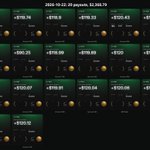
Meanwhile, yesterday was the first day with 23+ payouts. It's my best day so far.
You don't get payouts every day with other firms like you do with perpetuals.
That's why I'm optimizing mainly for speed nowadays.
Futures are the next problem.
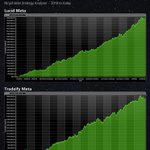
With futures, I think you can get payouts every three days if you're really smart about it. But it requires a lot more effort, multiple Metas, and significantly more complexity.
That's exactly the kind of problem no human should solve by hand.
Let's see if my test harness can solve that.
Perpetuals already pay every day. Futures every three days is next.

This test harness is the craziest thing I'm building right now, and it's not limited to regular trading.
I have a harness for every prop firm and its rules, and it goes further than that.
It has rejected over 20,000 strategies and combinations, plus 7,000 on a single prop firm alone.
It keeps testing thousands of ideas and finding nothing. Maybe my criteria are too strict.
That's what I thought, until I did the math. Test 20,000 strategies with zero edge and the best one will still look like a 4.5-sigma edge, by pure luck.
My best real idea scored 4.06.
Most traders stop at the first backtest that looks that good. That's how you end up trading an overfit system with real money.
So I tested the harness itself. I planted a fake edge in the data, information about the future that no real strategy could ever have, and ran it through.
The harness found it. It isn't blind. The ideas were just empty.
A harness that finds nothing in 20,000 tries is worth more than one that finds 50 winners.
Those 50 winners are the expensive part.
It will be the best thing we've built, if we can finish it.


Most ICT communities are gamifying prop firms with no clue about real trading. Zenom Premium traders are doing the opposite.
Over the past three months, they've been winning on both sides: in the real markets and at prop firms.
For two consecutive months, Premium traders have ranked among the top 3 in the world in one of the most brutal trading competitions out there, where one bad month knocks you off the leaderboard, and nobody cares about your story.
That doesn't come from drawing liquidity zones on a chart. It comes from code.
Every strategy is a set of rules that gets backtested, stress-tested on data it has never seen, and only then deployed live, with the same rules applied to funded accounts and real capital.
If it can't survive that process, it never goes live.
That's the difference between a trading community and a community of coders who trade.
Not your average ICT Discord.


My Perpetual Prop Firm Tier List Ranked by Edge Using AI Agents. Zero Opinions, Just Data.
Every crypto prop firm tier list I see ranks firms based on opinions. I decided to backtest them instead.
54 plans, 348 account sizes and configurations, across 17 firms. Data from 2018 to today.
Here's how I tested them:
Zero trading edge: Every trade direction was determined by a coin flip.
Same strategy across all firms: Only the rules changed.
Optimized per plan: Position sizing, markets, number of concurrent accounts, profit targets, and other parameters were optimized within each plan's rules.
All costs included: Every fee counted, the best publicly available promo codes applied, and every failed account repurchased.
The results?
Vest 2-Step 5K: +$200 profit per $100 spent on evaluation fees.
Size Prop 1-Step 5K: -$100 per $100 spent. Not a single payout.
Same coin flip. Same zero edge. Completely different outcomes.
Most firms actually pay a coin flip something. A few don't even return your initial investment.
One important warning:
Most of these firms are relatively new, and we are still early in their lifecycle.
This tier list ranks mathematical edge, NOT sustainability, trustworthiness, or reputation.
A profitable model on paper means nothing if the firm doesn't survive long enough to pay you.
Which perpetual prop firm and plan are you currently trading?

I'm building the future number one prop firm comparison website in the world.
Not another list ranked by who pays the biggest affiliate commission. The ranking comes from the math, and the math doesn't care who the partner is. Even if I rank a firm low and they pull my affiliate access, the credibility is worth more than any single payout.
Here's what it will show that no comparison site does:
Your own trades, run through every firm's actual rules: trailing or end-of-day drawdown, daily loss limits, consistency, payout caps. The firm that turns your edge into payouts, not the one with the best discount code.
How many months you would actually get paid, and what comes back on every dollar of fees.
The number nobody publishes: after how much in payouts each firm moves you to live. By firm, from real traders, backed by payout certificates.
And rule changes the day they happen, read from each firm's own pages.
They're buddies with the firms. I'm building it for the traders.

Diversification is supposed to save you when one strategy fails. For the last six months, it didn't save anything.
Apparently, these have been the choppiest six months in the last eight years.
The short side, mean reversion, other instruments, everything fell apart. Nothing worked.
Most traders would look at that and decide their system is broken. They'd start rewriting rules, chasing the last few months, and throwing away years of research.
That's the wrong lesson.
When every uncorrelated piece falls apart at the same time, it's usually not the strategies. It's the market.
Chop like this is part of trading. Real trading comes with stretches where nothing works, and you only find out which systems are real by sitting through them.
Meanwhile, I'm getting payouts almost every day with futures and perpetuals.
Same trader. Same discipline. Two completely different results, because the prop firm model and real trading are different games.
The market doesn't care how good your backtest was. It only rewards whoever is still running when the chop ends.

That's right. Pretty much all of these influencers are approaching it that way, but they don't have the balls to say it.
They're not positive EV under regular market conditions, and their followers are losing money.
So I imagine the goal is to keep those followers around for as long as possible, making money for the firm.

The only thing she did wrong was call herself a "profitable trader".
Otherwise how she approaches props is how nearly all profitable prop traders approach prop and how its been designed to be. I'm not taking sides here, but I would only use the terms "profitable trader" if the trader is net positive on a singular brokerage account - something I would not even dare call my own approach to Props.
This is also why I publicised my dashboard, to show that you can be "prop profitable", but not actually be equity/net profitable. And also to show newcomers how it's actually done.
This is also why prop trading and real brokerage trading are two different games entirely. I would not approach each the same way.
On prop, I would aim for profit acquisition and take risks using leverage that I simply would not do on a brokerage account.
On a personal brokerage account, I would prioritise capital preservation where my aim is to simply grow my account.
There are lots of overlapping skills and themes, but they are not the same beast. I would not approach my brokerage account like I would with my props accounts. Similarly, I would not approach my props the same way as a brokerage account.
If I ever use the terms "profitable trader" to describe myself, I would be referring to my algo KazeQuantum IV: myfxbook.com/portfolio/kazeq…
And not my prop trading results. My prop trading results are simply geared towards making money. Nothing more.
I've spoken about this topic before at length, almost everyone successful here in Prop trading is a Game Master:
xitter.cf/Market_Emotions/status…
xitter.cf/Market_Emotions/status…
xitter.cf/Market_Emotions/status…
And yes, you could not justify people who do this as profitable traders, but so what? It's also completely fine, because we're here to make money and that's all that really matters 💰

Prop firms don't need you to be a bad trader. They need you to quit.
Someone who doesn't know what losing streaks to expect will give up after a bad run. That's how these firms make money.
Losing runs are normal.
When the target is 2-3x the stop, most trades hit the stop. Four or five stops in a row happen more often than not.
If you quit after a bad run, you lock in the loss and miss the payout that would have paid for it.
And it's not even about skill.
With random outcomes, some people will start at the right time, while others will simply get unlucky and start during a losing streak or on a choppy day.
I backtested every possible start day from 2018 to 2026.
In half the starts, the first payout comes in about 4 days.
The unluckiest start waited 202 days.
Same rules. Same method. Different start day.
Most traders would call that second person a bad trader. They're not. They just started on the wrong day and gave up before the math played out.
Know the worst case before you put a dollar in. Run the numbers against your own wallet.
Start only when you can sit through a bad run.


Hedge funds spend hundreds of millions of dollars building test harnesses. Most retail traders are still testing strategies by hand.
Researching trading strategies manually is incredibly difficult, and at this point, I don't even think it's worth the effort. There's a reason why top quant funds invest so heavily in automated research infrastructure.
My CFD portfolio hasn't been performing well since June, and I haven't been able to figure out exactly why. That's actually one of the reasons I've spent so much time developing my own testing harness.
And it didn't stop with CFDs.
I'm now building dedicated research harnesses for everything: CFDs, futures, and even prop firm research.
The idea is simple: automate everything you would normally do manually, but at a scale no human could ever match.
The harness can test thousands of strategies, rank them, and automatically reject those that don't pass robustness checks.
But here's the interesting part.
When you're testing thousands of strategies, some will look incredible purely by chance.
That's why I built additional gates specifically designed to filter out strategies that only pass because of random luck.
It can compare performance against the S&P 500, run coin-flip simulations as a baseline, test different market periods, and apply multiple robustness filters before a strategy is even considered.
And the more I work on it, the more I realize that almost anything you can do manually in quantitative research can be engineered into a harness.
The funniest part? I started building this almost by accident.
A quant called me out on some of my research, so instead of ignoring him, I kept developing the system, adding more robustness filters, better validation, and more sophisticated testing methods.
That criticism ended up pushing me to build something much more powerful than I originally intended.
It's honestly mind-blowing how far you can take this.
And I think this is where quantitative trading research is heading: not manually searching for the next strategy, but building systems that continuously discover, test, reject, and rank thousands of ideas.
The edge isn't just in the strategies anymore. It's in the research infrastructure that finds them.


Most traders want a 70% win rate. Jim Simons's Medallion Fund was right only 50.75% of the time.
Robert Mercer said it himself: they were right 50.75% of the time, but they were 100% right 50.75% of the time.
A tiny edge, known with certainty, repeated across thousands of trades. That's the whole game. A 70% win rate you've never proven out of sample is worth less than that.
And academia and quants still say all of Medallion's strategies are overfitted, because he used data mining and machine learning in his approach.
Yet he built the most successful hedge fund in history.
Doing the opposite of what they say seems like the best way to get crazy numbers, like a Sharpe ratio of 2, the way i'm getting.
I'm going to get rid of all strategies with a 0.5+ drawdown correlatio and tail risk to overfit it even more.
It sounds like a great idea.

Most traders choose a prop firm based on the profit split.
I choose based on how fast the money hits my account.
That's why I moved from CFDs to futures, and then to perpetuals.
With CFDs, I was waiting months for payouts, often having to recover drawdowns first. With futures and perpetuals, the entire cycle is much faster.
Since September 1st:
7 payouts in 41 days.
$7,400 withdrawn.
One payout every 6 days on average.
First payout after just 7 days.
Longest stretch without a payout: 17 days.
The craziest part?
I received 3 perpetual prop firm payouts in a single day, from accounts I'd purchased just 4 days earlier.
And yesterday, I received my biggest payout of this experiment so far: $2,500 from a single Lucid account.
I'm reinvesting 50% of every payout into new accounts and keeping the other 50%.
Not a single additional penny out of my own pocket.
The goal is to build an entire prop firm portfolio funded exclusively by previous payouts.
Most traders obsess over profit splits.
I obsess over payout velocity and how quickly I can recycle capital.
That's an edge almost nobody talks about.

I started this crazy experiment around September 1st, starting with futures and later expanding into perpetual prop firms, from absolute zero.
One firm, 5 evaluations.
My goal was simple: never, ever reinvest a single penny out of my own pocket. Only reinvest 50% of my payouts and keep the other 50%.
And it's been going pretty well so far.
I started with 5 evaluations. Now I'm sitting at 7 funded futures accounts, another 10 evaluations, and 60 accounts with perpetual prop firms.
I've already doubled my initial investment, and the returns are even higher if we account for the profits I've reinvested and compounded.
Not a single penny of my own money will ever go into prop firms again for the rest of my trading career. Everything will be funded by reinvesting payouts.
Let's see where this experiment takes me one year from now.


