

Polymarket v2, specialized for stock tokens. 24/7. $ABELL powers burn + staking: lose a trade, 50% auto-buys and burn 0x2062801D30E9308eB55Bd158224e85C5855625F7
Robinhood
Joined September 2026
- Tweets38
- Following7
- Followers65
- Likes14
Pinned Tweet
JUST IN : $ABELL PRODUCT ARE LIVE
WEBISTE : after-bell.uk/app/#/markets
Another event. Another question.
The information move 24/7. Market should be able to do the same
After-bell.uk

A token should have a job.
Our second AFTERBELL article breaks down why $ABELL exists, how it connects to the product, and how market activity feeds into its economic design.
Read it ↓
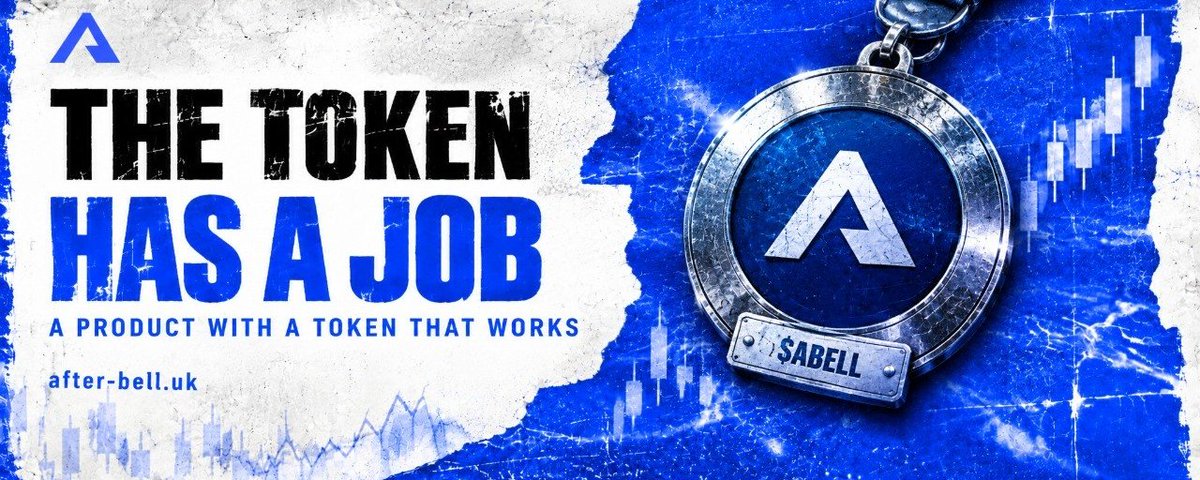


The burn mechanism has its own execution layer.
When a losing market settles, 50% of the losing stake enters the BurnRouter.
The router uses a TWAP-based execution to buy $ABELL from the open market.
The purchased tokens are then burned.
If liquidity falls below the required threshold, the circuit breaker prevents the buyback from executing.
The burn isn't a marketing event.
It's protocol infrastructure.
See the mechanism → after-bell.uk

News creates questions.
Questions create markets.
And markets don’t have to wait for the opening bell.
Explore : after-bell.uk

Oracle design is part of the protocol, not an afterthought.
AFTERBELL uses Chainlink as the primary stock price source.
Robinhood's REST API provides a second data source for cross-checking.
If the two sources differ by more than 5%, the market pauses.
The system doesn't guess.
It stops, checks the evidence, and resolves manually when necessary.
Two sources. One check.
Read the resolution model → after-bell.uk

Under the interface, settlement happens on-chain.
Orders are matched through the off-chain CLOB.
USDG is used for settlement.
Smart contracts on Robinhood Chain hold the collateral and issue the market positions as ERC-1155 tokens.
Once the market resolves, the contracts handle settlement.
Off-chain matching.
On-chain settlement.
See the architecture → after-bell.uk

This is the interesting part of prediction markets.
The event happens first. The market forms around what happens next.
AFTERBELL is built around that same idea, applied to stock-token markets.
after-bell.uk
Prediction markets have a different liquidity problem.
AFTERBELL uses a Central Limit Order Book instead of an AMM.
Orders are placed on the book and matched directly between traders.
No liquidity pool.
No impermanent loss.
Just a matching engine designed around the way prediction markets actually trade.
See the architecture → after-bell.uk

What happens when the market closes, but the event doesn't?
Our first AFTERBELL article looks at the gap between traditional market hours and continuous information.
Read it here :
We’ve completed our $ABELL listing request on @coingecko
• Request ID: CL2709260020
• Status: Pending (submitted Sept 27, 2026)
Geckoterimal: geckoterminal.com/robinhood/…
Thanks for the support. We’ll keep everyone posted once @coingecko completes their review.


$ABELL is paired with robinhood:0x6330d8c3178a418788df01a47479c0ce7ccf450b
Three reasons:
1. Ecosystem alignment. AFTERBELL is a prediction market for stock tokens. Pairing $ABELL with a stock token keeps it inside the stock token economy, not just another DeFi token.
2. Price discovery against a real asset. COIN is volatile and liquid. $ABELL price reflects relative value against Coinbase stock, not a stablecoin peg.
3. BurnRouter depth. COIN already trades on RHC. Existing COIN holders can add $ABELL without leaving the stock token ecosystem. The pool stays deep enough for TWAP buys without massive slippage.
Trade-off: $ABELL inherits robinhood:0x6330d8c3178a418788df01a47479c0ce7ccf450b volatility. We chose narrative alignment over price stability. Design choice, not mathematical optimization.
$ABELL has concrete utility: stake it to get trading fee discounts. No guessing, no tiers based on "loyalty" only the amount staked determines the discount.
Base trading fee: 0.5% per transaction.
$ABELL staked-Discount-Effective fee
0 | 0% > 0.5%
1,000 : 20% : 0.4%
10,000 : 40% : 0.3%
100,000 : 60% : 0.2%
When you stake, $ABELL is locked in the Staking contract. Circulating supply drops. Combined with the loss-burn above, this means $ABELL supply shrinks from two sources: burned (from losses) and locked (from staking).
There is also a 0.1% resolution fee paid when a market settles. Trading + resolution fee allocation:
- 70% to treasury (operations)
- 20% to market maker subsidies (liquidity)
- 10% to the keeper bot (oracle)
Loss-burn does not go into the allocation above. 100% of loss-burn goes directly to $ABELL buyback + burn. No treasury cut, no intermediary.