

Reporter. Worked: PTI (New Delhi). The Tribune (Chandigarh). The Guardian (London). New Lines (Washington). The National (Abu Dhabi).
#Kashmir. South Asia.
Joined March 2015
- Tweets1K
- Following836
- Followers1.4K
- Likes604




Pinned Tweet
I am nearing the completion of two-year research for a book on Sheikh Mohammad Abdullah, with the entire timeline of events covered. If you got a question/argument which you feel is important, do drop a word in comments/DM/f2f over cups of tea (it will be of immense help to me).
A poignant review of the letter from Post-box #Kashmir
You can order the book here on Amazon: amzn.in/d/0ddRJib7


#PostBoxKashmir
#Letter-Blessed is the Nation whose soul is Restless
Sheikh Muhammad Abdullah’s letters are beginning to feel increasingly personal with each passing day. The more I read, the more fascinating history becomes. They reveal things we were perhaps never told, taking us beyond familiar political narratives and allowing us to rediscover SMA.
This is a side of SMA that perhaps even his comrades-in-arm could not fully narrate to the nation, let alone his political adversaries. Decades of political propaganda & relentless attacks on his image in J&K may have overshadowed dimensions of his personality that deserved to be explored.
While reading this particular letter,I felt something different. Although SMA was writing to a colleague or a friend,I could not shake the feeling that he was addressing a much larger audience, perhaps the nation itself,especially its younger generations.
He reflects on a profound truth about the destiny of nations,as long as people remain committed to righteous deeds, they retain their strength & standing. But when they surrender to luxury, indulgence and inaction,gradually turning away from the remembrance of Allah, their decline begins. He reminds us that this is the way of Allah & that the destiny of nations is ultimately shaped by their actions & intentions.
What I find particularly profound is that he does not attribute the rise or fall of nations simply to politics,power or changing circumstances.He takes the discussion somewhere much deeper,to the relationship between the individual & Allah,to righteous deeds,remembrance, purity of intention,spiritual conviction & the ability to remain steadfast in moments of triumph as well as tribulation.
To me, he seems to be conveying that before a nation can rediscover its greatness,its people must rediscover the greatness within themselves.A nation cannot truly rise unless its individuals work on their own character,strengthen their connection with their Creator & live by the values they profess.
Reading this, I was reminded of Alama Iqbal's beautiful couplet
Apne man mai doob ke paa ja suragh-e-zindagi,
Tu agar mera nahi banta, na ban, apna tou ban
Perhaps this is the very spirit of what SMA is trying to convey,look within before looking for answers outside. Rediscover yourself before setting out to rediscover the greatness of your nation.
His reflections on governance are equally revealing.He speaks of the promise of Allah being granted to those who prove themselves worthy through their deeds.I do not read this merely as a call for political struggle,but as an appeal for inner strength,righteousness & self-improvement.
Remain steadfast through difficulties. Do not blame others for every setback.Carry humility in moments of victory & patience in times of defeat.Above all,cultivate within yourself the character & capacity to become worthy of what you seek from Allah.
There is a spiritual,perhaps even metaphysical dimension to these letters that I am still trying to comprehend. At times,I struggle to fully grasp the context in which SMA wrote these words. Some of his reflections carry a depth that makes one pause & read them again. They seem to emerge from an inner world of thought and spirituality that perhaps very few around him could fully appreciate.
I sometimes wonder how many people around him truly understood the depth of that inner world.
44 years after his passing, Sheikh Muhammad Abdullah continues to live in people's memories in the political consciousness of J&K remarkably, in the metaphysical presence of its political discourse.His name,ideas & legacy continue to shape conversations even today.
Perhaps that is the greatest revelation these letters offer, Sheikh Muhammad Abdullah was not merely a political figure of his time.There were dimensions to him that we are only now beginning to discover & perhaps,as we continue to read,reflect & look beyond familiar narratives,generations after us will discover even more.


3
399
It was not an inter-faith marriage. Alys accepted Islam & was named Kulsum by Faiz's mother. Her elder sister, originally Chistobel, also accepted Islam when she got married to Taseer. Little reading would be helpful before you comment next.
This quoted post is unavailable.
Faiz Ahmad #Faiz is a giant of modern Urdu poetry whose verses brought together two worlds, one of romance, seperation and longing, and another of injustice, freedom and suffering. Listen to this lovely podcast:
Fb: facebook.com/share/v/1CrACca…
YT: youtu.be/_0RWPdIbfsw?si=r1DO…
Speeches tell us what a historical personality wanted the world to hear. Letters often tell us what he wanted a particular person to understand. And sometimes, inadvertently, they reveal what he never intended history to discover.
The Code of Brave Men
One more day, one more letter & another glimpse into a side of Sheikh Muhammad Abdullah that we rarely get to see.
I read this letter a couple of times & then went back to it again. Not because I couldn't understand it but because I found myself wondering, Am I reading about the same Sheikh Muhammad Abdullah whom we were taught to see through the labels of a Qadyani, a communist & a man supposedly distant from religion?
Addressing his colleagues on 15 June 1956, Sheikh Muhammad Abdullah offers something far more profound than political advice. He urges them to remain steadfast in their commitment to truth, to speak when truth demands to be spoken & to fear Allah above all else not the people.
What follows is particularly remarkable. Sheikh Muhammad Abdullah invokes the teachings of #ProphetMuhammad SAW.
"If anyone knows a true word, he should say it and fear of people should not prevent him."
He then recalls another saying of the ProphetMuhammad SAW ‘’No one should consider himself insignificant."
When the Companions ask how anyone could consider himself insignificant, the Prophet Muhammad SAW explains that it is when a person feels the need to say something concerning Allah but remains silent out of fear of people. On the Day of Judgement, Allah will ask what prevented him from speaking. He will answer, "The fear of people." To which Allah will say, "You should have feared Me the most."
I found myself pausing here. There is something extraordinary about the moral and spiritual conviction reflected in these words. This is not merely a man quoting religious teachings, this is a man urging others to live by them.
And it makes me wonder whether we have fundamentally misunderstood Sheikh Muhammad Abdullah. The political labels attached to him have perhaps overshadowed an intellectual and spiritual side that deserves far greater attention.
I also find myself reflecting on the confidence Mirak Shah Sahib (RA) must have placed in Sheikh Muhammad Abdullah when he entrusted him with the reconstruction of the #Dargah #Hazratbal shrine. Could it have been his understanding of the #Quran, his religious vision and his ability to communicate its message that inspired such confidence? It is a thought worth exploring.
Perhaps his political opponents understood his mass appeal, but never quite appreciated the depth of the thought and religious understanding that informed his speeches.
For years, we have heard the story that Sheikh Muhammad Abdullah would sell the #Quran in his public speeches but after reading these letters, I find myself questioning how much of what was circulated about him was actually an attempt to discredit a man whose command over religious thought and public oratory was difficult to match.
The more I read these letters, the more I realise that the Sheikh Muhammad Abdullah preserved in popular memory may be only a fraction of the man who actually existed & perhaps that is the greatest tragedy, we have spent generations debating his politics, while barely attempting to understand his inner self.


New book in the town!
Post-box #Kashmir - Letters from Sheikh Mohammad Abdullah is a great addition to the repository of Kashmir's modern history.
Amazon link: amzn.in/d/00LFmU9u


Jinnah's 1929 14-points & 1946 Cabinet Mission proposal sought autonomous states within the Indian Union, a copy-paste of the later Article 370. 1946 proposal even included an agreed-upon clause that Union will control Defense, Foreign Affairs & Communication. Bite that!
2
5
720
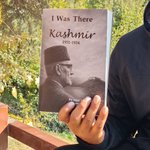
Review: I Was There by Pir Afzal Mukhdoomi #Kashmir 1931-34 qadriazhar.blogspot.com/2026…
3
305
Review: I Was There.
Mukhdoomi walks you through streets and mohallas of Srinagar ... the book makes you time travel to a century ago and shows you the city in its sadness and joys, revolting and calm, quiet and disquiet.
read here: qadriazhar.blogspot.com/2026…
In 1980, Pakistani dictator announced his UN speech will precede Quranic recitation. UN secretariat didn't permit it, citing it can't be selective. PTV did the trick. It edited a Quranic recitation over visuals of Zia in UN assembly. Pakistanis believed it happened.
Did SMA actually do nothing for the Muslims of Jammu? Did he laugh and mock them? Here is one account, conveniently never told, never repeated. Context is key, Jinnah failed to protect Muslims of East Pakistan, Nehru failed to protect Hindus of West Pakistan.


Brother asked a good question, but being as lazy as they come, won't make an effort to research. M officers, political delegations, volunteers were dispatched. Result: 6/10 districts are still M-majority, many tehsils >90% M. Make an effort, you can have educated opinion.

Cool your brains, brother is a valid source vis-a-vis childhood/family events.
Your veteran journalist was a key consultant in formation of PDP, so his loyalties aren't secret.
SMA's interventions saved J Muslims post 6 November, that is why 6/10 Jammu districts are M-majority.


Nehru (with 460000 army) & Jinnah (with 210000 army) couldn't save Hindus of West Pakistan & Muslims of East Punjab. Kapurthala Muslims got reduced from 56% to 0.2%. Yet, you get a poorly-sourced quote to fit your convenience, ignoring the efforts made to salvage the crisis.
Iqbal, the poet, had become greatly disappointed about #Kashmir when he visited the place in 1921.
کشمیری کہ با بندگی خو گرفتہ
Kashmiri, he lamented, has become accustomed to slavery.
Then a decade later, Iqbal saw hope - in one man.


Nawab being nawab!
Ali Akbar Shah, president of the Sindh Muslim League, led a Sindhi deputation to Nawab Liaquat Ali Khan to urge protection of Sindhi culture. Liaquat responded, “what is Sindhi culture, except driving donkeys & camels?”
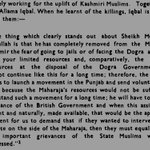
Allama Iqbal had deep reverence for Sheikh Mohammad Abdullah, as the poet here clearly stated: "he has completely removed from Muslims of #Kashmir the fear ..."

The tragedy of Muslims of subcontinent is that leaders like Basha Khan were thrown into oblivion by the empires and their mercenaries.

“پاکستان تو انگریز نے پنجاب کے سرمایہ دار اور جاگیردار اور فوج کے لئیے بنایا تھا۔”
باچا خان بابا
اللہ میری تقصیر معاف فرماۓ، مجھ پہ ایسا زمانہِ جاہلیت بھی گزرا ہے جب میں خان عبدالغفار خان کو غلط سمجھتا تھا۔ لیکن اللہ کا کرم ہے کہ مرنے سے پہلے میں نے اپنی اصلاح کر لی۔
1
6
609