

News about the fate of the marine biological carbon pump in the face of vanishing (sea-)ice project funded by the Swiss National Science Foundation @snsf_ch
Lausanne (CH)-Cape Town (SAF)
Joined June 2024
- Tweets48
- Following67
- Followers25
- Likes11



Thank you very much to @mclanelabs for gifting us very nice T-shirts, stickers and the Legokit! We are now prepared to head back to the ocean!


2
74
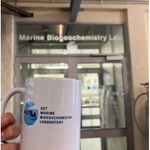
For anything and everything marine nitrogen isotope related – this is where the magic happens! At the University of Cape Town Marine Biogeochemistry Lab. But not before a strong coffee (or two)! @NisotopesUCT @iste_unil @epflENAC @snsf_ch @swisspolar @TOSOceanography @UCT_news

2
61
Let there be light! Rather, let the light be experimentally controlled! Here is Amelia Deary, 2nd year PhD student at the UCT-MBL, adjusting tube light intensity to emulate conditions at depth. @NisotopesUCT @iste_unil @epflENAC @snsf_ch @swisspolar @TOSOceanography @UCT_news
2
105
This is what happens when meltwater from a distant land terminating glacier encounters seawater in Igaliku. They hardly mix because of their different densities. A pic for a fluid dynamics book?
@iste_unil @epflENAC @snsf_ch @swisspolar @TOSOceanography @fyfluiddynamics

Scientists are not the only hard workers onboard – look at all that autotrophic growth! These filters travel to SA for isotopic analysis of particulate organic carbon and nitrogen. Stay tuned! @NisotopesUCT @iste_unil @epflENAC @snsf_ch @swisspolar @TOSOceanography @UCT_news

2
46
Ever wondered what is on the menu for phytoplankton? Or how fast they grow? On-deck incubation tubes facilitate the isotopic enrichment experiments - the first step in answering these questions! @NisotopesUCT @iste_unil @epflENAC @snsf_ch @swisspolar @TOSOceanography @UCT_news

Let's begin September with plenty of energy! Here the humpback whale encountered while sampling Igaliku Fjord in July😍😍😍 @iste_unil @epflENAC @snsf_ch @swisspolar @TOSOceanography @UCT_news

1
43
CARVICE_ocean retweeted

The ArcWatch/TransArc3 expedition (PS144) aboard the German research vessel Polarstern, presents a unique opportunity to revisit the Arctic after TransArc2 (2015).
👁️swisspolar.ch/projects/proje…

Icebreaker Polarstern has reached the central Arctic. The first transect will follow the 80 latitude line and cross the Nansen, Amundsen and finally reach the Makarov Basin. Happy sampling and sailing to PS144 scientists and crew @usys_ethzh @SwissPolar @ERC_Research
Stay tunned! Talking about water, here is seawater coming out of the incubation pipes of Amelia Deary from the University of Cape Twon. She will tell you more about her research at @NisotopesUCT in the coming two weeks. @iste_unil @epflENAC @snsf_ch @swisspolar @TOSOceanography

Seawater covers 70% of the Earth's surface. We use bottles deployed with both sides open to collect it. They are closed remotely to trap water from a selected depth. @ElhuyarZientzia @iste_unil @epflENAC @snsf_ch @swisspolar @TOSOceanography @_oceanography @unoceandecade


The ‘bow’ is the front of a boat. This is where @masierks enjoys the beautiful views, but it can also be the most bumpy and a must avoid place with rough seas. @ElhuyarZientzia @iste_unil @epflENAC @snsf_ch @swisspolar @TOSOceanography @_oceanography @unoceandecade

And here is the ‘starboard’, the right hand side of a boat. This side is used to deploy small equipment such as CTD sensors. @ElhuyarZientzia @iste_unil @epflENAC @snsf_ch @swisspolar @TOSOceanography @_oceanography @unoceandecade


3
48
Do you want to learn the parts of a boat? Here the beautiful Sanna as example. Her 'stern' is the rear part which we use to deploy heavy equipment. @GCRC_GINR @ElhuyarZientzia @iste_unil @epflENAC @snsf_ch @swisspolar @TOSOceanography @_oceanography @unoceandecade


2
47
Let us know what you think and why...
Sea-ice or iceberg calved from a glacier? @PolarObs @iste_unil @epflENAC @snsf_ch @swisspolar @uct_news @unoceandecade @TOSOceanography @ClimactSwiss

1
84
Here the last of our ‘filter series’! Probably the most beautiful ones…. Yes, the small particles between 51 and 1 um. Nature is diverse and full of colours! @iste_unil @epflENAC @snsf_ch @swisspolar @TOSOceanography


4
96
Large sinking particles are thought to drive marine carbon export. They are collected in the 51 micron pore size filter. Here is an example of one filter deployed at 6 m depth on the path of the East Greenland Current. @iste_unil @epflENAC @snsf_ch @swisspolar @TOSOceanography

3
87
How hot is it where you live? We are having pretty hot days in Lausanne, so let's break the ice!
3
169
We aim to infer C export driven by sinking particles. That is why we usually placed 3 filters with 330, 51 and 1 micron pore size in @mclanelabs pump heads. The 330 serves to retain large plankton (swimmers), algae, etc. @iste_unil @epflENAC @snsf_ch @swisspolar @TOSOcenography

The collection of particles is a keystone of @_CARVICE_. This pump head from @mclanelabs allows for the placement of different pore size filters like in a double sandwich. More on the filters on the next post! @iste_unil @epflENAC @snsf_ch @swisspolar @TOSOceanography


Sorry for the short break. We have lots of amazing science and visuals from Greenland.
@ISTE_UNIL
@MaxiCastrillejo
@jaccsa
@UCT_news
@SwissPolar
@snsf_ch
@NisotopesUCT