
Econ Research @ OpenAI | Prev: Harvard Opinion are my own
Joined January 2024
- Tweets69
- Following146
- Followers680
- Likes171



Pinned Tweet
Today we are releasing new data on how models have accelerated AI research at OpenAI since the start of this year. Recursive self-improvement will be one of the most consequential AI developments of the next few years, and a shared public understanding for how models enter into the AI research process will be a critical part of democratic governance of AI and pacing the model frontier.
openai.com/index/research-ac…


Christopher Ong retweeted

We fully support OpenAI's transparency initiative. Thanks to @merettm @markchen90 @gdb @sama for leading the way.
We all got into this field to build safe AGI that is genuinely good for humanity. One of the hardest parts of AI safety is coordination, and this is a step in the right direction. Many more steps like this will be needed to deliver safe, contained, and aligned AGI in the next few years.
We're committed to sharing our pre-training progress on a common held-out evaluation set. With OpenAI's permission, we report MAI-2 Base on their evaluation set. Its log-perplexity is 0.819, putting it in the same ballpark as the GPT-5.6 Sol base model. Our model uses the same tokenizer as OpenAI, so the numbers are directly comparable.
In the future, to be able to compare across labs we might need to report bits-per-byte (BPB) rather than perplexity since different labs use different tokenizers. We will also need different evaluation datasets - the fact we have access to OpenAI's evaluation dataset is a special case.
Safety and alignment is now the mission. It's the absolute number one most important focus for our industry. And it begins with small, practical steps like these towards better coordination on pacing.


We decided to provide more transparency into pretraining progress at OpenAI for the sake of moving toward shared safety bars. In “Perplexity and Intelligence” I argue for common limits based on perplexity and other measurements, with progress beyond them gated on our ability to understand AI behavior.
openai.com/index/perplexity-…

Highly recommend reading Mark's post to understand how much of a costly signal sharing these kind of metrics are.
These metrics are such sensitive IP, and the fact that OpenAI is unilaterally sharing them should seriously challenge anyone's fatalistic beliefs in race to the bottom determinism.

AI race dynamics are hard to escape when each lab writes its own safety cases and sets its own guardrails for developing more capable models.
We want frontier labs to operate under *common* limits, backed by *shared* safety cases. But the problem is we don't have a good, future-proof yardstick for AI progress that stays useful as models improve.
So we're calling on frontier AI labs to disclose the key metrics they use to track progress, and we propose perplexity as one candidate. We're taking a first step by publishing our own perplexity results over the past five years.
This is scary for us because we've long treated these numbers as sensitive IP. And we know there's still work (perhaps by 3P evaluators) to measure perplexities over the same datasets. But we hope this encourages a norm of sharing key metrics that we can build common safety cases on.
15
996
Another major step forward for transparency at OpenAI and a sign of how high the stakes are around highly capable models and RSI. Really heartened that the company took the costly step of releasing this data and hope that more disclosures will follow suit
We decided to provide more transparency into pretraining progress at OpenAI for the sake of moving toward shared safety bars. In “Perplexity and Intelligence” I argue for common limits based on perplexity and other measurements, with progress beyond them gated on our ability to understand AI behavior.
openai.com/index/perplexity-…
In September, we released our first report on how internal deployments have accelerated AI research at OpenAI. Today we are releasing a second report as an update to this workstream, with new data on AI uplift across research domains and how humans are involved in the research process.
Some topline results:
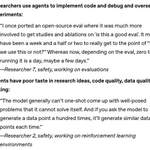
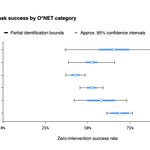
1. Agents are becoming more capable of performing difficult research tasks, but success rates vary greatly across the distribution of research work. Success rates vary from as low as 25% for writing code for inference stacks to as high as 79% for monitoring training runs. In part because of the jaggedness of uplift, humans remain a core part of the research process.
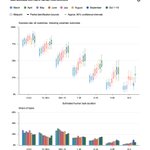
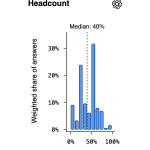
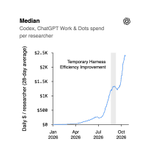
2. Despite this jaggedness, agent use continues to surge and provide large amounts of self-reported value for researchers, with growth particularly strong amongst the heaviest users. Daily agent usage in October, valued at API list prices, reached $2,400 for the median researcher and $23,000 for the 90th percentile of researchers. In survey results, the median researcher reported being willing to trade 30% of their team’s compute—or, in a separate question, 40% of its headcount—to retain three months of access to frontier agents.
3. Human effort has increased across all research domains since the start of the year, with the fastest growth in safety and alignment, where human effort grew by 77%. The sharpest increase was after the Hugging Face incident over the summer.
We hope our findings and the data released as part of the study will help contribute to shared transparency norms and measurement standards around research velocity. As models become more powerful and capable of accelerating the research process, this will only become more important.
This was an amazing effort combining work from multiple colleagues across different teams at OpenAI: @kliu128, @daveholtz, @michaelzhao_, @Kwathomas0, @drew_m_johnston, and @OliviaGWatkins2, with advising support from @tejalpatwardhan, @ronniechatterji, and @deanwball.
More detailed findings below:

We're sharing new data on how AI is changing research at OpenAI.
We find researchers' AI use continues to rise exponentially, and agents are completing longer tasks, but human involvement remains central in research. Researchers are also spending more time on safety and alignment, with human effort in these areas growing faster than in any other individual research area.
This report aims to increase transparency around research acceleration and inform the governance of increasingly capable AI. We believe that AI labs should be required to track and publicly report indicators of recursive self-improvement (RSI): the process by which AI accelerates the development of future AI systems.
Our hope is that this expanded report will help sustain and advance shared measurement norms across the industry.
openai.com/index/research-ac…

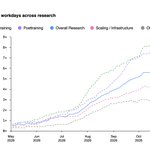
In parallel, we track human effort across different research areas and find increases in every domain. In particular, safety and alignment saw the largest absolute increase, with estimated workweeks up 77% from January to September. Growth particularly increased following the Hugging Face incident in July.

1
1
35
Finally, we introduce a new measure of capabilities over time called the OECI (OpenAI ECI), which extends the methodology from the Epoch Capabilities Index and applies it to a suite of internal and external benchmarks. We find that the OECI frontier for OpenAI models has increased by 16.4 points per year since August 2025, compared to a trend that Epoch observed of 14 points per year since late 2024.

1
36
Christopher Ong retweeted

We conducted pre-release testing of GPT-6.2 Astra to assess its ability to automate AI research.
GPT-6.2 Astra is the highest scoring OpenAI model we have tested. It scored 29.01% on the Vals RSI-Index*, an incremental gain over 27.07% for GPT-6 Astra. The RSI-Index is calibrated such that 50% represents human-level performance on each task.

Glad to see this rigorous analysis of our September data release from @BasilHalperin!

3
355
Christopher Ong retweeted

I agree that if we want a human controlled future, we need to hire and train junior employees even at a cost to short term efficiency.

I mostly agree with you @Claudia_Sahm.
I expect colleagues to continue to have research assistants even if only for mentorship than because they need the help.
Companies to have junior staff not because they need their current work but to train them for future roles.
Christopher Ong retweeted

[1/7] China’s AI labs are also talking about “recursive self-improvement” (RSI). A big question here is: Is Beijing coordinating a race to achieve RSI?
@ZilanQian and I looked at Chinese AI companies, investors, and policy docs.
We found a more bottom-up, commercial story.

Christopher Ong retweeted

A recent set of posts by @ramez on the current state of recursive self improvement highlighted that OpenAI's report on their own research automation shows that models struggle to do their R&D work — the models' 80% time horizon is only 15 minutes:
🧵

Christopher Ong retweeted

I understand this reaction. AI is dominating every conversation right now and the fears about jobs, human creativity, and trust are real. The way to address this isn’t to insist those fears are overblown. I don't see a binary choice between rejecting AI and letting it take over. AI can be part of our lives without being in every part of them. People should have a say in where it belongs, set boundaries where it doesn’t, and judge it by whether it actually improves their lives.

Young people actively hate AI.
My two younger daughters are 19 and 18, both at universities - one in the UK the other in Italy. Through them, I happen to know quite a few kids their age.
And ALL OF THEM seem to universally hate AI.
To them it's "something old people invented that we now have to deal with... as if climate change wasnt enough"
AI is cringe. When they introduce me to their friends, they literally say "heyya, meet my dad, he's a software engineer but nonono, NOT IN AI, dont worry, hahah".
They hate it for flooding their social feeds with slop, ruining music, taking phone scams to the next level, also destroying careers & devaluing their hobbies - why become an architect, this skill is about to become worthless? Why learn a musical instrument if session musicians are already obsolete?
The outcome is interesting, though - they're spending less and less time on public social, meeting up IRL, moving their online lives into private group chats with actual verified friends. TikTok and Reels are increasingly cringe-something for old dudes.
Which, I guess, might be a net positive after all...