

They thought I would break in the storm.And maybe-in parts-I did.But I never left my ground,never lost my line.And when the storm finally passed.I'm still here
Joined July 2023
- Tweets13.2K
- Following4.9K
- Followers4.5K
- Likes25.6K





Pinned Tweet
A view from the West
I am not Russian. I grew up in Western Europe, far from Russia and the history and conflicts that still shape the country today.
For most people in the West, Russia is quite simple. We know Putin, we know the war, and we know a few opposition personalities from our newspapers and television. Beyond that, Russia is often just Russia, a country of more than 140 million people we hardly ever talk about.
My own view has changed a lot over the last four years. Through my work with the Russian resistance, I started talking to people I would never have met otherwise. I discovered regional movements, people helping political prisoners, activists, volunteers and people resisting the regime from inside Russia. Some have very different ideas about what should come after Putin, and they don't all agree with each other. But that is also part of the reality that is often missing when we talk about Russia in the West.
Most people here have never heard of them. They know the names of a few opposition politicians, but they know very little about the much wider resistance around them. And I think we may regret that one day.
There is a lot of discussion in Europe about what Russia should look like after Putin. Should it remain a federation? Could some regions become independent? Who could take power and who would the West be willing to work with? I follow these discussions, but I have never felt that these decisions belong to me. I can have an opinion, but in the end it is not my country. The people living there, including the different peoples and regions of Russia, will have to decide their own future.
I also understand why it's difficult to talk about Russian resistance in the West today. Russia has been waging this war for years. We have seen threats, propaganda, espionage and attempts to influence our countries. So when somebody comes to us and says, “I am Russian and I want to change Russia,” trust doesn't come automatically. Why should it?
But that makes personal contacts even more important. We need to know who these people are, what they stand for and what they are doing. And they need to understand us as well. There are things about Europe and the West that are difficult to understand from inside the Russian political world, just as there are things about Russia that I needed years to understand.
I don't think we should wait for one big opposition movement or one famous person who somehow represents everybody. The people I have met are far too different for that, politically and personally, and their ideas about Russia's future can be very different too.
For me, that isn't necessarily a weakness. It is simply something the West has to understand if we ever want to deal seriously with the people who may play a role in what comes after Putin.
That is also where I see my own place. I don't support the Russian resistance because I want to tell Russians what their country should become. That's not my decision to make. What I can do is bring people together, explain what I see from here and help voices that are unknown in the West reach people who would otherwise never hear them.
I have learned a lot from doing this, including that the West and the Russian resistance often know surprisingly little about each other.
Putin will not be there forever. Nobody knows whether change will come slowly or whether things will suddenly move very quickly. But when it happens, I don't think that will be the right moment for Europe to start looking around and asking who else exists besides the Kremlin and the same opposition figures we have known for years.
Those contacts should exist before they are needed.
There are people inside and outside Russia already thinking about what comes next. Others are taking risks today without knowing whether they will ever see the Russia they are fighting for.
Their future is theirs to decide.
But I would like the West to know who they are.
Freya FAE
t.me/actiondirect/236

Nafis Kashapov: Replacing Putin won't be enough if Russia remains an empire.
Tatar activist and political exile Nafis Kashapov spoke about his years of opposition to Putin, the struggle for Tatarstan's rights and the Russian opposition abroad.
He recalled how, shortly after Putin came to power in 2000, Moscow began challenging the rights of Russia's national republics. His brother Rafis responded with a protest statement from the Tatar Public Centre, defending Tatarstan's constitution and political autonomy.
Kashapov also spoke about his participation in a recent protest in Warsaw, where he carried a placard showing Putin being brought before a tribunal for war crimes.
He was particularly critical of Russian opposition politicians living abroad who support Ukraine but refuse to recognise the right of Russia's national republics to self-determination.
In his view, some of them seem more interested in taking Putin's place than changing the system itself.
Kashapov believes that Tatarstan has already lost much of its political independence under Moscow's centralisation of power. Today, people from Tatarstan are being sent to fight and die in Russia's war against Ukraine.
He argues that Russia cannot become democratic while continuing to deny its peoples the right to decide their own future.
The future of Tatarstan, he says, belongs to the Tatar people.
t.me/tatarstan_independent


Freya_Fae 💙💛 🤝 🤍💙🤍 retweeted

The government of independent Tatarstan in exile congratulates the opposition "Student List" on its victory in the Serbian elections. The time will come when Putin’s puppets in the national republics will also scatter—if they manage to get away in time.
t.me/tatarstan_independent/4…

"OTPOR" Destroys National Guard Vehicle in Orel
Activists from the "OTPOR" movement destroyed a National Guard vehicle in Orel.
The act was carried out by a former participant in the so-called "special military operation" who witnessed the crimes of the Putin regime firsthand on the front lines. This experience completely changed his beliefs, and he now consciously stands on the path of fighting against the system.
The Putin regime is conducting a covert mobilization, destroying its own citizens in order to seize foreign lands. The real enemy is in the Kremlin, and the security forces are only used to maintain this regime.
🟧 Russians don't agree with the actions of the Putin regime. Join the resistance, take action locally, and share information anonymously.
t.me/otpor_move

While Siberians, residents of the Far East, the Sakha people, Buryats, and Tuvan people are fighting in Ukraine for the "Russian world," Putin is selling their natural resources to China at ridiculously low prices.
t.me/ABN_Freedom_for_Nations
💥Another partisan operation! In the Sverdlovsk region, a train carrying fuel tankers has been derailed, and local residents are reporting explosions and a raging fire.
As a result of the operation, twenty freight cars derailed. The enemy has confirmed that at least seven tankers are on fire. Russian Railways (RZD) reports that traffic on the Reshety – Aramil section, where the operation took place, has been suspended.
The news Telegram channel Astra, citing local residents, reports that flames and thick black smoke are rising into the sky.
"There was an explosion on the railway, on Chusovsky Trakt. I woke up when I heard the explosion; it was bright as day," one witness reported.
We congratulate the heroes on their successful operation! Fuel is the lifeblood of Putin's war. This blood must be drained with devastating strikes.
Text: Rospartizan
Picture:Alresistance

Protecting Ukraine's skies is one of the areas we are actively exploring right now.
Interceptor drones could open up new opportunities for countering aerial threats and protecting Ukrainian cities from Russian attacks.
We are testing this direction and assessing its potential for further development.
🎥 Watch: youtu.be/N5joAjt7_vE


Защита украинского неба — одно из направлений, которое мы сейчас активно изучаем.
Дроны-перехватчики могут открыть новые возможности для противодействия воздушным угрозам и защиты украинских городов от российских атак.
Мы тестируем это направление и оцениваем его потенциал для дальнейшего развития.
🎥 Смотреть: youtu.be/N5joAjt7_vE
🔥 The Legacy of ""Barrels"? Burning Trains in the Urals Consume Millions More of the Kremlin's Funds
🛤 In the Sverdlovsk region, a train carrying fuel derailed and caught fire. Local officials will predictably blame the massive fire on anything: old rails, employees of Russian Railways who were laid off two weeks ago – anything to avoid revealing the real reason. But regardless of their reports, the logistics and budget of the dictatorship have suffered yet another direct loss.
🛢 Operation "Barrel" has set a new standard for the underground. In the future, the scale, complexity, and number of such "incidents" for the regime will grow exponentially.
t.me/soprotivleniye_lsr

Another political prisoner has died in Russian prison.
🕯 Alexander Kondratov, the production designer of the TV series Liquidation, had lived abroad for years. A few months ago, he returned to Russia to renew his passport.
He was arrested at the airport and charged with treason.
According to reports, Kondratov was tortured in detention. He has now died in hospital.
He returned to Russia for a passport. He never made it back.
The warning is clear: if you have left Russia, think very carefully before returning. And if you believe you may be at risk of arrest, don't wait until it's too late.
t.me/wind_sower

Putin is losing allies in Europe. In Serbia, Vucic lost the election.
The 14-year era of the rule of Aleksandar Vucic's party in Serbia has come to an end. The former president himself has already conceded defeat, and the opposition "Student List," according to preliminary results, is set to gain a majority of seats in parliament.
This is a serious loss for the Kremlin. Serbia was not just a friendly country, but a convenient gateway to Europe. Through Belgrade, sanctions were circumvented, RT Balkan propaganda was disseminated, and operations of Russian intelligence services were carried out. And Russian businesses controlled strategic oil and gas assets.
And now, following Orban's defeat in Hungary, another long-time partner of Putin has lost power.
Russian Media Corps
t.me/rusmediacorps
Serbia - Student Protests and Elections
After almost two years of student-led protests, Aleksandar Vučić has admitted defeat in Serbia's parliamentary election.
The protests began in November 2024, after the collapse of a railway station canopy in Novi Sad killed 16 people. Anger over corruption and government responsibility brought thousands into the streets.
The students kept going. They organised protests, travelled across the country, spoke to people and eventually decided to take part in the elections.
On Sunday, Serbia saw its highest voter turnout in decades. Preliminary results suggest that the student-backed list has won a majority in parliament.
Thousands celebrated in Belgrade after Vučić conceded defeat.
The students have won an election. Now comes the difficult part: delivering the changes they have been demanding for almost two years.
Source: The Guardian
theguardian.com/world/2026/o…

Lado Gamsakhurdia - Telegram
"Congratulations on the 12th anniversary of the formation of the Chechen Battalion named after Sheikh Mansur!
On behalf of the Caucasian Legion, we sincerely congratulate the command, soldiers, and veterans of the Chechen Battalion named after Sheikh Mansur on its 12th anniversary!
Freedom for Ichkeria! VICTORY!"
t.me/Ladogamsakhurdia

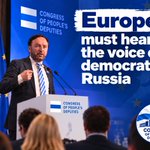
Europe Must Hear the Voice of Democratic Russia ⬜️🟦⬜️
The Congress of People's Deputies continues to engage with European institutions, calling for a stronger international response to Putin's regime and recognition of Russia's responsibility for its war against Ukraine.
The Congress recently received an official reply from the European External Action Service (EEAS) to a letter addressed to European Commission President Ursula von der Leyen and European Commissioner Magnus Brunner.
In its appeal, the Congress called for Russia to be recognised as a terrorist state and a state sponsor of terrorism.
The EEAS response condemned Russia's war against Ukraine as a serious violation of international law, including the UN Charter. It also reaffirmed the EU's commitment to supporting Ukraine for as long as necessary.
The reply does not mean that the EU has accepted the Congress's proposals. However, the Congress intends to continue raising these issues with European institutions.
For its delegates, international cooperation involves more than sending letters and receiving official replies. It requires regular contact with European officials, concrete proposals and continued political discussions.
The Congress argues that Russia's future should not be decided solely by representatives of the regime responsible for the war against Ukraine.
It believes democratic Russian forces should also be involved in international discussions about accountability for the war, restoring the rule of law and establishing peaceful relations with neighbouring countries.
The Congress says it will continue working with European institutions to ensure that democratic Russian voices are heard and its political proposals receive serious consideration.
t.me/i_ponomarev/14647

Russia after Putin – what could happen next?
Historian Maxim Kuzakhmetov talks about Russia's imperial history, the war against Ukraine and the possible future of Russia's regions.
Some of the topics discussed:
🔹️ Putin isn't the only problem. Russia had imperial ambitions long before he came to power. Removing him won't guarantee that the next government will be any different.
🔹️ Arkhangelsk and Ingria could have a future outside Russia. He supports independence for both regions. Arkhangelsk has its own history, natural resources and access to the sea. He believes it could manage without Moscow.
🔹️ But what happens after independence? Former Russian soldiers, armed groups or local politicians could take control. A new state could easily end up with another authoritarian government.
🔹️ He also talks about security. Newly independent states might need help from outside. He mentions NATO bases and even Ukrainian troops as possible protection against armed groups and attempts to restore Moscow's control.
🔹️ After the Soviet Union collapsed in 1991, many people from the old system remained in power. There was no proper lustration, and those responsible for Soviet crimes were largely never held accountable. He believes this is one reason why so little really changed in Russia.
🔹️ He doesn't believe an economic crisis will necessarily lead to protests or bring down the regime. People may complain about prices and shortages, but that doesn't mean they'll demand democracy. Russia still has powerful security forces, and many people who are unhappy with Putin don't oppose the war itself.
🔹️ He believes Ukraine's military victory and Russia's defeat are more likely to bring political change than economic problems or public protests.
🔹️ He calls for trials over Soviet and Putin-era crimes and for lustration to prevent people responsible for repression from returning to power. He also supports criminal penalties for publicly defending Stalin, a position that raises questions about freedom of speech.
The host, who now lives in Germany, also talks about the limits of political activity from exile. She says she doesn't have the moral right to tell people inside Russia what to do. They are the ones facing arrests, prison sentences and torture, while she can speak openly from abroad.
They also discuss how deeply Stalinism and imperial thinking remain rooted in parts of Russian society. Even if Putin is gone, those attitudes won't simply disappear.
youtube.com/live/cd1SGoSk314…


"Historical Pitfalls with Maxim Kuzakhmetov" – a new segment of the "Time Will Tell" project
Friends and guests of the Congress of People's Deputies are launching a regular segment called "Historical Pitfalls with Maxim Kuzakhmetov" as part of the "Time Will Tell" project.
The first episode will be broadcast today, October 24th, at 12:00 PM Central European Time (CEST).
🎥 Join the broadcast:
youtube.com/live/cd1SGoSk314…
The Congress of People's Deputies
t.me/roskongress
Rosdep.org

October 24, 1990 – Chuvashia's Declaration of Sovereignty
On October 24, 1990, Chuvashia adopted its Declaration of State Sovereignty.
The declaration described Chuvashia as a sovereign state and recognised the cultural rights of the Chuvash people and other ethnic groups in the republic.
36 years later, Chuvashia is still part of the Russian Federation. The sovereignty declared in 1990 never led to full independence.
The Government of Independent Tatarstan in Exile marked the anniversary and recalled the years of cooperation between Chuvash and Tatar national activists.
It also expressed its support for Chuvashia's independence and future development.
Sovereignty isn't given. It's claimed.
Source: t.me/tatarstan_independent/4…


The Declaration on the State Sovereignty of Chuvashia was adopted on October 24, 1990. It proclaimed "the state sovereignty of Chuvashia as the supremacy, autonomy, and independence of the republic’s state authority throughout its entire territory.".
t.me/tatarstan_independent/4…

October 24, 1990 – Chuvashia's Declaration of Sovereignty
On October 24, 1990, Chuvashia adopted its Declaration of State Sovereignty, giving the republic a chance to pursue sovereignty and independence from the Soviet Union.
The Severia movement congratulated the Chuvash people, recalling their historical ties to Volga Bulgaria and marking this important date in their history.
In its statement, Severia expressed regret that Chuvashia never achieved independence and remained part of the Russian Federation, which the movement considers an occupying power.
Source: t.me/severia_gov

Alexander Skobov, a prominent human rights activist imprisoned in Russia for his outspoken criticism of the war and the Putin regime, has stated that he doesn't want his release in exchange for the easing of sanctions against Russia.
He strongly opposed the idea of being included in any potential prisoner exchange that would involve a partial lifting of sanctions against Russia.
The idea of such a deal was previously suggested by Nobel Peace Prize laureate Dmitry Muratov.
The 68-year-old dissident, Alexander Skobov, sentenced in March 2025 to 16 years in prison, stated in a letter dated October 4th that he doesn't condemn those who agree to participate in an exchange. However, he himself believes that his imprisonment is a way to influence the situation in favor of Ukraine.
"I am categorically against any deal that would involve any weakening of sanctions until a complete ceasefire. And I won't agree to be a commodity in such a deal," Skobov wrote. His letter was published by opposition dissident Oleg Sofyanik.
Source: t.me/utrofevralia

Severia Calls for Partisans in Russia
The Severia movement has published a new call for people in Kursk, Oryol, Kaluga, Tula, Bryansk and Starodub.
The group wants independence from Russia and is looking for people willing to take part in different activities, including intelligence gathering, direct action and drone operations.
Not every resistance movement in Russia is fighting for a different government in Moscow. Some want to leave the Russian Federation altogether.
Severia is one of them.
How much support the movement actually has on the ground is unclear.
Source: t.me/severia_gov
The Russian Volunteer Corps (RVC) captures Russian soldiers, adding to Ukraine's pool of prisoners available for exchange.
In the second part of their interview with Roman Popkov, the prisoners continue describing conditions inside the Russian Armed Forces.
One of them had been paying his commanders since 2022 to keep him away from the front line. When he ran out of money, he was sent to infiltrate Ukrainian positions.
Another had dreamed of becoming an officer. Instead, he found himself in the freezing cold among burned-out ruins, with burns to his face and no food or medical supplies. He had to wash his eyes with urine just to get them open. His ambitions for a military career have changed since then.
These prisoners are not just captives. They can be exchanged for Ukrainian defenders held in Russian captivity.
Watch the second part of the interview on the RVC's YouTube channel.
Russian Volunteer Corps (RVC)
t.me/rvc_army
🇺🇦 Fundraiser for Ukraine's 38th Brigade
The Marina Donbass Arena team is raising 250,000 UAH to buy a pickup truck and Starlink equipment for soldiers of Ukraine's 38th Brigade.
The current total is 46,735 UAH, with more still needed to reach the goal.
If you can help, please donate or share.
🔗 Monobank:
send.monobank.ua/jar/6McvEpx…
PayPal: [email protected]
More information ⬇️
tiktok.com/@marina.donbass.a…
t.me/roskongress/27297
"Historical Pitfalls with Maxim Kuzakhmetov" – a new segment of the "Time Will Tell" project
Friends and guests of the Congress of People's Deputies are launching a regular segment called "Historical Pitfalls with Maxim Kuzakhmetov" as part of the "Time Will Tell" project.
The first episode will be broadcast today, October 24th, at 12:00 PM Central European Time (CEST).
🎥 Join the broadcast:
youtube.com/live/cd1SGoSk314…
The Congress of People's Deputies
t.me/roskongress
Rosdep.org