
I’m 5th year PhD at VT working on CSS problems using deep learning with my advisor, Eugenia Rho. Lab page: https://teapawt.net/t.co/MEUvt2OR8a
Washington, D.C., VA, US
Joined January 2022
- Tweets35
- Following156
- Followers67
- Likes54
Excited to present my research work at Kamehameha Exhibit Hall I today at 4:30 PM! 🎉 #CHI2024
- Topic: Leveraging Large Language Models to Predict Pandemic Health Decisions and Outcomes Through Social Media Language 📊
Our novel LLM prompting framework extracts causal relations from social media posts to forecast human behavior in the real world.
programs.sigchi.org/chi/2024…
3
87
Fascinating read on using AI design patterns for agentic workflows, specifically the "Reflection"🤩 Self-critique for LLMs mirrors our RBIC framework, which we will present at CHI 24. RBIC employs Role-Based Incremental Coaching to deepen LLMs' task comprehension and performance.

Last week, I described four design patterns for AI agentic workflows that I believe will drive significant progress this year: Reflection, Tool use, Planning and Multi-agent collaboration. Instead of having an LLM generate its final output directly, an agentic workflow prompts the LLM multiple times, giving it opportunities to build step by step to higher-quality output. Here, I'd like to discuss Reflection. For a design pattern that’s relatively quick to implement, I've seen it lead to surprising performance gains.
You may have had the experience of prompting ChatGPT/Claude/Gemini, receiving unsatisfactory output, delivering critical feedback to help the LLM improve its response, and then getting a better response. What if you automate the step of delivering critical feedback, so the model automatically criticizes its own output and improves its response? This is the crux of Reflection.
Take the task of asking an LLM to write code. We can prompt it to generate the desired code directly to carry out some task X. After that, we can prompt it to reflect on its own output, perhaps as follows:
Here’s code intended for task X:
[previously generated code]
Check the code carefully for correctness, style, and efficiency, and give constructive criticism for how to improve it.
Sometimes this causes the LLM to spot problems and come up with constructive suggestions. Next, we can prompt the LLM with context including (i) the previously generated code and (ii) the constructive feedback, and ask it to use the feedback to rewrite the code. This can lead to a better response. Repeating the criticism/rewrite process might yield further improvements. This self-reflection process allows the LLM to spot gaps and improve its output on a variety of tasks including producing code, writing text, and answering questions.
And we can go beyond self-reflection by giving the LLM tools that help evaluate its output; for example, running its code through a few unit tests to check whether it generates correct results on test cases or searching the web to double-check text output. Then it can reflect on any errors it found and come up with ideas for improvement.
Further, we can implement Reflection using a multi-agent framework. I've found it convenient to create two different agents, one prompted to generate good outputs and the other prompted to give constructive criticism of the first agent's output. The resulting discussion between the two agents leads to improved responses.
Reflection is a relatively basic type of agentic workflow, but I've been delighted by how much it improved my applications’ results in a few cases. I hope you will try it in your own work. If you’re interested in learning more about reflection, I recommend these papers:
- Self-Refine: Iterative Refinement with Self-Feedback, by Madaan et al. (2023)
- Reflexion: Language Agents with Verbal Reinforcement Learning, by Shinn et al. (2023)
- CRITIC: Large Language Models Can Self-Correct with Tool-Interactive Critiquing, by Gou et al. (2024)
I’ll discuss the other agentic design patterns as well in the future.
[Original text: deeplearning.ai/the-batch/is… ]
1
1
267
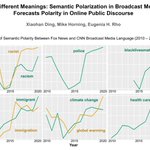
Excited to share our research on the relationship between TV news language and social media discourse. (accepted by ICWSM 2023) @eugeniarho
See ojs.aaai.org/index.php/ICWSM…. We analyzed a decade of closed captions from
@CNN and @FoxNews and related Twitter discussions. #icwsm (1/6)
