
Yunyang retweeted

Our work led by @talaldotpdb on aligning protein generative models to experimental fitness with ProteinDPO is now published in @naturemethods!
New in the published paper includes stabilizing mutations to H5 hemagglutinin, a component of flu vaccines.
nature.com/articles/s41592-0…

Yunyang retweeted

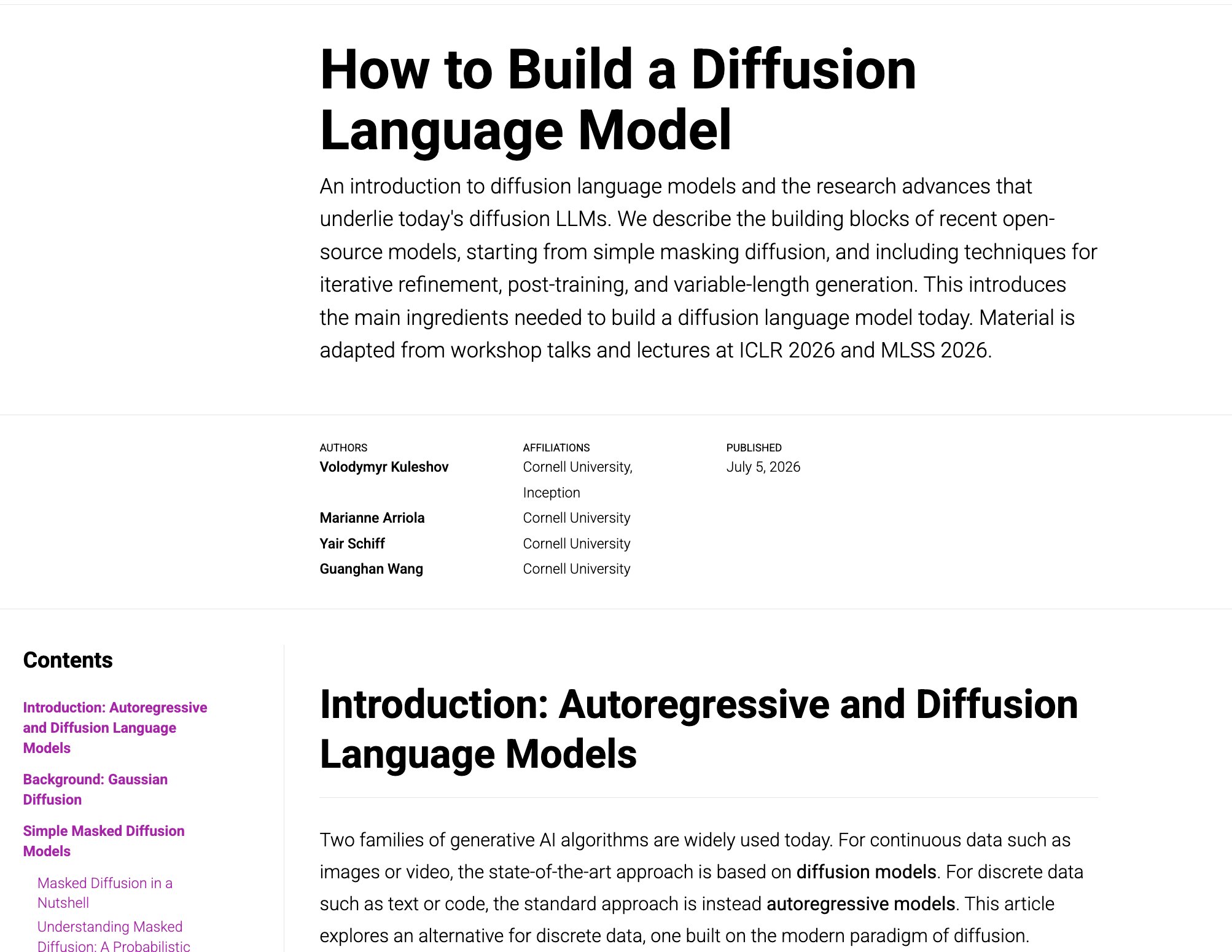
New blog post: How to Build a Diffusion Language Model.
Diffusion LLMs went from open problem to reality in 2 years (Mercury, Gemma Diffusion, Nemotron Diffusion). With my Cornell group, we wrote up the research advances that make them work.
We use today's OSS large diffusion models as examples and show how they're built from core techniques:
• masked diffusion (MDLM)
• iterative refinement (UDLM, ReMDM)
• variable-length generation (block diffusion, encoder-decoder architectures)
• controllable generation (D-CFG, D-CBG)
• fast samplers (Duo)
• RL post-training (d1, d2)
This post covers research led by a talented group of Cornell PhD students including @mariannearr @SchiffYair @Guanghan__Wang
The content is adapted from talks I gave this year on dLLMs. It covers most of the main ingredients behind open-source diffusion language models today.
Link: kuleshov-group.github.io/blo…
Yunyang retweeted

Our book "Generative AI and Stochastic Thermodynamics: A Tale of Free Energies" is out this month. Over the coming weeks @sirui_lu97, @wellingmax and I will post about some of the topics it covers.
Starting it off: heat and work in latent variable models and variational EM.
Yunyang retweeted

new post on harness engineering for AI self-improvement: lilianweng.github.io/posts/2…
It is hard to forecast how much the future of RSI will rely on harnesses. Likely harness engineering will evolve in the direction of self-improvement and enable auto-research, and, in turn, smarter models keeps harnesses simple.
Even when many harness improvement get eventually internalized into core model, the need to specify goals and context will not disappear.


Yunyang retweeted

New Anthropic research: Natural Language Autoencoders.
Models like Claude talk in words but think in numbers. The numbers—called activations—encode Claude’s thoughts, but not in a language we can read.
Here, we train Claude to translate its activations into human-readable text.
Yunyang retweeted

Excited to share OptimusKG, a modern multimodal knowledge graph, led by @lvvittor @ayushnoori @InakiArango
📚 Knowledge substrate for LLM retrieval
🔍 Verification, knowledge grounding
⚖️ Reward modeling for RL in reasoning models
🧬 Discovery use cases such as hypothesis generation
optimuskg.ai
OptimusKG brings together molecular, clinical, anatomical, and environmental knowledge with tracked provenance that spans 21M datapoints and 110M properties
OptimusKG is reproducible and updatable. Data generation pipeline can regenerate the graph as source datasets change, helping the resource stay aligned with evolving science
A frontier multimodal research agent @EdisonSci assessed whether data points in OptimusKG are supported by scientific literature. It found support for 70.0% of sampled true edges, while 83.4% of sampled false edges had no supporting evidence. Additionally, OptimusKG also captures experimental data that has not yet been widely synthesized in publications
arxiv.org/abs/2604.27269
github.com/mims-harvard/Opti…
Many thanks to Lucas Vittor, Ayush Noori, Iñaki Arango, Joaquín Polonuer, Samuel G. Rodriques, Andrew White, David Clifton
@harvard @harvardmed @HarvardDBMI @KempnerInst @harvard_data @broadinstitute @EdisonSci @UniofOxford
Yunyang retweeted

Nice paper from Google.
And a great application of AI agents.
Wearables capture a staggering amount of physiological signals every day. CoDaS is an AI co-data-scientist that turns raw wearable sensor data into clinically relevant biomarkers through an iterative loop of hypothesis generation, statistical analysis, adversarial validation, and literature-grounded reasoning with human oversight.
Across 9,279 participant-observations, it surfaced 41 mental-health and 25 metabolic candidate biomarkers, including circadian instability features linked to depression (ρ = 0.252) and a cardiovascular fitness index linked to insulin resistance (ρ = -0.374).
Why does it matter?
Biomarker discovery is one of the slowest, most expert-bound workflows in medicine. An agentic system that can propose, test, and stress-test candidate biomarkers end-to-end changes the cadence of translational science and starts turning passive consumer sensor data into something clinicians can actually act on.
Paper: arxiv.org/abs/2604.14615
Learn to build effective AI agents in our academy: academy.dair.ai/

Yunyang retweeted

New genomic benchmark just dropped, based on ClinVar and includes 5 supervised tasks (pathogenicity, phenotype association, gene classification). i'm curious which frontier labs will pick this up first 👀

Introducing ExomeBench: a benchmark for evaluating genomic models on disease-associated genetic variants, built in collaboration with with @MayoClinic.
Most genomics benchmarks focus on general sequence modeling tasks. What remains under-evaluated is whether these models can answer clinically meaningful questions about genetic variants.
That's why we built ExomeBench and are releasing it to the public: a benchmark for evaluating health-relevant variant interpretation in exome regions.

Yunyang retweeted

Our @NeurIPSConf work led by @_YunyangLI “E2Former: An Efficient and Equivariant Transformer with Linear-Scaling Tensor Products” was selected as a spotlight (with score ranked ~17 / 21k submissions).
Poster: Thur Dec 4, Exhibit Hall CDE #5512
Online: openreview.net/forum?id=ls5L…

Yunyang retweeted

Want more flexible relative binding free energy calculations? Open Free Energy's new release includes a SepTop implementation -- see release notes: openfree.energy/science/upda…
Method described in my group's paper here: doi.org/10.1021/acs.jctc.3c0…


Yunyang retweeted

We're partnering with @GoogleResearch to kick off a new series of Featured Notebooks exploring topics ranging from health to science to (of course) AI.
Starting with "How do scientists link genetics to health" this notebook explores some of what we've learned over the past 10 years of genomic research:
notebooklm.google.com/notebo…
Yunyang retweeted

What is AvgFlow?
It is a model training and inference framework for accelerating flow-based models that generate 3D molecular conformers.
Uses SO(3)-Averaged Flow to accelerate model training (fewer epochs needed and eliminating the need of rotation augmentation) and reflow + distillation to accelerate model inference (fewer inference steps), yielding faster convergence and better performance across architectures while maintaining accuracy.
🔗 ⬇️

Yunyang retweeted

New work: “GLASS Flows: Transition Sampling for Alignment of Flow and Diffusion Models”. GLASS generates images by sampling stochastic Markov transitions with ODEs - allowing us to boost text-image alignment for large-scale models at inference time!
arxiv.org/pdf/2509.25170
[1/7]
Yunyang retweeted

Super excited to share what @stephenz_y and I’ve been up to during our internship at🍎:
Using optimal transport makes flows straighter and generation faster in flow matching, but small batch OT is biased and large batch OT is slow.
What to do? Use semidiscrete OT!
🧵

Yunyang retweeted

Introducing Nequix MP, a new foundation model for materials.
Example of using Nequix to simulate the dissolution of a NaCl nanocrystal in water:
1/n
Yunyang retweeted

Type 2 diabetes affects hundreds of millions globally. Our research explores a suite of ML models that show the potential of using wearable data & routine blood tests to effectively predict insulin resistance, a major precursor to type 2 diabetes. More: goo.gle/4oDX9MS
Yunyang retweeted
Introducing DeepPolisher — in collaboration with UC Santa Cruz Genomics Institute, we developed this new open-source method to improve genome assembly accuracy. It reduces indel errors by 70% and total assembly errors by 50%. Learn more: goo.gle/3Hn8PCG

ALT Architecture of DeepPolisher. The sequence reads are categorized by parental origin and are aligned to the draft genome assembly. The input channels are: the base information, reported quality by the sequencer, the quality of the mapping, and annotations of mismatched bases. This is sent to an encoder-only Transformer, which classifies the errors in the assembly and then suggests a fix, which is used to correct the assembly.
Yunyang retweeted
Let your wearable data "speak" for itself! Introducing SensorLM, a family of sensor-language foundation models trained on ~60 million hours of data, enabling robust wearable data understanding with natural language. → goo.gle/4lSLwQi
Yunyang retweeted

🚀 Launch day! The NeurIPS 2025 PokéAgent Challenge is live.
Two tracks:
① Showdown Battling – imperfect-info, turn-based strategy
② Pokemon Emerald Speedrunning – long horizon RPG planning
5 M labeled replays • starter kit • baselines.
Bring your LLM, RL, or hybrid agent—let’s push strategic AI forward.

ALT Banner reading “PokéAgent Challenge @ NeurIPS 2025” with two panels: Track 1 – Competitive Pokémon Battle Bots, Track 2 – Long-Horizon RPG Gameplay. Call-to-action: “Create video-game AI! Win prizes! Live now at pokeagent.github.io.”