

researcher @mind_robotics @UofIllinois CS
the promised land
Joined December 2022
- Tweets4.8K
- Following2K
- Followers2.2K
- Likes59.6K


disappointed in my senator today. this is a good bill, and i’m glad it passed over his objections. it’s not an oil and gas bill, it will reduce emissions on net, clean energy gets held up by permitting disproportionately more than oil and gas. hopefully it passes in the house.

We desperately need permitting reform to build out new infrastructure, bring costs down, and bring new, renewable sources of energy online. But it needs to be the right kind of regulatory reform, not oil and gas development masquerading as reform. And throughout the negotiation process, I have made my priorities clear: to bring down energy costs through new clean energy development, to lower emission rates, to support and protect tribal sovereignty, to stop the administration from attacking American clean energy projects, and to ensure that any permitting reform legislation cannot be weaponized by this or any future administration to single out states for adverse treatment and provide giveaways to the oil and gas industries. This is why I submitted more than a dozen amendments for consideration in both the managers’ package and on the Senate floor that would have made the bill better.
As it stands, this bill achieves some critically important priorities, but falls short on others. I appreciate the bipartisan work on this bill and the support of the 36 Senators who joined me in pushing for an amendment that would have struck the legislation’s changes to the National Historic Preservation Act (NHPA). In the new Congress, there will be a lot of opportunity to improve protections for tribal sovereignty, and I will continue consulting with California’s tribal leaders to ensure their voices are heard in the halls of Congress.
I strongly believe we need permitting reform and to build new infrastructure quickly and efficiently. But I also believe that this can be done in a way that does not needlessly degrade clean water, endanger wildlife, or disrespect tribal nations. And for those fundamental reasons, I opposed the bill. It is my hope that when this bill is again considered in the new Congress, that a Democrat majority can pass a more balanced work product that accomplishes all of these objectives.
2
384
underscore advait patel retweeted

here are some of my thoughts after attending this year’s corl:
1. "collecting robot data is expensive" is a much better argument for what to work on during your phd than for what to bet your company on. i don’t think the robot learning community has fully internalized the bitter lesson yet.
i think a lot of our favorite inductive biases will matter less as we get more and better data (the data IS the prior). academia keeps working on them partly because compute is limited and partly because coming up with a clever prior feels good lol. i’m guilty of this too.
for a company, uncertainty can be way more expensive than data collection. you can hire operators, measure how much useful data they collect, and improve that number. much harder to estimate how long it’ll take for a research idea to pan out.
there’s still plenty of architecture work worth doing tho. look at recent llm research. moe, hybrid attention, and looped transformers are all ways to get more out of the compute / memory you have. fwiw, i think robot learning people should read more of the llm literature.
2. the capability that enabled "agentic robotics" is mostly spatial understanding. you can show a model an image and it can tell you where the end effector should go. agents can write code and already know a lot about robotics, duh; that shouldn't be a surprise to anyone.
this makes 3d vision + motion planning + mpc a lot more interesting. those tools could already do a lot if someone was willing to write the glue code, look at failures, and tune everything. agents can take over most of that now. rigid objects still seem to be the capability ceiling tho. throw in deformation and messy contact and i think we’ll want vlas for a while. on the other hand, real2sim scene building and training data generation seem at least as interesting to me as letting the agent control the robot directly.
i have no insider info on where the training data for these visual capabilities came from, but my guess is sim. with models this large, spatial skills learned in sim seem to transfer surprisingly well to real images. so (visual) sim2real is probably just a scaling problem.
underscore advait patel retweeted

I didn’t sign it, but I considered it. I do think Anthropic is power seeking and very effective at mobilizing its beliefs (which comes with risks they don’t do a good job acknowledging), but I found this statement too strong for my taste.

Ahead of Anthropic’s IPO, a rare coalition across AI safety, open source, e/acc, science, and law has signed the MisAnthropic Statement. Read the statement or sign at: misanthropicstatement.com/

specifically looking for the UMI Arena workshop. cc @airoa_org

3
657
underscore advait patel retweeted

One of the most revealing things people say when they hear about a new development is that, “they should build [some other thing] instead.”
What they? There’s no they! There’s only the private owner of the lot. If Walgreens owns the lot, then Walgreens is going to build a Walgreens. If a gas station company owns a lot, which they purchased to build a gas station, then they’re going to build a gas station. You can’t see the gas station going up and say, “you know what we really need there is a pool supply store.”
What in the world are you talking about?
People are natural central planners.
You have to take away their right to influence these kinds of decisions at all. You have to create the legal conditions under which they are not allowed to affect these decisions. Because if you let regular people weigh in, they will reveal that they have an insane theory of how the world should work.
They will see a Walgreens going up on a private lot owned by Walgreens and say out loud, “they should build apartments there instead” like scheming little Soviets.

It’s difficult to explain without sounding crazy but this person successfully blocked turning an abandoned parking lot into taxable 21st century infrastructure because she thought the space could be better used as a trampoline park. (No one has offered to build the trampoline park).
She’s homeless and pulls people’s hair out for almost a living.

underscore advait patel retweeted

I am concerned that people are underpricing the possibility of Taiwan action in 2027. There is a real complacency in the assumption that the price is too high for China to pursue it. Especially given the apparent state of US munitions; we lack credible deterrence at the moment.

China's Xi says Taiwan 'reunification' must happen as history cannot be stopped reut.rs/4zMCT0K


underscore advait patel retweeted

“I was struck by a statistic that seemed to me shocking. In the last 50 years, the automobile has killed more people in the United States than we have had fatalities in all our wars: on all the battlefields of all the wars of the United States since its founding 177 years ago.”
— Dwight D. Eisenhower, Remarks to the White House Conference on Highway Safety, February 17, 1954.


i think one of my main realizations over the last couple of years has been that people have very good intuitions for what individual actions are morally correct, and if something feels wrong, then it probably is, even if you can’t explain it.
however, people’s intuitions for what good and moral policy looks like is terrible, and we should spend a lot more time being rigorous, questioning our assumptions, playing devil’s advocate, and steelmanning views that oppose our own.
7
1,040
i’ll be in austin for CoRL starting sunday. would love to chat with folks interested in pretraining for robotics, data quality and diversity metrics, human / robot transfer and cotraining, or interesting action representations and tokenizers.
i also love talking about Mind, feel free to reach out if you’d like to learn more about us!
underscore advait patel retweeted

FWIW I am an electrician and the jobs are actually forever. Server racks are constantly replaced. HVAC too. Every 3-6 years all the wires, transformers, bus duct, etc… have to be replaced. My company has a very long contract with AWS and the scope of work is well past 10 years
underscore advait patel retweeted

sorry, if it's not a real robot eval, it's meaningless. thanks for playing. better luck next time.


underscore advait patel retweeted

Our RobotArms team is cooking! Ping pong tourney against the arm coming soon 👀
underscore advait patel retweeted
Our BCI team is moving quick! This is an awesome working demo

Been working on some cool stuff with the BCI team at @sigrobotics !
We got the Chrome Dino game to jump by flexing our biceps using EMG signals to test our data recorder.
Huge shoutout to the team for making this happen! @a2th2tn @AVMishra08 @sids347 @rzheng1232

my goat @_robert_molina

Humans should be more coordinated than robots.
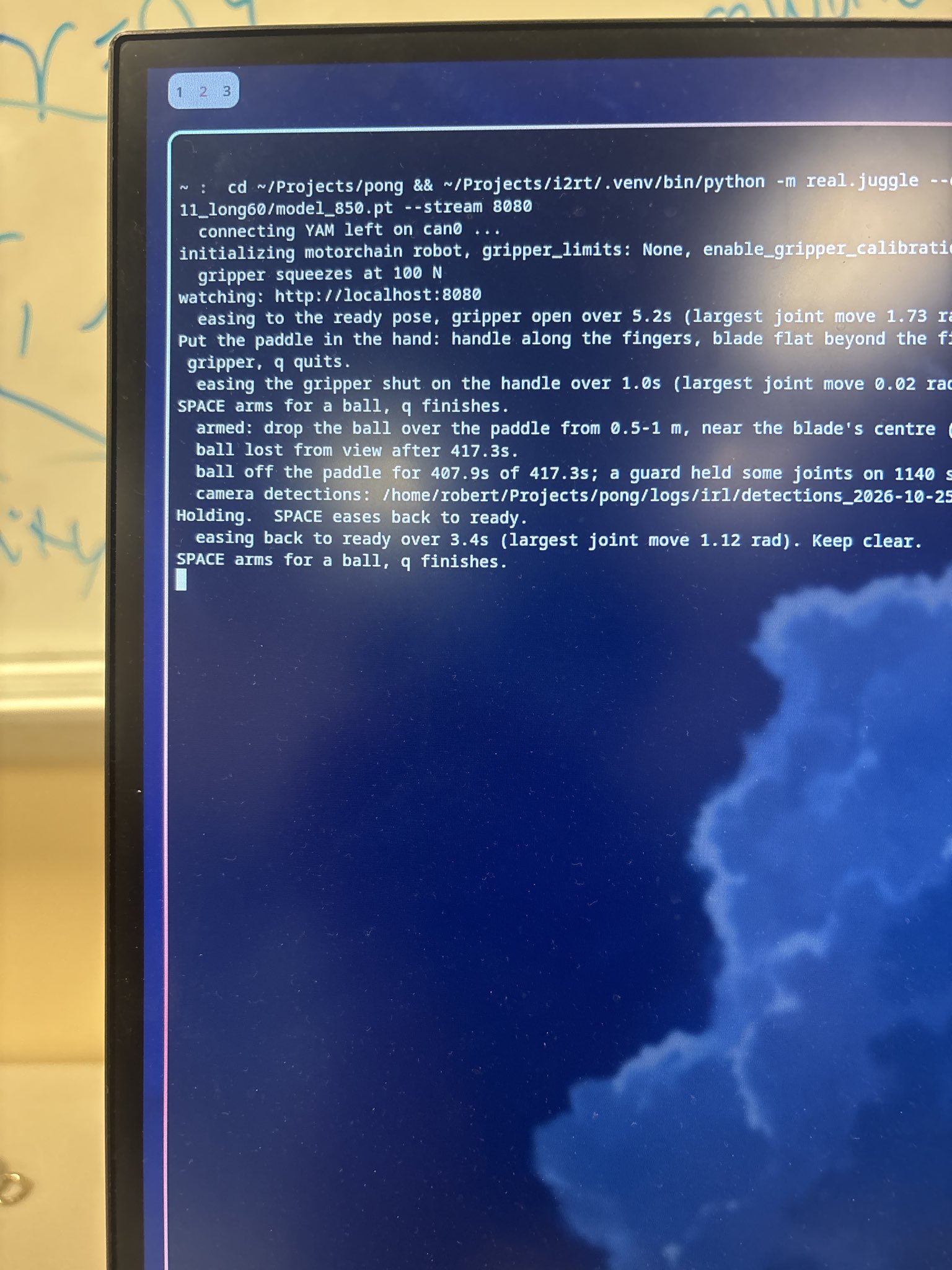
Not at at SIGRobotics though. @_robert_molina trained one of our robotic arms to keep a ping-pong ball bouncing on a paddle for up to 7 minutes using RL.
Watch the time-lapse, it just keeps going.
7
1,756
underscore advait patel retweeted

Day 29/365 of robot learning.
I'm trying to get my robot arm to bounce a ping pong ball using zero real-world demos, purely through sim-to-real transfer. Hoping to get it working this weekend if it's even possible!
Got the idea from @sigrobotics, so shoutout to them!


Day 28/365 of robot learning.
Today I spent some more time experimenting with PPO and trained two policies from scratch in PyTorch using Isaac Lab: a drone learning to fly toward different targets, and another robot learning to defend against soccer shots.
For the drone, I trained 4,096 environments in parallel on a gpu, reaching a 100% success rate. The reward shaping was pretty fun to debug because the policy would find ways to maximize rewards while completely ignoring some basic things I hadn't accounted for. For example, in one experiment, the drone would reach its target properly but start spinning uncontrollably because I hadn't penalized rotation. Adding a penalty for body rotation helped fix this.
It also made me think more about how hard it is to design proper evals, benchmarks, and reward functions that capture the behaviors we want from robots. Just because a policy performs well on these metrics doesn't necessarily mean it'll generalize to different environments during deployment. I guess this is also why research on policy steerability is pretty important in robotics, since being able to correct a policy's behavior during deployment could help account for things we didn't anticipate during training.
I'm also finally done with exams, so I want to take this a step further and try something more challenging. I'm planning to experiment with sim-to-real transfer and see if I can get my robot arm to perform some tasks zero-shot, without any additional real-world training.
underscore advait patel retweeted

Per-joint Gaussian noise is a terrible way to explore a 20+ DoF hand
We introduce EigenDEXplore, which explores along coordinated patterns from human hand motion, while keeping full control of every joint
Better learning, from tool use 🔨 to reorientation 🔄 to bimanual 👐