




Aleh Shydlouski retweeted

🚀 Today we're launching Agent Sandboxes in @pydantic Logfire: a profoundly different kind of sandbox.
"The world doesn't need another sandbox" they say. Maybe. Or maybe the world doesn't need another firecracker/gVisor/VM infra-fest.
Our Agent Sandboxes are different. They're just an isolated interpreter with cold start times measured in milliseconds, where the code can only call the tools you give it and use the directories you mount.
A massive bonus is you can snapshot and resume a REPL weeks later, with the snapshots costing virtually nothing.
Programmatic tool calling, solved.
Start free, $1000 of free credit to try it in the first month 👇
pydantic.io/launch-agent-san…
Friday hot take: After @dhh keynote, I was thinking about projects that contain only AGENTS md and SPEC md.
You built your little tool, tested, it works, then you ask an agent to describe it in .md files
Instead of publishing the whole project, you publish only these .md files.
As an outcome of this, we have two things:
- Anyone can replicate your tool however they like, in any language, style, or architecture.
- After a while, your project gets indexed by agents, and when agent solves a similar problem, it already has the spec of what worked before
This approach not for production, but rather for small local dev tools and its like encoding-decoding mechanism for universal libraries that fit any environment.
There is also a "Spec driven development". (see @dbreunig talk about No code libraries)
But SDD kind of expects evaluation/development of the project throught the spec+tests, whereas here we only looking for replication in other environments from somewhere already implemented and working version.
The .md files would be written targeting such replication (with examples and corner cases) from already working solution - "Spec driven replication" 👀
Would be Interesting to try how much better/worse it would be compared to rewriting code from one language to another 🤔
2
2
217
I'm inspecting Qwen reasoning trace and upgraded my previous research with Decision models, but latest Opus 5/5.5 no longer letting me inspect reasoning trace of another model. Seems related to anthropic.com/news/distillat… . Very poorly done safeguard, no problems like this on OpenAI


Lately I've been exploring reasoning traces from local models like Qwen3.8, and found they can expose the exact phrases in a prompt or skill that make the model argue with the prompt instead of solving the task.
I'm collecting such cases into a so-called "confusion-table", each case pinned to the phrase that caused it and explaining the mechanics of prompt/skill confusions.
With those phrases repaired, the model spends its reasoning on the task instead of the prompt — and follows the intent more reliably across runs.
Tested on two popular skills and inside GEPA. Thread:
olegivye.com/twitter/confusi…

1
201
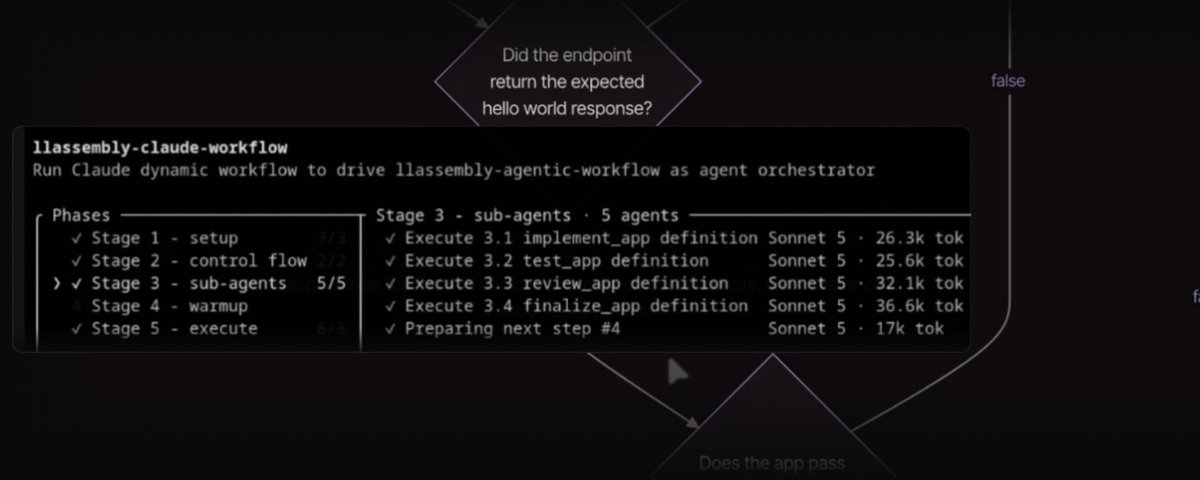
Jev + Jinja Skills turned out to be a great combination for tasks where you need simple, non-deterministic answers across many items.
You can run Jev in the middle of a Claude session and pass data without loading it into the context, saving tokens, time, and cost.
I ran some benchmarks with LLAJinja triggering Jev from Opus session 🧵:

@mitsuhiko Any future plans on MiniJinja for python? Its marked as experimental and it would be nice to apply it here from the sandbox perspective
1
93
When Jev is defined in a Skill you can re-run something that worked before with a one-second response time.
It's a good use case when a non-deterministic task needs a lot of context and Opus can't handle it with a Python script.
Plus Opus don't waste time to define request, if it's already written as part of the Jinja Skill, it's just triggering it.
LLAJinja now supports Jev and decision models (including Ollama) in Jinja-templated Skills, without plugins or extensions, in any harness that supports Skill loading:
1
2
264
More about Jinja Skills and LLAJijna:
teapawt.net/_electronick/status/21…
Working on a Skill that lets you run other Skills as Jinja templates. It works in any Harness/dev tool that supports Skill loading, with no extensions or plugins needed.
A few cool things you can do with it:

45
Working on a Skill that lets you run other Skills as Jinja templates. It works in any Harness/dev tool that supports Skill loading, with no extensions or plugins needed.
A few cool things you can do with it:
Composing Skills:
With the power of Jinja templates, you can compose multiple Skills, or parts of Skills, together:
1
24
And some more cool features: github.com/electronick1/LLAJ…

20
Lately I've been exploring reasoning traces from local models like Qwen3.8, and found they can expose the exact phrases in a prompt or skill that make the model argue with the prompt instead of solving the task.
I'm collecting such cases into a so-called "confusion-table", each case pinned to the phrase that caused it and explaining the mechanics of prompt/skill confusions.
With those phrases repaired, the model spends its reasoning on the task instead of the prompt — and follows the intent more reliably across runs.
Tested on two popular skills and inside GEPA. Thread:
olegivye.com/twitter/confusi…
Example 2: @trailofbits `goal-prompt` skill, which turns a spec into a goal.
Here the confusion shows up in behavior: the model sometimes makes extra tool calls and wanders outside the working directory.
In total, 24.3 cases per run. After one rewrite iteration based on the confusion-table: 14.3, and the reasoning halved.
The model is much more reliable at focusing on writing the goal rather than handling contradictions in the skill.

1
125
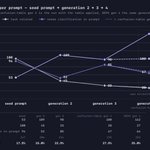
Example 3: applying the confusion-table inside GEPA, on KOR-Bench puzzles.
GEPA reflects on pass/fail. Prompt related contradictions are invisible to that signal, so it grows with every generation as the prompt grows.
At generation 4, I branched from the same parent and the same minibatch. GEPA's reflection pushed confusions up, while confusion-table held them flat and scored higher.

99