

Private Fund Manager. This is never financial advice. https://teapawt.net/t.co/tqpyMBTb8r
Investor
Joined September 2020
- Tweets2.6K
- Following149
- Followers347
- Likes15.7K





Pinned Tweet
1/ I firmly believe the majority of value in healthcare will accrue to the biggest network with the least latency and the most *relevant* and proprietary data. The intelligence contained will be an unprecendeted deflationary force for the US Healthcare System.
J.P. Capital retweeted

“When there is a frenzy of activity in one area of the market there is very often an anti-bubble of discarded companies. In the dot com era these were companies with steady cash flow.”
— Nick Sleep 🗣️ (Nomad Letter Jun 2006)
J.P. Capital retweeted

I wonder how much influence Teledyne’s decentralized approach had on shaping $CSU.TO ?

J.P. Capital retweeted
If you only had 20 investment punches left in your life, how differently would you invest?
Punchcard investing + the power of a true 1 OF 1 watchlist.

J.P. Capital retweeted

AI can overbuild. Timing still ships.
That’s the SiTime pitch for me. A 1-1 company in a HUGE growing TAM.
Full thesis below. I Own $SITM. Not advice.
isolatedalpha.substack.com/p…
J.P. Capital retweeted

EA AI safetyism increasingly looks like Marxism-Leninism for the algorithmic age.
The old vanguard claimed privileged knowledge of the inevitable course of History. The new one claims privileged knowledge of the probabilistic course of Humanity.
Both use an elaborate intellectual framework to reach the same political conclusion: a small group of enlightened people must constrain everyone else for their own good.
That has never lead to anything except monumental human suffering.
J.P. Capital retweeted

“The most difficult part of investing is not identifying great companies. It is maintaining the self-control to wait for the right price, and the humility to accept that you will occasionally miss a spectacular winner by doing so. But that is the price of a process that protects your capital over the long term.”
Thanks @DimitryNakhla


J.P. Capital retweeted
One of the most expensive mistakes in investing is overpaying for a great business. Even excellent companies can deliver years of disappointing returns when the starting valuation is too high.
J.P. Capital retweeted
Revenue growth is a vanity metric if you do not understand systems.
Any inefficient system can be scaled if you throw enough capital at it. That does not make it a good business. It just makes it a larger inefficient system.
I have learned to look past the headline number. The real question is much simpler and much more uncomfortable. Does the fundamental transaction actually make money? If unit one loses money, unit one million will not save you. It will just bankrupt you faster.
A good business has to answer three questions honestly. After you deliver the product, do you actually keep anything? Does it cost you more to acquire a customer than that customer will ever pay you? And does the next sale move you closer to profitability or further away? If you cannot answer yes to those, then growth is not progress. It is just accelerated capital destruction with good PR as we see way too much these days.
Look at WeWork. They grew to over three billion in revenue by signing expensive long term leases and renting desks short term at a loss. Every new building they opened added more negative margin. Growth was just masking a broken arbitrage.
Look at $PTON . They grew more than two hundred percent year over year during the pandemic and everyone called them a rocket ship. But the cost to acquire each customer kept rising, the hardware margins were thin, and churn was inevitable once the world reopened. When growth slowed, there was no profitable core underneath.
MoviePass is the most honest example. They grew to three million subscribers in months by offering unlimited movies for less than ten dollars while paying full price for every ticket. Roughly ten dollars in and thirty dollars out on every heavy user. The faster they grew, the faster they died. It was never a business. It was a subsidy.
Even $UBER had to learn this. From 2014 to 2019 they grew to fourteen billion in revenue while subsidizing every single ride. It only became a truly good business when they fixed the unit itself, by raising their take rate, rationalizing incentives, and making sure each ride contributed profit. Growth before that fix was just venture funded market share.
Compare that to $AAPL or $COST . Deliberate, sometimes boring growth. But every single transaction is profitable at the unit level. The system is sound. So scaling it creates enduring wealth instead of just noise.
Most of fintwit celebrates revenue because it is visible. If you are intelligent enough to look past the headlines, you will interrogate the unit because it is what actually matters.
TDLR
Growth is how you get big. Unit economics determines if you survive being big.
J.P. Capital retweeted

Most companies fail to create true wealth because their returns on investment barely cover their borrowing and operational costs. When these businesses grow, they are actually consuming capital rather than generating value.
Long-term investing success relies entirely on filtering out these traps and identifying the rare exceptions known as quality compounders. These unique companies earn exceptionally high returns (often 20% to 40%), and can continuously reinvest their profits at those same high rates for decades.
Because a cheap stock price cannot fix a business that destroys value, serious investors must prioritize finding these high-return compounders before evaluating management or valuation, ignoring everything else.
What is a quality compounder? How do you identify a business that compounds for decades?
Free deep-dive available tomorrow morning: open.substack.com/pub/qualit…

J.P. Capital retweeted
One of my friends asked me:
“D when you make 15-20% in a short time frame do you ever get tempted to sell?”
My response:
“When you play monopoly, do you ever get tempted to sell Boardwalk after you make 15-20% profit in a short time frame?”
Great assets are meant to be owned.
J.P. Capital retweeted

Most people think they’re making decisions, but if you really look closely, they’re just reacting to how they feel in the moment and calling it logic after the fact. It feels rational while it’s happening, which is exactly why it’s so dangerous.
They quit when things get uncomfortable, they buy when everything feels exciting, and they walk away the second uncertainty appears. That’s not a strategy, it’s emotion, and emotion is one of the most expensive forces in life.
You don’t need a long list of mistakes to fall behind, you just need one poorly timed decision driven by fear or excitement. Years of progress can disappear not because the opportunity was bad, but because your timing was completely disconnected from reality.
Long term outcomes have very little to do with how you feel today and everything to do with what you can sustain over time. Discipline is showing up and doing the right thing after the motivation is gone, and clarity is making decisions that still make sense years later.
If you look at investing, the biggest mistakes are almost never about intelligence, they come from reacting at the wrong time. People sell great businesses in moments of panic and chase things they don’t understand just because they’re going up, and both usually end the same way.
I try to follow one simple rule that saves me from a lot of this. Never make a decision in a state you won’t be in consistently, because if you’re emotional, excited, fearful, or exhausted, you’re not thinking clearly enough to make a sensible long term decision.
Feelings change quickly and markets change just as fast, but the consequences of your decisions stick around much longer than either. They sit there quietly and compound in the background, for better or worse.
So the next time you feel the urge to act, pause for a second and ask yourself whether you’re responding to a moment or actually making a rational decision.
🌹
J.P. Capital retweeted
One of the most elegant frameworks for thinking about investing comes from Bill Miller — shared in a speech at Columbia Business School and referenced by Nick Sleep in the Nomad Partnership Letters.
Miller argued there are 3 competitive advantages in investing:
1️⃣ Informational — you know a meaningful fact nobody else does
2️⃣ Analytical — you’ve cut up public information to arrive at a superior conclusion
3️⃣ Psychological — behavioral advantages that most investors simply cannot maintain
___
The informational edge has largely disappeared in today’s market. Which means the truly sustainable advantages are analytical and psychological.
Sleep put it best in the Nomad Letters 📝
“𝐓𝐨 𝐫𝐞𝐩𝐞𝐚𝐭: ‘𝐰𝐡𝐚𝐭 𝐲𝐨𝐮 𝐚𝐫𝐞 𝐭𝐫𝐲𝐢𝐧𝐠 𝐭𝐨 𝐝𝐨 𝐚𝐬 𝐚𝐧 𝐢𝐧𝐯𝐞𝐬𝐭𝐨𝐫 𝐢𝐬 𝐞𝐱𝐩𝐥𝐨𝐢𝐭 𝐭𝐡𝐞 𝐟𝐚𝐜𝐭 𝐭𝐡𝐚𝐭 𝐟𝐞𝐰𝐞𝐫 𝐭𝐡𝐢𝐧𝐠𝐬 𝐰𝐢𝐥𝐥 𝐡𝐚𝐩𝐩𝐞𝐧 𝐭𝐡𝐚𝐧 𝐜𝐚𝐧 𝐡𝐚𝐩𝐩𝐞𝐧.’ 𝐓𝐡𝐚𝐭 𝐢𝐬 𝐞𝐱𝐚𝐜𝐭𝐥𝐲 𝐰𝐡𝐚𝐭 𝐰𝐞 𝐚𝐫𝐞 𝐭𝐫𝐲𝐢𝐧𝐠 𝐭𝐨 𝐝𝐨. 𝐖𝐞 𝐬𝐩𝐞𝐧𝐝 𝐚 𝐜𝐨𝐧𝐬𝐢𝐝𝐞𝐫𝐚𝐛𝐥𝐞 𝐩𝐨𝐫𝐭𝐢𝐨𝐧 𝐨𝐟 𝐨𝐮𝐫 𝐰𝐚𝐤𝐢𝐧𝐠 𝐡𝐨𝐮𝐫𝐬 𝐭𝐡𝐢𝐧𝐤𝐢𝐧𝐠 𝐚𝐛𝐨𝐮𝐭 𝐡𝐨𝐰 𝐜𝐨𝐦𝐩𝐚𝐧𝐲 𝐛𝐞𝐡𝐚𝐯𝐢𝐨𝐮𝐫 𝐜𝐚𝐧 𝐦𝐚𝐤𝐞 𝐭𝐡𝐞 𝐟𝐮𝐭𝐮𝐫𝐞 𝐦𝐨𝐫𝐞 𝐩𝐫𝐞𝐝𝐢𝐜𝐭𝐚𝐛𝐥𝐞 𝐚𝐧𝐝 𝐥𝐨𝐰𝐞𝐫 𝐭𝐡𝐞 𝐫𝐢𝐬𝐤 𝐨𝐟 𝐢𝐧𝐯𝐞𝐬𝐭𝐦𝐞𝐧𝐭.”
The market has to price in everything that can happen — every tail risk, every nightmare scenario, every possible outcome.
Your job as a long-term investor is far simpler: stay in the middle of what will actually happen. Let the market worry about the full cone of uncertainty. 𝐘𝐨𝐮 𝐟𝐨𝐜𝐮𝐬 𝐨𝐧 𝐭𝐡𝐞 𝐡𝐢𝐠𝐡-𝐩𝐫𝐨𝐛𝐚𝐛𝐢𝐥𝐢𝐭𝐲 𝐝𝐞𝐬𝐭𝐢𝐧𝐚𝐭𝐢𝐨𝐧.
This is exactly why Sleep made $COST his largest holding. Its obsession with sharing scale benefits with customers made its future more predictable than almost any other business. A narrower cone of uncertainty. A higher probability destination. Lower risk — not higher — despite what the volatility might suggest in any given quarter.
The businesses worth owning for the long run are the ones where you can look out 5, 10, 15 years and say with reasonable confidence: I know roughly where this ends up. Everything else is just noise along the way.
Analytical clarity + psychological patience = a durable edge.


Destination over drama
One of the best ways to become an above average investor has nothing to do with intelligence. It has everything to do with how you behave.
I hold large positions and in many cases I have owned these businesses longer than most. That is not to show off, it simply means more money is at stake and more time is involved. When that is true, you either learn emotional control or you underperform.
There’s no need to do backflips or front flips every earnings season. A company beats and the stock drops or a company misses and the stock rallies. $MELI falls 10% after reporting and suddenly the pot is stirred. Did the competitive position change overnight? Did the long term economics break in 24 hours? Or are we just reacting to a 3 month report card that is largely irrelevant in the big picture? Is that really what determines whether you build wealth or not?
One of the most underlooked edges in investing is calm. It is patience, I call it ass sitting. The ability to sit still when everyone else feels the need to react.
There are plenty of people younger than me who are sharper and smarter in many technical ways. They can read faster, consume information better and quicker, etc. But age brings experience, wisdom and scar tissue. It brings the understanding that most of what feels urgent is not important.
Think of yourself ten years ago. Your judgment today is dramatically better than it was then. Ten years from now it will be significantly better again.
There is a difference between “renting stocks” and “owning businesses”. Renters obsess largely over everything that doesn’t matter like quarterly noise, after hours trading, earnings issues/beats, analyst upgrades, checking the price multiple times per day, etc. Owners focus on the business, long term compounding, and what Nick Sleep so beautifully calls “destination analysis”.
I used to refresh prices constantly. I used to care deeply about whether I predicted a beat or miss correctly. None of that mattered or moved the needle. What moved the needle was staying calm when the thesis was intact and letting time work. This is the most fundamental aspect of wealth creation in the stock market. Unfortunately the vast majority of investors fail to understand this fundamental truism.
My point is not to criticize anyone. It is to share something I wish I fully understood 15 years ago when I started. The market does not reward activity, it rewards calmness. So if you want to outperform and become wealthy practice sitting on your ass.
🌹
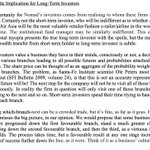
Nick Sleep, in his 2010 shareholder letter, on Culture as a subtle Moat in Companies and the Implications for Long-Term Investors.
@DimitryNakhla

4
307
"Parents will understand when I say that when children are born, they seem to bring their own love with them. However, stocks are not like children. The more stocks you own the less you care about each one individually." - Nick Sleep, 2004
4
185

