

Risk & Compliance | Banking & Fintech | Payments & Digital Assets | Views my own
Joined March 2011
- Tweets2.5K
- Following1.1K
- Followers499
- Likes593



Pinned Tweet
I'm very happy to share a new article — "In Defense of the Second Line of Defense: The Role of Independent Risk Management" — just published in the 2023 Starling Compendium.
To access, click through, choose join, and "Observer Status" (which is free). insights.starlingtrust.com/c…

"#Tokenisation represents a structural transformation of the European financial market ecosystem – i.e. the financial markets and the infrastructures that underpin them – rather than merely an infrastructure upgrade.
…
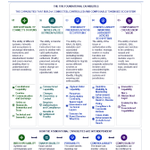
Tokens and the way they are used must be standardised. Only this can ensure safe and efficient interoperability, transferability, portability, controllability and composability across systems and networks.
These five capabilities are interdependent. Interoperability connects new and legacy systems and networks. Transferability allows for the movement of values. Portability preserves seamless continuity. Controllability preserves authority. Composability enables new financial logic."
ecb.europa.eu/pub/pdf/other/…

1
21

"The Bank of Israel announces today that in the coming years it will focus on examining options for modernizing wholesale central bank money, and on the implications of #tokenizing_assets in the Israeli economy.
Beyond theoretical study and continued close monitoring of global developments, the Bank aims to carry out, within the next two years, a pilot of a wCBDC [wholesale CBDC] system with the participation of various entities in the financial system.
...
In the first stage, the intention is to focus on using wCBDC for the cash settlement of various stages in the life cycle of tokenized Makam [short-term securities issued by the Bank of Israel] – issuance, trading, redemption, and so on – while other use cases will be examined as well." boi.org.il/en/communication-…

45
"#CBDC [Central Bank Digital Currency] projects are increasingly shifting towards wholesale_applications.
…
Wholesale projects are increasingly focused on tokenized deposits, tokenized reserves, and integration with tokenized securities rather than on CBDC as standalone digital currencies—often with a growing role for private sector participants in the development and testing of these projects.
…
Meanwhile, retail CBDC momentum has become more selective, with some jurisdictions continuing to advance towards launches and pilots while others have paused or redirected their efforts." imf.org/en/publications/poli…

38
"IOSCO's stakeholder engagement indicates that a cryptographically relevant #quantum computer would undermine the foundations of digital trust, posing one of the most significant long-term threats to the sound functioning of global financial markets.
…
The debate is therefore no longer about whether or even when quantum computing will become a threat. The more pressing question is how far behind the financial system already is in preparing for it.
Immediate action is required."
iosco.org/library/pubdocs/pd…


"Effective #human_oversight is a key cross-cutting element when firms either: (i) use AI to automate aspects of their cyber defence; or (ii) use highly autonomous, capable AI systems in their business or operations.
Effective human oversight is meaningful, risk-based and capable of changing outcomes. It improves decisions, prevents harm and enables errors and their impacts to be addressed, rectified or reversed.
…
The form and intensity of oversight needs to reflect the AI use case's materiality, risk, autonomy, complexity and explainability.
Human in the loop approval may be appropriate where errors could have serious or irreversible consequences;
human on the loop monitoring may suit lower-risk activity where intervention is needed only when defined triggers are met.
Human in command arrangements can set autonomy, guardrails and escalation routes, particularly for highly autonomous AI.
Contestability and kill switches (which already feature in algorithmic trading) can enable decisions to be appealed and systems paused, constrained or shut down safely."
bankofengland.co.uk/prudenti…

2
45
The related consultation paper is here. CP17/26 and GC26/9 – Cyber risk and resilience management fca.org.uk/publications/guid…

5
"Whether a digital token represents or constitutes a #deposit therefore depends on the legal and economic substance of the arrangement, including the rights and obligations of the parties, rather than its technological form or label.
MAS adopts a technology neutral approach and recognises that tokenisation does not, in and of itself, determine or alter the legal or economic nature of a product.
…
MAS considers the account_based nature of deposits to be a fundamental characteristic that should be preserved in tokenised deposits. In considering this, MAS will have regard to the substance of the arrangement, including whether:
a. the depositor's right to repayment arises from the terms governing the depositor's deposit account, rather than solely from possession or control of the digital token;
b. the bank maintains an ongoing account relationship with the depositor, and is able to ascertain the identity of the depositor and the amount owed at any given time (see Example 1 in the Appendix); and
c. transfers between depositors can only take place with the bank's consent."
mas.gov.sg/-/media/mas-media…


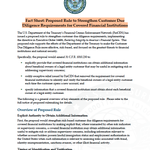
"This proposed rule [to strengthen #customer_due_diligence requirements] supports the efforts of the Department of the Treasury to make the Customer Due Diligence Rule more effective, risk-based, and focused on the greatest threats to financial institutions and national security.
Specifically, the proposal would amend 31 C.F.R. 1010.230 to:
• explicitly provide that covered financial institutions can obtain additional information about beneficial owners of a legal entity customer that may be useful in mitigating risk or addressing supervisory concerns;
• codify exceptive relief issued by FinCEN that removed the requirement for covered financial institutions to identify and verify the beneficial owners of a legal entity customer each time the customer opens a new account; and
• specify information that a covered financial institution must obtain about each beneficial owner of a legal entity customer." home.treasury.gov/system/fil…

1
65
The notice of proposed rulemaking is here: federalregister.gov/public-i…

9
"#Financial_asset_tokenization activities increased in 2026, with clearer evidence of commercial adoption in asset classes that have gained early traction — such as fixed income products and MMFs — and expansion into broader areas of the market, including tokenized equities and equity-linked products.
…
This growing adoption brings with it implications for how existing risks are managed ... the legal certainty of token ownership, transfer, and collateral use; the operational resilience of DLT networks and smart contracts; and market structure issues of fragmentation and interoperability.
…
The emergence of tokenized equities and equity-linked products is a case in point. These products can differ materially in legal structure, investor rights, and risk profile, underscoring the importance of clear product classification, disclosure and conduct requirements, particularly where they are marketed to retail investors or made available across borders where legal and regulatory treatment may differ." iosco.org/library/pubdocs/pd…

1
1
40

"The private sector is quickly building a multi_instrument_ecosystem of tokenized money to meet these needs of tokenized markets. In addition to #stablecoins, tokenized deposits, tokenized money market funds, and other potential settlement assets are coming to market, each providing distinct benefits and tradeoffs.
…
As a result, corporate treasurers, banks, asset managers, and payment providers may use several tokenized instruments at once to serve different aspects of their business models, in the same way they use multiple rails today.
…
Given these diverse needs of tokenized markets, I believe traditional rails and the forms of money exchanged on them will continue to play an important role in underpinning trust in the overall payment system. In particular, central bank money need not be used in every transaction or on every platform, but its presence at the foundation of the system is essential."
federalreserve.gov/newsevent…

41
"There are three key asymmetries that may make the euro area banking system vulnerable to the AI-enabled increase in #cyber_risks. The first concerns countries with and countries without access to cutting-edge frontier models.
This affects the euro area as a whole, as frontier AI models are predominantly developed outside the EU and EU entities have often faced restrictions in accessing the most capable models.
…
The second asymmetry is between attackers and defenders, with defenders currently at a structural disadvantage, as discussed above.
…
The third asymmetry regards banks equipped with a sophisticated cybersecurity apparatus and those with more limited resources. This may be down to fixed cost and resource constraints and could pose a risk, as the weakest link in a network may affect the stability of the entire system.
ecb.europa.eu/press/financia…

1
18

"No measurable progress has occurred in the #global_average_cost of retail cross-border payments since 2023: the data shows that the decline in highly expensive corridors was not sufficient to reduce the global averages.
…
However, the impact of this work has not yet translated into the desired level of measurable improvements for end-users, underscoring the importance of further strengthening the focus on implementation at the local level to ensure that the benefits of these significant international efforts can be realised." fsb.org/uploads/P161126.pdf

1
39
