

Interventional Radiology resident @umiamimedicine breaking down what's real in medical AI and health tech 💭Founder @collectATC (acq. by @iyk_app)
- Tweets352
- Following394
- Followers535
- Likes2.2K


ALT ALT TEXT Horizontal bar chart titled "Google Deepmind Humanity's First Exam" with the Kaggle logo in the top right corner, set against a beige background with warm yellow and blue gradient accents at the bottom. The chart ranks 16 AI models by their percentage scores on the benchmark: #1 GPT 6.2 Astra: 90.7% #2 GPT 6.2 Sol: 87.5% #3 Gemini 4 Neon: 85.6% #4 GPT 6 Astra: 84.0% #5 GPT 6.1 Sol: 81.7% #6 Gemini 4 Carbon: 79.2% #7 GPT 6.1 Terra: 78.1% #8 Gemini 4 Argon: 76.6% #9 Gemini 4 Hydrogen: 70.5% #10 Claude Opus 5.5: 70.0% #11 Claude Sonnet 5.5: 65.6% #12 GPT 5.6 Sol: 56.5% #13 Gemini 3.8 Flash: 56.1% #14 Claude Haiku 5.5: 42.5% #15 Gemini 3 Flash Preview: 33.4% #16 Gemini 3.1 Flash-lite: 18.5% Bottom text reads: "SOURCE: Hfe Leaderboard (kaggle.com/benchmarks/deepmind/hfe)"


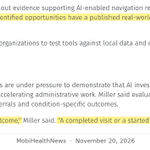
ALT Screenshot of a MobiHealthNews article from November 20, 2026. Clean yellow highlight bands mark the line that only three of the framework's 14 identified opportunities have a published real-world evaluation of an AI-enabled version, and Ian Miller's quote: A reminder isn't the outcome. A completed visit or a started treatment is.

ALT Screenshot of the Digital Medicine Society Unified Patient Journey, showing the circular map of 14 care moments.


ALT Excerpt from the CMS Clinical Super Intelligence roadmap, page 7, highlighting: Potential competency-based approach: Align FDA regulation with the level of risk and activity, potentially anchoring around a novel competency-based approach, similar to how physicians are evaluated for their credentials, to premarket evaluation of certain SI-enabled devices.