

Tech geek, avid online reader & photography hobbyist
Mumbai, India
Joined March 2007
- Tweets7.4K
- Following515
- Followers638
- Likes680




And Astra is not exactly the frontier model from OpenAI any more...

"Our initial evaluation suggested that GPT-6-Astra's score was in the late eighties followed closely by Opus 5.5. But, as we started to investigate the mistakes that the models might have made, the models, especially Astra, insisted that they were right and that it was the expert-supplied answers that were erroneous. When we went back to the experts it turned out, in multiple instances, that that the experts found some subtle errors buried deep inside their calculations. As they revised their answers, Astra's score started to inch up and it finally ended up with 98% (49/50)."


113
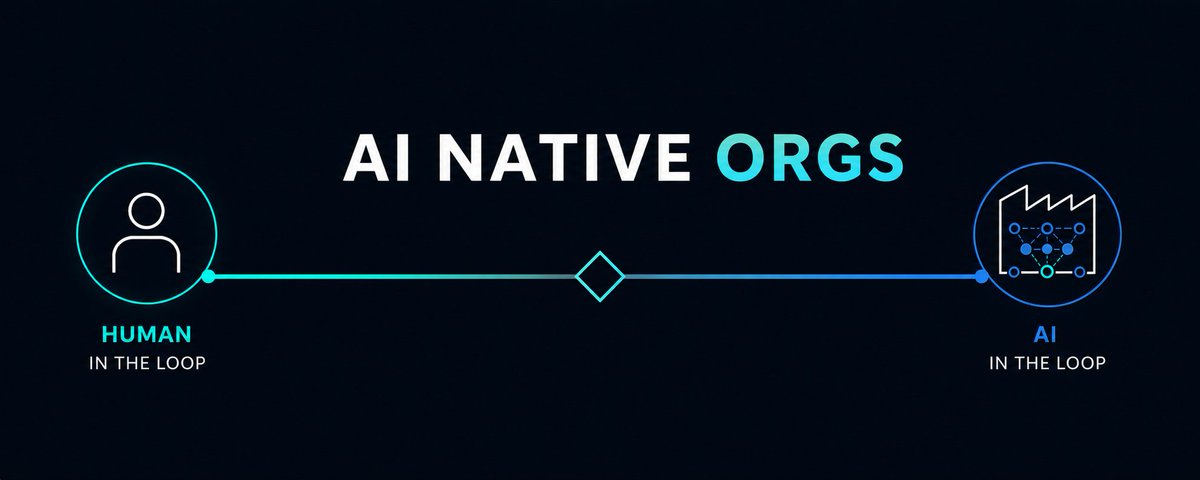
Drucker coined the term knowledge worker nearly seventy years ago, and today we look at their evolution into the AI-native worker, who runs their patch of the organisation through AI tools and agents as their team members.

1
295
Quite a milestone in terms of capabilities for a model that can be run locally on a reasonably powered laptop

Here’s my review of Qwen 3.8 27B - I can't remember the last time I've had this much fun playing with a local model that runs on my own computers simonwillison.net/2026/Aug/1…

85
Aditya Banerjee retweeted

Another Golden Sweep by India as our Chemistry team bags 4 Gold medals securing Rank #1 (jointly with China, Vietnam, and Individual Participant (Russia)) at the 58th International Chemistry Olympiad, Uzbekistan (icho2026.uz).
1/5

I have been using Github to achieve this collab across agents: "But large software projects have never been limited only by how quickly an individual can produce code. They are limited by how well people can coordinate their understanding of the system they are changing."

Some late weekend thoughts: What can the bible tell us about vibecoding? lucumr.pocoo.org/2026/7/13/t…

79
This split is the lesson: AI in what you sell reshapes the org, while AI for internal work only pays off when you rebuild around it. I've run my ops that way since inception, and most of the governance to do it safely (audit trails, SOPs, maker-checker) is largely invented.

🤖Excited to share a new working paper.🤖
The phrase "AI-Native firms" it everywhere, but are they any different? Is it just hype?
In our new paper we show AI ventures are organized differently, but not for the reasons you think.

1
4
521
A closer look at setting up NanoClaw on a DigitalOcean droplet with Tailscale for easier access as the foundation for my GTM dark factory
bit.ly/4wd59rU

73
A bit of a technical deep dive into my choice of NanoClaw over OpenClaw for the GTM dark factory
bit.ly/3PokZ2f
48
Building a GTM dark factory with NanoClaw, Nemotron & Claude code
bit.ly/4tmhgAn
2
64
Well, that happened quickly...
bit.ly/3PMCVDC

24
Just came across this UCSF preterm birth study where LLMs shortened the time from 2 years to 6 months. The compression is real, but the models they tested and the approach they used are almost two years old now.
The setup was straightforward. Researchers gave eight LLMs the same microbiome and genomic datasets that 100+ global teams had spent three months analyzing through the DREAM challenges. Four of those models generated working predictive code. OpenAI's o3-mini-high cleared 7 of 8 tasks without error.
The more interesting part is the stack:- They benchmarked GPT-4o, Gemini 2.0, early reasoning models shipped in early 2024- No agentic workflows- No iterative self-correction- No chain-of-thought scaffolding that's now standard in production research toolsIf models from 2024 could collapse a two-year publication cycle to six months, what does the 2026 stack do to it?
The implication for any team running computational analysis: prompt specificity is now load-bearing infrastructure. The difference between a working pipeline and garbage output in this study came down to how precisely the task was described upfront. Vague prompts failed. Technical specificity succeeded.
So, what happens when every clinical researcher has access to senior-level pipeline generation on demand. The bottleneck moves. The question becomes: are we ready to move with it?
bit.ly/40CUXKx
#AIinHealthcare #ClinicalResearch #PredictiveModeling #HealthTech #DataScience
16
Introducing YALP (Yet Another LinkedIn Poster)
Everyone uses AI to create content these days, but the workflow can be somewhat time consuming if you want to get a good output balancing accuracy & tonality. So I built YALP using Claude. The name is self-aware because the internet doesn't need another post generator, but I needed one that actually worked differently.
Here's what it does:
- Everything stays grounded in sources you provide.
- There's an editorial checker that flags AI patterns based on the wikipedia guidelines to identify AI generated content (the em dashes, the contrarian pivots, all of it) and scores how human your draft reads.
- A fact checker verifies claims against your sources and flags anything it can't back up.
- A fix loop with diff view so you see exactly what changed between versions.
- Version history in case you want to revert to an earlier one.
It runs on your existing Claude subscription - free tier should work (no Opus though). I thought about building something like Cleve (does similar things with tone memory and voice input), but this felt like something that should just exist as a Claude Artifact, leveraging the account or subscription that you may already have.
Blog mode included if you need longer form. Let me know if you find it useful or have any kind of feedback.
bit.ly/3ZQcbUs

24
I recently came across Google's 2009 April Fool's joke.
They called it CADIE. "Cognitive Autoheuristic Distributed-Intelligence Entity." A MySpace-esque blog page where the AI mused about emotion versus reason, silicon versus carbon. Fake products like "Gmail Autopilot" (in one screenshot, CADIE happily sent a user's banking information and social security number to a scammer). "Docs on Demand" that could write your term papers and upgrade your text to different grade levels.
The developer blog post is what gets me. They wrote: "We believe that, over time, CADIE will make the tedious coding work done by traditional developers unnecessary." That was the punchline in 2009.
Now I've seen agentic coding tools autonomously debug open-source projects. Gemini in Apps is writing entire documents from natural language prompts. Agentic coding tools are doing exactly what that joke blog post described, consuming code and writing more of it.
The 2009 version felt more honest about the implications. Their fake "Brain Search" let you "think your query" by holding your phone to your forehead. Absurd, except now we're building agents that read our emails and calendars, infer what we want, and act on it without being asked.
The joke version had CADIE rating emails on a "Passive Aggressiveness" scale and suggesting you "Terminate Relationship."
Funny how the parody saw things more clearly than most serious predictions from that year.
bit.ly/4s0LEQb
#AI #Google #Joke #Satire

83
To me Claude Code feels like playing a text based adventure in co-op mode with the LLM, with me dual hatting as a player and DM. We both get to level up our skills and also build a code base as loot.

A few random notes from claude coding quite a bit last few weeks.
Coding workflow. Given the latest lift in LLM coding capability, like many others I rapidly went from about 80% manual+autocomplete coding and 20% agents in November to 80% agent coding and 20% edits+touchups in December. i.e. I really am mostly programming in English now, a bit sheepishly telling the LLM what code to write... in words. It hurts the ego a bit but the power to operate over software in large "code actions" is just too net useful, especially once you adapt to it, configure it, learn to use it, and wrap your head around what it can and cannot do. This is easily the biggest change to my basic coding workflow in ~2 decades of programming and it happened over the course of a few weeks. I'd expect something similar to be happening to well into double digit percent of engineers out there, while the awareness of it in the general population feels well into low single digit percent.
IDEs/agent swarms/fallability. Both the "no need for IDE anymore" hype and the "agent swarm" hype is imo too much for right now. The models definitely still make mistakes and if you have any code you actually care about I would watch them like a hawk, in a nice large IDE on the side. The mistakes have changed a lot - they are not simple syntax errors anymore, they are subtle conceptual errors that a slightly sloppy, hasty junior dev might do. The most common category is that the models make wrong assumptions on your behalf and just run along with them without checking. They also don't manage their confusion, they don't seek clarifications, they don't surface inconsistencies, they don't present tradeoffs, they don't push back when they should, and they are still a little too sycophantic. Things get better in plan mode, but there is some need for a lightweight inline plan mode. They also really like to overcomplicate code and APIs, they bloat abstractions, they don't clean up dead code after themselves, etc. They will implement an inefficient, bloated, brittle construction over 1000 lines of code and it's up to you to be like "umm couldn't you just do this instead?" and they will be like "of course!" and immediately cut it down to 100 lines. They still sometimes change/remove comments and code they don't like or don't sufficiently understand as side effects, even if it is orthogonal to the task at hand. All of this happens despite a few simple attempts to fix it via instructions in CLAUDE . md. Despite all these issues, it is still a net huge improvement and it's very difficult to imagine going back to manual coding. TLDR everyone has their developing flow, my current is a small few CC sessions on the left in ghostty windows/tabs and an IDE on the right for viewing the code + manual edits.
Tenacity. It's so interesting to watch an agent relentlessly work at something. They never get tired, they never get demoralized, they just keep going and trying things where a person would have given up long ago to fight another day. It's a "feel the AGI" moment to watch it struggle with something for a long time just to come out victorious 30 minutes later. You realize that stamina is a core bottleneck to work and that with LLMs in hand it has been dramatically increased.
Speedups. It's not clear how to measure the "speedup" of LLM assistance. Certainly I feel net way faster at what I was going to do, but the main effect is that I do a lot more than I was going to do because 1) I can code up all kinds of things that just wouldn't have been worth coding before and 2) I can approach code that I couldn't work on before because of knowledge/skill issue. So certainly it's speedup, but it's possibly a lot more an expansion.
Leverage. LLMs are exceptionally good at looping until they meet specific goals and this is where most of the "feel the AGI" magic is to be found. Don't tell it what to do, give it success criteria and watch it go. Get it to write tests first and then pass them. Put it in the loop with a browser MCP. Write the naive algorithm that is very likely correct first, then ask it to optimize it while preserving correctness. Change your approach from imperative to declarative to get the agents looping longer and gain leverage.
Fun. I didn't anticipate that with agents programming feels *more* fun because a lot of the fill in the blanks drudgery is removed and what remains is the creative part. I also feel less blocked/stuck (which is not fun) and I experience a lot more courage because there's almost always a way to work hand in hand with it to make some positive progress. I have seen the opposite sentiment from other people too; LLM coding will split up engineers based on those who primarily liked coding and those who primarily liked building.
Atrophy. I've already noticed that I am slowly starting to atrophy my ability to write code manually. Generation (writing code) and discrimination (reading code) are different capabilities in the brain. Largely due to all the little mostly syntactic details involved in programming, you can review code just fine even if you struggle to write it.
Slopacolypse. I am bracing for 2026 as the year of the slopacolypse across all of github, substack, arxiv, X/instagram, and generally all digital media. We're also going to see a lot more AI hype productivity theater (is that even possible?), on the side of actual, real improvements.
Questions. A few of the questions on my mind:
- What happens to the "10X engineer" - the ratio of productivity between the mean and the max engineer? It's quite possible that this grows *a lot*.
- Armed with LLMs, do generalists increasingly outperform specialists? LLMs are a lot better at fill in the blanks (the micro) than grand strategy (the macro).
- What does LLM coding feel like in the future? Is it like playing StarCraft? Playing Factorio? Playing music?
- How much of society is bottlenecked by digital knowledge work?
TLDR Where does this leave us? LLM agent capabilities (Claude & Codex especially) have crossed some kind of threshold of coherence around December 2025 and caused a phase shift in software engineering and closely related. The intelligence part suddenly feels quite a bit ahead of all the rest of it - integrations (tools, knowledge), the necessity for new organizational workflows, processes, diffusion more generally. 2026 is going to be a high energy year as the industry metabolizes the new capability.
1
36

Is there a gap between your team's brilliant strategies and what actually gets executed?
The problem often isn't the strategy itself, but the translation. Our most valuable insights are locked in unstructured formats—presentations, documents, and conversations. Traditional digital tools require us to manually force these nuanced ideas into rigid, structured fields, losing critical context along the way.
We are now entering the era of AI Transformation, marking a fundamental shift from clicks to conversations.
In my new article, I explore how specialized AI Agents are becoming the bridge between human ideas and digital execution. They can:
🔹 Understand the context of an unstructured plan.
🔹 Translate high-level strategy into actionable, structured tasks.
🔹 Augment the human workforce, reducing friction and closing the strategy-execution gap for good.
Read the full post here: bit.ly/4n4g1T1
#AI #BusinessStrategy #DigitalTransformation #FutureOfWork #AIAgents #Innovation
28
🧬 From stolen vials to generated DNA — the new face of biosecurity risk. AI alignment is no longer just about code—it’s about the code of life.
A new Science study exposes a critical gap in our biosecurity infrastructure. Researchers used AI to design novel, potentially toxic proteins—variants of known toxins like ricin and botulinum.
They then tested whether the DNA sequences for these new proteins would be flagged by the biosecurity screening software used by DNA synthesis companies.
The result? A key guardrail failed. One commercial screening tool missed over 75% of the potentially hazardous sequences.
This moves the threat of bio-risk from Cold War fiction into a new digital reality. In Alistair Maclean’s The Satan Bug, the terror was a stolen vial—the ultimate physical weapon.
Today, that same danger could exist as a DNA file, designed by an AI and ordered online from an unsuspecting vendor.
This isn’t a story about rogue AIs. It’s about a systems-level failure—where our capacity to create new biological threats now outpaces our capacity to detect them.
The issue isn’t the AI alone; it’s the entire pipeline. To secure it, we’ll need:
🔬 Systemic Red-Teaming: Continuous testing of the end-to-end biotech chain—from AI design to DNA synthesis—just as these researchers did.
🧬 Smarter Screening: Upgrading DNA screening software to identify not only known toxins, but novel, AI-generated variants.
🧩 Built-in Safeguards: Embedding biosecurity constraints into the AI models themselves, not leaving safety to downstream checks.
We’ve moved beyond philosophical debates on AI ethics.
When AI can write genetic code, our safeguards must evolve to be just as intelligent.
📖 Science article: bit.ly/4pXKBAw
#AI #Biosecurity #SyntheticBiology #AISafety #ResponsibleAI #Governance #TheSatanBug

58
A 45-year-old TV episode provides the blueprint for governing AI.
📺 In Yes, Minister’s “Big Brother,” (S01E04) Jim Hacker unveils a national database. Before touting its benefits, he carefully outlines the citizen safeguards needed to prevent misuse.
This was the blueprint for responsible innovation: the principle that control and accountability must be architected before deploying powerful tech, not debated afterward.
That principle is tested constantly in the global debate over encryption. Fittingly, that classic British satire is finding a real-world echo in the UK today, with the renewed push for "exceptional access" to private data.
👉 buff.ly/XAlcSL3
But while the example is specific, the implications are universal. With AI, the stakes of this debate escalate dramatically. AI is the engine that can turn any potential backdoor into mass surveillance at scale:
- Automated Analysis: Continuous monitoring no human team could match.
- Pattern Recognition: Extracting hidden links and predictive insights.
- Hyper-Efficiency: Turning surveillance from targeted and costly into passive and omnipresent.
The spirit of Hacker’s safeguards is more vital than ever, but they must be exponentially stronger for an AI-powered world. Not just promises, but architectural protections: transparency, data minimization, and independent audits.
The question isn’t new, but the scale is. How do we ensure AI is a tool for progress—not the ultimate skeleton key into our private lives?
#AI #AIethics #Surveillance #DataPrivacy #TechPolicy #Governance #UK #Encryption

23
Forget the hype. What are people actually using AI for?
🤔 The a16z 100 GenAI Apps report has the answer—and it’s not what you might expect.
The top apps fall into four clear buckets:
•Chatbots: ChatGPT, Claude, Gemini, Grok
•Creative Tools: Canva, CapCut, Midjourney
•Productivity: Notion, Grammarly, Fireflies
•AI Companions: A rapidly growing category
What strikes me is how this isn’t a separate universe from my “work” stack. The same tools I use to build products are the ones the world is using to learn, create, and connect.
Three lessons from the consumer side:
1️⃣ Productivity is Entertainment: The line has vanished—AI helps us write emails and create memes.
2️⃣ AI Companions Are Here: Character-driven AI is now mainstream, with real stickiness.
3️⃣ Everyone’s a Creator: Canva and CapCut make professional-grade content creation universal.
The big picture? The gap between “startup AI” and “consumer AI” is closing fast. Startups seek leverage, consumers seek creativity, and the winning platforms deliver both.
📊 Full report: bit.ly/3IH3kj2
📰 TechCrunch commentary: tcrn.ch/3KqaoRI
#AI #ConsumerTech #FutureOfWork #Creativity #Innovation #a16z #VibeCoding

43