





Top 5 AI Tools Every Small Business Needs in 2026 acablog.com/top-ai-tools-sma…

How to Build Muscle on a Vegan Diet: The Ultimate Guide acablog.com/how-to-build-mus…
10 Surprising Similarities Between the World’s Biggest Faiths acablog.com/10-surprising-si…

10 Full-Body Workouts You Can Do at Home with Zero Equipment acablog.com/10-full-body-wor…

The Ultimate Guide to Quantum Mechanics for Beginners acablog.com/ultimate-guide-q…

How to Fix Your Sleep Schedule in 7 Days: A Complete Guide acablog.com/fix-sleep-schedu…
7 Proven Study Hacks for Busy Business Students acablog.com/study-hacks-busy…

10 Simple Daily Habits to Boost Your Overall Health acablog.com/10-simple-daily-…

How to Eat Healthy Without Strict Diets acablog.com/eat-healthy-with…


15 Easy Ways to Improve Your Mental Health Every Day acablog.com/15-easy-ways-imp…

The Importance of Sleep: Your Ultimate Guide to Better Rest (And Why You Deserve It) acablog.com/importance-of-sl…

I built and tokenized my own protocol today without touching a single line of code.
No dev team.
No months of building.
Just an idea → AI → live on-chain.
This is what @CodeXero_xyz unlocks.
From thought to protocol in minutes.
If this is how 2026 starts…
imagine where we end up. 🚀

Bro… I typed a vibe into @CodeXero_xyz and it spat out a live prediction market.
No Solidity.
No backend.
No UI grind.
Just a prompt → on-chain logic → usable dApp.
This is what happens when AI meets decentralized compute.
Building stops being a bottleneck.
Ideas start shipping.
We’re not late.
We’re before most people even realize what just changed 🚀
#CodeXero #infofi #crypto

From Idea to Onchain Product in Minutes. How @CodeXero_xyz Changes Web3 Forever
Most Web3 builders are still stuck in a slow and broken workflow.
You write specs. Then code. Then audit. Then deploy. Then realize users want something else and start over.
CodeXero flips that entire stack.
Instead of writing contracts, you describe what you want.
A subscription app. A prediction market. A DAO. A tokenized protocol.
The AI translates your intent into working onchain logic, frontends, and token mechanics.
What used to take weeks now takes minutes.
Behind the scenes, CodeXero uses Cluster Protocol to coordinate decentralized compute that builds, tests, and assembles everything needed to run a real dApp.
You are not generating mockups. You are deploying live systems.
This changes who gets to build.
Founders without dev teams.
Creators without capital.
Communities without technical leads.
They can all turn an idea into an onchain product that users can actually interact with, pay into, and earn from.
This is not no-code.
This is intent-to-protocol.
Web3 stops being a place where only engineers ship.
It becomes a place where anyone with a clear idea can launch a real economy.
That is why CodeXero is not just a tool.
It is a new creation layer for the internet.

How Commitment-Based Allocation Works on AlignerZ
Most token launches reward speed. Whoever clicks first wins.
@AlignerZ_Labs flips that model by rewarding commitment instead of timing.
Here’s how it works step by step:
On AlignerZ Labs, users do not rush into a sale the moment it opens. Instead, they choose how long they are willing to commit to vesting their tokens.
Each participant submits a bid that includes:
• The amount they want to allocate
• The vesting duration they accept
The system then assigns a weight to each bid.
Longer vesting periods carry higher weight.
Allocation is determined by:
• Vesting commitment
• Bid weight
• Overall pool limits
Not by:
• Gas wars
• Wallet size alone
• First-come timing
This design creates three important outcomes:
→ Long-term participants are prioritized
Those willing to stay aligned with the project for months or years receive better access.
→ Launch-day sell pressure is reduced
Tokens remain vested instead of flooding the market immediately after TGE.
→ Fairer distribution mechanics
Capital is allocated to aligned holders rather than short-term speculators.
In short, Commitment-Based Allocation treats patience as a measurable asset.
The longer you commit, the more the system values your participation.
This is one of the core ideas behind what AlignerZ calls ICO 2.0.
#AlignerZ #InfoFi #TVS

Cluster Protocol’s CodeXero is about to 100x the number of dApps on Sei.
Most people still think this is just another no-code tool. That misunderstanding is the opportunity.
Here is why @CodeXero_xyz changes the trajectory of the Sei ecosystem and why getting in early matters.
Built by Cluster Protocol, CodeXero is not a template generator. It is a full-stack AI protocol that converts natural language into production-ready decentralized applications deployed directly on Sei Network.
The key insight is simple.
Most dApps never get built because the bottleneck is not ideas. The bottleneck is execution.
Smart contracts require Rust expertise.
Frontends require React knowledge.
Oracles, indexers, wallets, and risk parameters require deep protocol experience.
CodeXero removes every one of those constraints.
With CodeXero, a builder describes intent, not implementation.
“I want a yield optimizer that rebalances based on volatility.”
“I want a trading bot with risk caps and onchain analytics.”
“I want a custom DeFi primitive with governance and incentives.”
The system does the rest.
CodeXero generates:
• Smart contracts optimized for Sei’s execution model
• Frontend dashboards with live data
• Oracle integrations and risk logic
• Wallet connectivity and deployment pipelines
This is not prototyping. These are live, deployable dApps.
Why this matters for Sei.
Sei is optimized for speed and throughput, but high-performance chains only win if developers actually ship. CodeXero turns Sei into the easiest place on crypto to launch real applications.
Lower build cost plus faster iteration equals an explosion in experimentation.
More experimentation equals more successful products.
More products equals more users, liquidity, and fees flowing through the chain.
This is how ecosystems compound.
The second-order effect is even bigger. CodeXero does not just help developers. It creates developers.
Non-technical founders, traders, analysts, and community builders can now deploy protocols without waiting for engineers. That unlocks an entirely new class of onchain builders who were previously locked out.
Every previous platform shift that reduced complexity led to exponential growth.
Websites after WordPress.
Apps after app stores.
Now dApps after AI-native builders.
CodeXero is that shift for Web3.
Early ecosystems are defined by tooling, not narratives. The chains that win are the ones where building feels inevitable instead of intimidating.
Cluster Protocol understood that distribution follows creation.
CodeXero is the creation engine.
If Sei becomes the chain where anyone can ship a protocol in days instead of months, the dApp count does not grow linearly. It explodes.
Most people will notice after the charts move.
Builders notice before that.
Get in early.

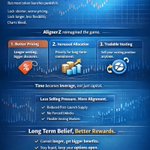
Longer Vesting = Bigger Discounts? @AlignerZ_Labs Just Flipped the Script
Everyone says they want long term alignment.
But most token launches punish it.
Lock longer and you lose flexibility.
Lock shorter and you get worse pricing or miss allocation.
So rational players pick short vesting, sell early, and the chart bleeds.
AlignerZ redesigned this incentive loop from first principles.
Here is how it actually works.
In AlignerZ launches, vesting is not just a lockup.
It is an active pricing and allocation variable.
The protocol asks a simple question:
How much time are you willing to commit to the ecosystem?
If you choose longer vesting, three things happen.
First, pricing improves.
Longer vesting unlocks deeper discounts relative to spot.
Time becomes your leverage instead of capital alone.
Second, allocation increases.
Participants willing to lock longer are prioritized because they reduce immediate sell pressure and stabilize supply.
Third, exit is optional, not forced.
Your vesting position is tokenized as a Tradable Vesting Schedule.
If your circumstances change, you can sell the vesting position itself instead of dumping unlocked tokens on the market.
This is the flip.
Traditional launches reward speed and short term liquidity.
AlignerZ rewards patience, commitment, and time weighted belief.
The market impact is structural.
Less circulating supply post launch.
Fewer reflexive dumps.
More predictable unlock dynamics.
Stronger price discovery driven by conviction instead of panic.
For participants, the tradeoff becomes rational.
If you believe long term, you get better entry and more upside.
If you need flexibility, you still have liquidity through secondary vesting markets.
No one is forced to choose between belief and survival.
Longer vesting no longer means worse outcomes.
It means better terms, better alignment, and a healthier launch.
This is not a marketing gimmick.
It is incentive engineering.
Align incentives correctly and behavior follows.
AlignerZ did exactly that.
#AlignerZ #TVS #infofi

From random idea → live onchain app → tokenized experiment in minutes.
This is what building with intent actually looks like.
Here is a fully accurate breakdown of what happened today using @CodeXero_xyz , a prompt based no code builder designed for the Sei Network ecosystem.
I connected my wallet and interacted with a single prompt interface.
No IDE. No repositories. No manual setup.
I described the idea in plain language.
A simple subscription style application where users pay in SEI to access gated content, with configurable rules for how payments are distributed across participants.
From that prompt, CodeXero assembled the application using predefined, Sei compatible onchain modules.
The platform generated:
• Onchain logic for payments and access control using existing templates
• A frontend with wallet connection, subscribe actions, and basic dashboards
• End to end wiring between contracts and UI without manual intervention
No code written by me.
No dependency management.
No contract plumbing by hand.
Once configured, I deployed the app to Sei mainnet with a single action.
A small SEI fee was paid and the contract instance went live onchain.
The deployment also included a token component created through standardized templates.
Basic parameters like supply and participation rules were set via the interface, not custom token engineering.
The result was a live, verifiable onchain application suitable for early testing and experimentation.
This is the part that actually matters.
Nothing here claims perfect security.
Nothing here claims audits.
Nothing here claims production hardened economics.
What it shows is how fast the idea to execution gap is collapsing.
When building moves from writing code to expressing intent, the cost of experimentation drops dramatically.
Founders can test concepts earlier.
Non developers can ship functional prototypes.
Developers can focus on refinement instead of scaffolding.
Sei’s speed and low fees make this iteration loop practical, not theoretical.
If you are still stuck in the phase of planning without deploying, the bottleneck is no longer technical.
The tools already exist.
The difference now is who actually uses them.
2026 will not be about who had the best ideas.
It will be about who tested the most ideas onchain.

TVS by @AlignerZ_Labs : Brilliant Innovation… But What Are the Risks?
Tradable Vesting Schedules (TVS) are one of the smartest primitives introduced to reduce post-TGE sell pressure.
Tokens stay vested, which preserves scarcity.
Need liquidity? You exit by selling the TVS NFT instead of dumping tokens.
That said, no primitive is risk-free. Let’s talk about the real tradeoffs.
Risk 1: TVS Liquidity Risk
TVS positions are ERC-721 NFTs. Early-stage secondary markets may be thin.
If buyer demand is low, sellers may struggle to exit quickly or at fair value.
Liquidity depends on sustained interest, not just initial hype.
This mirrors early NFT markets where volume can disappear fast when sentiment turns.
Risk 2: Secondary Market Discounting
Short-term sellers may list TVS at steep discounts to exit fast.
Buyers benefit by acquiring future tokens below spot value.
Sellers accept a haircut versus holding until unlock.
If the underlying token performs well, TVS premiums can rise.
If price drops or momentum fades, TVS may trade far below intrinsic value, amplifying volatility.
Risk 3: Smart Contract and New Primitive Risk
TVS is a novel mechanism.
Audits help, but real stress testing only happens in live markets.
Edge cases, UX issues, or unforeseen exploits are still possible, as history has shown with early DeFi and NFT standards.
Due diligence on contracts and mechanics is essential before participating in an IWO.
Risk 4: Opportunity Cost of Long Vesting
Maximizing allocation or discounts often requires longer vesting commitments.
If you don’t sell the TVS, capital remains locked.
In a strong bull market, this could mean missing other opportunities.
In bearish conditions, vesting provides downside protection, but capital is still tied to the outcome of one ecosystem.
Risk 5: Adoption and Market Infrastructure
TVS only works at scale if marketplaces support it and traders actively participate.
Slow adoption can result in low liquidity, reinforcing itself over time.
Sustained success depends on AlignerZ delivering strong tooling, integrations, and community-driven secondary volume.
Final Take
TVS addresses a massive structural problem: day-one sell pressure that destroys price discovery.
By redirecting exits into NFTs instead of liquid supply, it creates tighter circulating supply and better alignment between holders, traders, and the protocol.
The risks are real.
But so is the upside.
For participants who understand vesting, liquidity tradeoffs, and execution risk, the model introduces a fundamentally healthier alternative to legacy token launches.
The IWO launches today.
Bid what you understand and can afford to vest or trade.
Bullish on the vision.
Cautious on execution.
What risks do you think are still underdiscussed?
#AlignerZ #TVS #InfoFi


