

Cognitive anthropology / cultural evolution / digital media / cultural analytics. Associate professor sociology @UniTrento - more info in the pinned tweet.
Trento, Italy
Joined October 2012
- Tweets9.3K
- Following1.8K
- Followers5.9K
- Likes9.8K





Pinned Tweet
Website: acerbialberto.com
"Cultural evolution in the digital age" (OUP): bit.ly/2McstmR
"Individual-based models of cultural evolution. A step-by-step guide using R" (Routledge): bit.ly/3MQBjT4
Substack (free - in italiano): bit.ly/3lDERMq
As the author of Technopanic, I must link this
panicpatrolshow.com (And yes, it’s made with AI.)

Over 11k video games (1993-2016), competitive content declined and prosocial content (friendship, warmth, care) rose, within genres and within franchises
osf.io/preprints/psyarxiv/5e…

Credere a ciò che vogliamo che gli altri credano; divieti social e come evirarli; l’OCSE su IA generativa e istruzione; un po' di evoluzione culturale in podcast; e un update sui sei gradi di Kevin Bacon.
albertoacerbi.substack.com/p…


In all past iterations of my cultural analytics module I tried hard to convince students that theories and hypothesis testing are fundamental. I do not think very successfully, partly I blame myself, but also traditions in which studies are descriptive and theories are
verbal and nobody cares to operationalise them.
This will go straight in the syllabus of next spring course!
zenodo.org/records/23494957
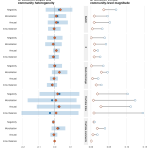
Tone and rhetoric aside, I try to give a charitable reading. I can even agree with their second point (blending)! In fact it suggests there is no generic “social media harm”, but rather which activities, in which environments, for which people, with which outcomes, etc...
On the first (risk ratios) I am less convinced: switching metric changes how big *it looks*, not what it tells us about possible causes.
Socialità e abitudini di lettura dal 2001 ad oggi secondo i dati ISTAT.
substack.com/home/post/p-221…
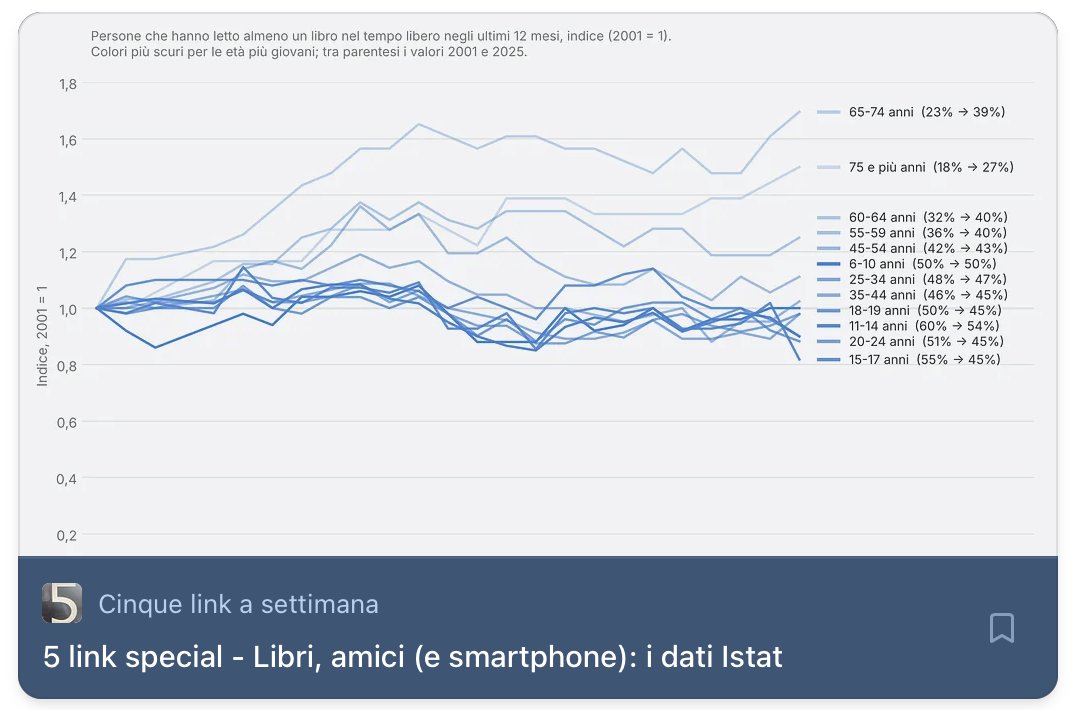
Una relazione positiva (!) tra social media e benessere; L'effetto (minuscolo) di non avere smartphone in classe; Yandex e i bot russi: troppo bello per essere vero; Un data center in miniera, con mele e Trentodoc; Distruggete siti web.
albertoacerbi.substack.com/p…

Interesting paper, claims that reduction of variation in LLMs (aka mode collapse) is mostly due to human biases - annotators preferring familiar answers - and it can be reduced using a specific prompting strategy.
simonucl.notion.site/verbali…

Posts on Ukrainian drones/Russian bots activity:
"it is not true, but it could be true, and if it was, I would be very right."


Very nice the authors of the Science paper on social/individual learning in orangutans took the time to write a detailed response to my short thread!

We actually used the daily number of peering events to assess overall propensities to engage in social learning. We also identified socially intiated learning by analysing how long exploration remains elevated after peering. Here is a detailed response:
docs.google.com/document/d/1…

Intelligenza (artificiale) collettiva; i giovani stanno meglio?; i 20 post più visti su Facebook fanno lo 0,03% delle visualizzazioni; l'IA dimostra teoremi; Netflix semplifica le serie?
albertoacerbi.substack.com/p…

Ignoring AI in research workflow is not an option. This looks like an interesting experiment. journalqd.org/special-workfl…
I asked ChatGPT to plot a comparison...


The 20 most-viewed Facebook posts (in US) represent only the 0.03 % of all content views (in US). I say "only" because usually the popularity of "cultural things" (think books, movies, songs, etc.)....
transparency.meta.com/report…
The 20 most-viewed Facebook posts (in US) represent only the 0.03 % of all content views (in US). I say "only" because usually the popularity of "cultural things" (think books, movies, songs, etc.)....
transparency.meta.com/report…
...follows a power-law, where hits get the big share of the market and everything else crumbles.
Feed algorithms are thought to reinforce this tendency, so that it is commonly thought that "richer get (even more) richer" in social media. But maybe is not the case?