

Making our neighbourhoods a little better, one issue at a time.
Richmond, BC
Joined April 2009
- Tweets22.2K
- Following1.5K
- Followers6.9K
- Likes38.1K



Active Citizens BC retweeted

I don't want flying cars.
I want clean water.
I want a stable climate.
I want bees to survive.
Active Citizens BC retweeted

Paris is converting automobile space to pedestrian space and it's amazing.


Active Citizens BC retweeted

La respuesta a la congestión es entregar espacio al transporte público y la movilidad activa, no ampliar capacidad viaria.


Active Citizens BC retweeted

𝐀𝐮𝐭𝐨𝐛𝐞𝐬𝐢𝐭𝐲 [𝑛𝑜𝑢𝑛]: the alarming growth of private cars in height, width, length and weight at the expense of public space, the environment and overall safety.
Active Citizens BC retweeted
𝗖𝗮𝗻 𝘆𝗼𝘂 𝗳𝗶𝗻𝗱 𝗧𝗵𝗲 𝗡𝗲𝘁𝗵𝗲𝗿𝗹𝗮𝗻𝗱𝘀🇳🇱? Sow safe, separated bike paths. Harvest daily cyclists of every age, ability, and background.
Mobility behaviour is not just a matter of personal choice. It is just as much a response to the systems we offer.

Active Citizens BC retweeted
Look, we've added some shelves to our library of transportation studies!
Send us any politician who still thinks that building more roads will solve congestion.

Active Citizens BC retweeted
Fun fact: When Barcelona pedestrianized many of their streets, childhood asthma rates and related ER visits declined significantly.

Active Citizens BC retweeted

MORE! On the Vienna housing model!
The Vienna Housing Model.
The decisive tool was already in place: wartime rent control, imposed so soldiers’ wives would not be thrown into the street. Rent control was never repealed. Combined with postwar inflation, that made private rental construction unprofitable and opened a window of opportunity for non market housing development. Rent control took private landlords out of the land market. Land prices fell. Rent control did not merely protect tenants. It cut the flow of labor and capital value into land Rent.
Vienna’s leaders knew of Henry George’s case for a single tax on land but found a better way. They taxed apartment units instead, on a progressive scale, and kept rent control. The city then used that same tax revenue to buy the land whose price the taxes had just depressed — the result was that the city was the only serious buyer in the market when urban land became available.
Vienna also invented a better way to build affordable housing. The city buys the land, sets the housing goals and publishes the subsidy. Competing nonprofit teams — architect, builder, developer, manager — submit schemes. Stakeholder juries pick the smartest one. The result is architecturally varied housing, not the barracks other anglophone countries call “public housing”. Design quality is not a luxury. It is how you keep the middle class inside the non-market system.
One-fifth was social housing for the poor and disabled. The rest was for wage-earners, owned and run by co-ops and limited-profit housing associations. Those associations operate like ordinary companies except they may charge only cost-covering rents, must recycle surplus into more land or more buildings, and may pay only a capped return to shareholders. The city did not socialize production. It socialized the land under it in line with the Henry George Principle.
Copying the Vienna model in cities that still worship the free market for housing would surely be contentious; but the crisis Vienna faced and the results it got are not in dispute. Jobs-rich global cities are now approaching the same level of housing precarity faced by Vienna. Rent control protects tenants, but it also makes a city’s land less appetizing to international real estate investment trusts (REITs).

ALT Vienna non market housing is wildly various in architectural style.
Active Citizens BC retweeted

Costco haul culture transfers the cost of storing goods from the retailer to the household.
In a city, you can live with a smaller kitchen, pantry, and refrigerator because the neighborhood itself functions as your pantry. Multiple grocers, bakeries, pharmacies, etc are storing things nearby until you need them.
In the burbs, the stores are farther away, so households have to buy in bulk and store things at home. The big house, basement, garage … all needed to compensate for lack of neighborhood amenities. suburbs relocate the warehouse from the merchant to your house.


Active Citizens BC retweeted

We need a vehicle weight tax. If you can buy an $80k, 3,000 kg SUV to haul one bag of groceries, taxpayers shouldn't be subsidizing your pavement wear/tear plus the added danger to our streets. If you can afford the payments, you can afford to stop asking society to subsidize it.

Active Citizens BC retweeted
🏙️ All cities make mistakes.
🤔 Good cities learn from them.
💪 But only GREAT cities fix them.
@GemeenteUtrecht took out 1970s car infrastructure to let the water of the #Catharijnesingel return.
Active Citizens BC retweeted
Dooring is a brutal type of crash that can ruin or end a person's life.
Whenever you can, design bike lanes to avoid dooring. 👇


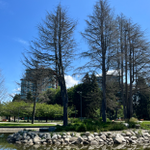
So many big trees removed. Deeply disturbing.
Why is this?
@Richmond_BC @TheRichmondNews
#MinoruPark #RichmondBC


Active Citizens BC retweeted

Love to see it. When I was Chief Planner I had a picture of my once 86 year old grandmother blissfully cycling to visit friends (in Holland, of course). It was a source of inspiration for what might be possible in our city. So your note is a full circle moment for me. Thanks for sharing.

Active Citizens BC retweeted

Statement by the leaders of Canada, France, Germany, Italy, Netherlands, Norway, and the United Kingdom on the Israeli Government’s decision to publish construction tenders for the E1 settlement project: pm.gc.ca/en/news/statements/…

Active Citizens BC retweeted
Real transportation freedom is not just the ability to drive quickly. It is the ability to reach the places we need to go safely, affordably, and by the mode that works best for us.

Active Citizens BC retweeted

“Air pollution fell substantially as Paris restricted car traffic and made way for parks, people-streets and bike-lanes.”
Better for the climate, better for health, better for livability and quality of life.
Common sense.
Such a no-brainer, it’s remarkable that more cities HAVEN’T done the same.
washingtonpost.com/climate-s…
